An embedded device is a purpose-built electronic product that contains computing hardware and firmware to perform a defined function, usually as part of a larger machine, vehicle, instrument or connected product. Unlike a general-purpose computer, it is not designed to run many unrelated applications. It is designed to measure, decide, control, communicate or protect within a specific operating context.
That simple definition hides a lot of engineering complexity. In modern electronics, an embedded device may combine microcontrollers, processors, sensors, power electronics, analogue interfaces, wireless communication, safety functions, diagnostics and mechanical integration. It may need to work for years in vibration, heat, humidity, electrical noise or strict regulatory environments.
For CTOs, engineering managers and product owners, understanding what an embedded device is helps clarify one important point: embedded development is not just about placing a processor on a PCB. It is about designing a reliable system that behaves predictably in the real world, can be manufactured at scale, and can be supported throughout its lifecycle.
What is an embedded device?
An embedded device is a physical electronic device with built-in computing capability, dedicated to one or more specific tasks. It typically receives inputs, processes information locally, and produces outputs through actuators, communication interfaces, displays or control signals.
A motor controller in a robot arm is an embedded device. So is a battery management unit, a maritime sensor node, an industrial access control unit, a smart measuring instrument, an automotive control module or a connected medical device. The embedded computer inside the product is usually not visible to the end user, but it determines much of the product’s performance, safety and reliability.
In practice, the term is often used alongside “embedded system”. The distinction is not always strict, but it is useful:
| Term | Practical meaning | Example |
|---|---|---|
| Embedded device | A physical product or module with dedicated computing inside | A smart sensor, control unit or connected actuator |
| Embedded system | The complete combination of hardware, firmware, power, sensing, communication and mechanics that enables embedded behaviour | A machine control platform with sensors, motor drives, firmware and diagnostics |
| Embedded software | The firmware or software running on the embedded hardware | Real-time control code, communication stack or bootloader |
| Embedded hardware | The electronics platform that supports the embedded function | PCB, processor, memory, power supply, interfaces and protection circuits |
The most important characteristic is purpose. An embedded device is built around the function it must perform, the environment in which it must operate, and the constraints it must respect.
Why embedded devices matter in modern electronics
Embedded devices sit at the centre of many high-value products. They turn mechanical products into intelligent machines, passive equipment into connected assets, and analogue processes into measurable, controllable systems.
In machine manufacturing, embedded devices can control motion, monitor load, detect faults and communicate with higher-level systems. In robotics, they coordinate sensors, motor drives and safety functions. In defence and maritime applications, they may need to handle secure communication, harsh environmental exposure and long service life. In consumer and professional electronics, they enable compact, connected and power-efficient products.
They also appear in less obvious places. Refrigeration controllers, payment terminals, weighing systems and delivery tracking devices are all embedded technologies supporting commercial operations. Even sectors outside traditional electronics, such as premium food retail and logistics, depend on these systems for storage, ordering, temperature control and delivery reliability, as seen in specialist suppliers such as Beef Boutique.
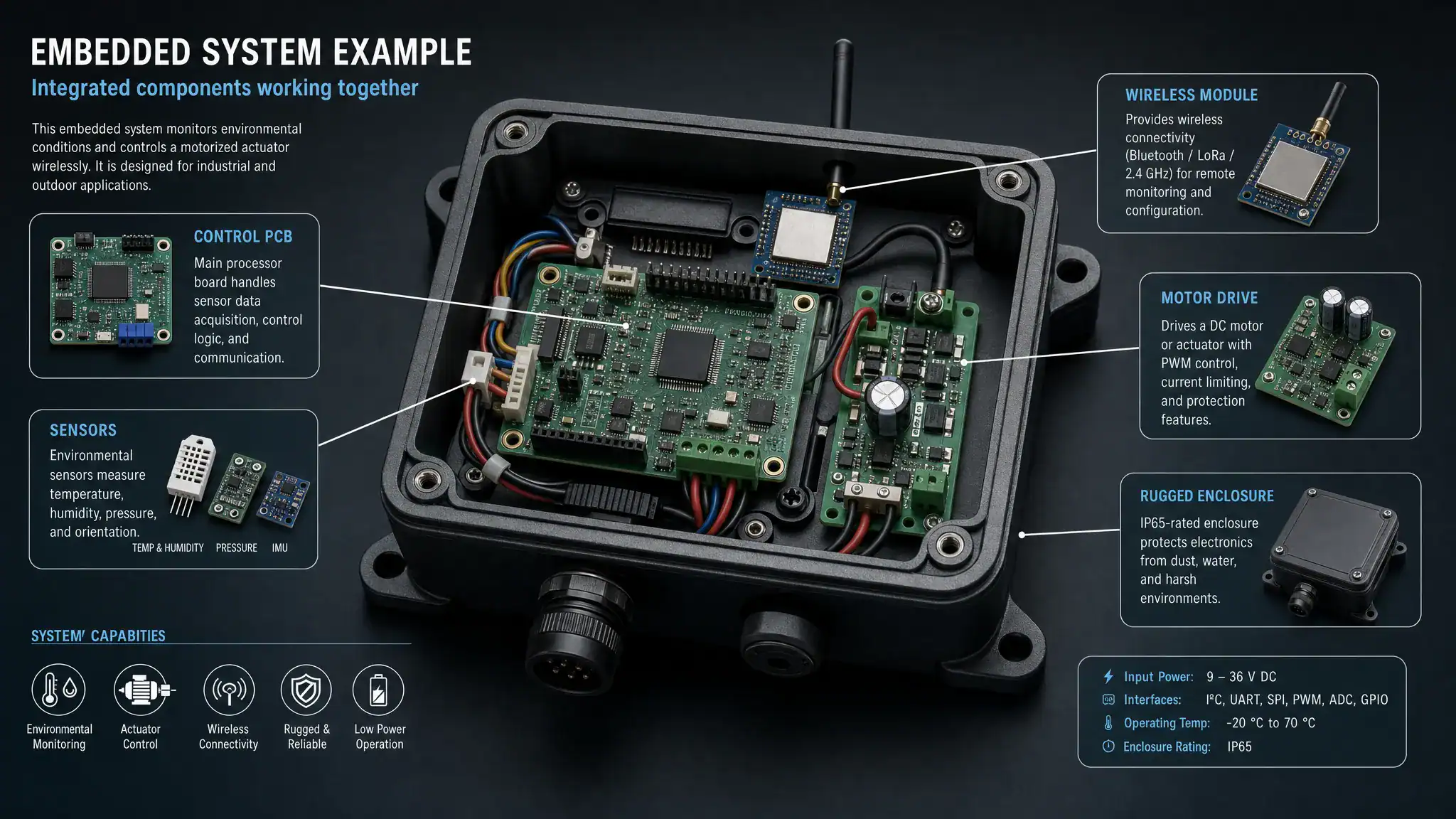
For product developers, the value of an embedded device is not only the intelligence it adds. It is the ability to control a product’s behaviour precisely, collect operational data, reduce manual intervention, improve safety, and create a platform for future product variants.
The core building blocks of an embedded device
Although embedded devices vary widely, most contain a similar set of engineering layers. Each layer has design choices that affect reliability, compliance and manufacturability.
| Building block | Function in the device | Engineering considerations |
|---|---|---|
| Processor or microcontroller | Executes firmware and controls device behaviour | Performance, real-time requirements, power use, lifecycle availability |
| Firmware | Implements logic, communication, diagnostics and control | Robustness, update strategy, fault handling, testability |
| Sensors | Measure physical conditions or user inputs | Accuracy, calibration, noise immunity, environmental exposure |
| Actuators or outputs | Drive motors, relays, valves, LEDs or other loads | Power rating, protection, thermal behaviour, safety states |
| Power electronics | Convert and manage electrical energy | Efficiency, thermal design, EMC, transients, load profile |
| Analogue electronics | Interface with real-world signals | Signal integrity, filtering, grounding, component tolerances |
| Connectivity | Enables wired or wireless communication | Protocol choice, cybersecurity, RED or radio requirements, antenna integration |
| PCB and layout | Physically connects components | EMC, heat spreading, manufacturability, test access, mechanical fit |
| Enclosure and mechanics | Protects and integrates the electronics | Ingress protection, vibration, user access, cable routing, heat dissipation |
In simple products, some of these layers may be minimal. In professional products, they are often tightly connected. A firmware decision can affect power consumption. A PCB layout choice can affect EMC. An enclosure can influence antenna performance and thermal behaviour. A sensor interface can become unreliable if grounding, filtering or cable routing are not considered early.
This is why embedded device development works best as system engineering, not as a sequence of isolated tasks.
How an embedded device works
At a functional level, most embedded devices follow a repeated cycle: sense, process, act and communicate.
The device first receives information. This may come from a temperature sensor, current sensor, accelerometer, encoder, camera, button, network message or analogue input. The firmware then interprets the information using predefined logic, control algorithms or local decision-making. The device responds by driving an output, logging data, sending a message, changing a state or triggering a safety function.
In a motor drive, for example, the device measures current, position and speed, calculates the required control response, switches power electronics at high frequency, and monitors whether the motor operates within safe limits. In a maritime monitoring product, the device may sample sensors, filter noisy signals, manage power consumption, transmit data over a communication link and continue operating despite moisture, vibration and supply disturbances.
The key difference from a desktop computer is determinism. Many embedded devices must respond within strict timing limits. If a control loop is late, a motor may behave poorly. If a safety input is missed, risk increases. If communication fails without a fallback state, the product may become unreliable in the field.
Embedded device, IoT device or smart product?
Many modern embedded devices are also connected devices, but the terms are not identical.
| Category | What it emphasises | Typical example |
|---|---|---|
| Embedded device | Dedicated local function inside a product | Motor controller, sensor node, control board |
| IoT device | Network connectivity and data exchange | Connected asset tracker or remote monitoring unit |
| Smart product | User-facing intelligence, automation or adaptability | Smart machine module or intelligent consumer device |
| Edge device | Local processing close to the data source | Vision module, AI-enabled inspection unit or gateway |
A product can belong to several categories at once. A connected industrial sensor is an embedded device because it performs dedicated measurement and processing. It is also an IoT device if it sends data to a platform. It may be an edge device if it analyses the data locally before communicating.
This matters because each label introduces additional design requirements. Connectivity introduces security, update management, antenna placement and sometimes radio compliance. Edge processing introduces thermal and processing constraints. Smart product behaviour introduces user expectations, diagnostics and serviceability.
What makes embedded devices difficult to design well?
Embedded devices often look simple from the outside. A small PCB, a few sensors and a firmware application can suggest a straightforward project. In reality, many product delays appear because early design decisions do not reflect real-world operating conditions.
A prototype may work correctly on a desk, with a laboratory power supply, short cables and a stable temperature. The same design may fail when installed in a machine cabinet, exposed to motor noise, long cable runs, supply dips, vibration or production variation. This gap between lab success and field reliability is one of the most common risks in embedded development.
Several factors increase complexity:
- The device must interact with unpredictable physical signals, loads and environments.
- Hardware, firmware, mechanics and power design influence each other.
- Compliance requirements such as EMC, CE, RED or safety-related standards may affect architecture.
- Component availability and lifecycle can influence long-term production.
- Production test access and calibration must be designed before volume manufacturing.
- Firmware must handle faults, edge cases, communication loss and update scenarios.
These issues are not signs that embedded products are inherently fragile. They are signs that embedded development requires system-level thinking from the start.
For example, electromagnetic compatibility is not something that can simply be “tested in” at the end. It is shaped by architecture, grounding, switching behaviour, PCB layout, cabling and enclosure design. ProMicro has written separately about what EMC means in product development and why considering it early can reduce redesign risk.
Examples of embedded devices in professional markets
Embedded devices are used across almost every technical sector, but the requirements differ strongly by application.
| Sector | Embedded device example | Key design priorities |
|---|---|---|
| Machine manufacturing | Motion control unit, condition monitoring module, machine interface board | Real-time control, EMC, maintainability, industrial communication |
| Robotics | Joint controller, sensor fusion module, battery and drive controller | Compact design, timing, power density, safety behaviour |
| Automotive | Control module, charger interface, sensor controller | Temperature range, vibration, lifecycle, validation discipline |
| Maritime | Monitoring unit, communication module, power control device | Moisture, corrosion, long service life, robust connectivity |
| Defence | Secure communication hardware, rugged control electronics | Reliability, environmental resilience, security, documentation |
| High-tech equipment | Measurement controller, precision analogue interface, embedded computing module | Signal integrity, accuracy, thermal stability, manufacturability |
| Consumer and professional electronics | Connected controller, charging product, smart interface module | Cost control, certification readiness, user experience, volume scale |
The device definition may be similar in each sector, but the engineering emphasis changes. A robotics controller may be constrained by size and power density. A maritime device may need better protection against moisture and corrosion. A high-tech measurement product may need careful analogue design and shielding. A wireless consumer product may need antenna performance and RED compliance considerations.
Design decisions that shape embedded device reliability
Reliable embedded devices are rarely the result of one excellent component. They are the result of coherent decisions across the entire product.
A processor should not be selected only because it is familiar or easy to prototype. It should match performance needs, power budget, peripheral requirements, software ecosystem, security expectations and lifecycle availability. A wireless module should not be selected only because it is pre-certified. It still needs correct antenna integration, power design, enclosure consideration and product-level validation.
PCB layout is equally important. Power paths, switching nodes, analogue inputs, high-speed interfaces and grounding strategy affect EMC and signal integrity. In power electronics, layout parasitics can influence switching behaviour, heat and reliability. In analogue electronics, small layout mistakes can create measurement errors that firmware cannot easily correct.
Firmware design also shapes reliability. Good embedded firmware includes predictable state machines, fault detection, watchdog strategy, diagnostics, logging where appropriate and safe behaviour under abnormal conditions. It should be testable, maintainable and aligned with the hardware architecture.
Finally, mechanical integration should not be treated as an afterthought. Cable exits, connectors, enclosure material, heat paths, sealing, antenna placement and service access all influence the behaviour of the electronics.
From prototype to production-ready embedded device
A prototype proves that an idea can work. A production-ready embedded device proves that the idea can keep working, repeatedly, under defined conditions, in manufacturable form.
This difference is critical for companies moving from innovation to market launch. Early prototypes often use development boards, evaluation kits, temporary wiring, overspecified components or manual calibration. These choices can be useful for learning, but they do not automatically translate into a product suitable for certification, assembly, testing, service and long-term supply.
A production-ready embedded device requires attention to:
- Defined requirements and operating envelope.
- Architecture that supports the required functions and future variants.
- PCB design that considers EMC, thermal behaviour and manufacturing.
- Firmware designed for fault handling, updates and testability.
- Prototype validation under realistic electrical, mechanical and environmental conditions.
- Manufacturing data, test strategy and component lifecycle planning.
This is where many projects benefit from a structured development process. Requirements, architecture, design, prototyping, validation and manufacturing preparation should be connected. If each phase is treated separately, important assumptions can be lost.
For teams preparing a custom electronics project, ProMicro’s guide on what OEMs should define before starting custom electronics design provides a practical starting point for reducing hidden assumptions.
What decision-makers should ask before developing an embedded device
Before committing to detailed design, technical and commercial stakeholders should align on the intended role of the device. The goal is not to define every resistor or firmware function immediately. The goal is to make the critical constraints visible early.
Useful questions include:
- What exact function must the embedded device perform in the final product?
- What operating environment will it face, including temperature, vibration, moisture, EMC exposure and supply variation?
- Which sensors, actuators, interfaces and communication links are required?
- Are there real-time control, safety or fault-response requirements?
- Which standards, market access rules or customer requirements may apply?
- What production volume, product lifetime and service model are expected?
- How will the device be tested during production and maintained in the field?
- Which features may be needed in future product variants?
Clear answers help avoid a common development trap: designing for the prototype instead of designing for the product.
When to involve an embedded electronics partner
Some organisations have strong internal electronics teams and can develop embedded devices independently. Others have excellent product knowledge but lack specialist capacity in areas such as power electronics, analogue design, PCB layout, EMC-aware architecture, embedded firmware, prototyping or production preparation.
A specialist partner becomes valuable when the product contains multiple interacting disciplines, when reliability is commercially important, or when mistakes could lead to certification delays, field failures or expensive redesigns. The value is not only extra engineering capacity. It is the ability to identify hidden requirements, challenge assumptions and design with the full product lifecycle in mind.
For OEMs and technology companies, this can mean involving embedded expertise before the architecture is fixed. Early collaboration can clarify whether a custom embedded device, an embedded computing module, a wireless platform, a motor control board or a different architecture is the right fit.
ProMicro supports embedded device development as part of an integrated electronics design process, including embedded systems, power electronics, analogue electronics, PCB design, system engineering, enclosure considerations, prototyping and support towards volume manufacturing. The emphasis is on robust, scalable electronics that are designed for real operating conditions, not only for laboratory demonstration.
Frequently asked questions
What is an embedded device in simple terms? An embedded device is an electronic product or module with a built-in computer that performs a specific function. It is usually designed to control, measure, communicate or automate within a larger product or system.
How is an embedded device different from a normal computer? A normal computer is designed for many different applications and user-controlled tasks. An embedded device is designed for a dedicated function, often with strict limits on timing, power consumption, size, cost, safety and reliability.
Is every IoT device an embedded device? Most IoT devices are embedded devices because they contain dedicated hardware and firmware. However, not every embedded device is an IoT device. Many embedded devices operate locally without internet connectivity.
Why do embedded devices fail outside the lab? Failures often occur because the prototype was not designed or tested against real-world conditions. Supply disturbances, EMC, heat, vibration, cable effects, firmware edge cases and production variation can all expose weaknesses that were not visible during early testing.
What should be defined before starting embedded device development? The most important inputs are the product function, operating environment, interfaces, power requirements, compliance expectations, production volume, lifecycle requirements and future product variants. These decisions shape the architecture and reduce redesign risk later.
Does an embedded device always need custom hardware? Not always. Some products can use standard modules or embedded computing platforms. Custom hardware becomes more relevant when the product has specific size, power, cost, reliability, compliance, interface or manufacturing requirements.
Turning an embedded device concept into a reliable product
Understanding what an embedded device is is the first step. The next step is designing it as a complete product, with hardware, firmware, power, analogue electronics, PCB layout, mechanics, compliance and manufacturing readiness considered together.
If your organisation is developing a machine, connected product, control unit, sensor platform or advanced electronic device, ProMicro can help reduce technical risk from the first architecture choices through prototyping and preparation for volume manufacturing.
Contact ProMicro to discuss how your embedded device concept can become a robust, scalable and production-ready electronic solution.