Reducing product development risk is not mainly about finding more issues at the end of a project. In embedded product development, the most expensive risks are often created much earlier, when the operating environment is not fully understood, the hardware and firmware are treated as separate workstreams, or compliance is assumed to be a final test activity.
For OEMs, machine builders, robotics companies, automotive suppliers, maritime technology providers and high-tech product teams, embedded electronics are rarely isolated components. They influence safety, reliability, certification readiness, manufacturing repeatability and long-term serviceability. That is why embedded systems design services are most valuable when they do more than deliver a PCB or write firmware. They help turn technical uncertainty into controlled, testable engineering decisions.
Why risk accumulates in embedded product development
An embedded system sits at the intersection of electronics, firmware, mechanics, power, sensors, communication interfaces, user behaviour and the external environment. A decision in one area can create unexpected consequences elsewhere. A power supply choice can affect EMC behaviour. A sensor interface can influence firmware timing. Enclosure geometry can change thermal performance. A wireless module can introduce RED-related considerations.
This is why a prototype that works in the lab can still fail later during EMC testing, production ramp-up or field use. The lab environment is controlled. Real products face temperature variation, vibration, moisture, electrical noise, user misuse, installation variation, component tolerances and ageing.
A risk-reducing design approach identifies these factors early, before the product architecture is locked. ProMicro has written more broadly about why system design embedded thinking matters from day one, and the same principle applies when selecting an external design partner.
| Development risk | Common root cause | How expert design support reduces it |
|---|---|---|
| Functional failure | Requirements describe intended behaviour but not edge cases | Define operating modes, fault states and verification criteria |
| EMC issues | Power, PCB layout, enclosure and cabling are considered too late | Design with grounding, filtering, routing and emissions in mind |
| Firmware integration delays | Hardware and software are developed in isolation | Co-design timing, interfaces, diagnostics and update strategy |
| Prototype-to-production gap | Prototype decisions are not suitable for repeatable manufacturing | Consider DFM, test access, tolerances and component availability early |
| Compliance delays | Standards are treated as a final checkpoint | Build compliance awareness into architecture, layout and documentation |
| Lifecycle problems | Short-term component or platform decisions create long-term exposure | Select technologies with maintainability, sourcing and support in mind |
Risk is not removed by one design review. It is reduced through consistent engineering discipline from concept to volume manufacturing.
Turning unclear ideas into testable requirements
Many product risks start with incomplete requirements. A product specification may describe what the product should do, but not where it will be installed, how users will interact with it, what disturbances it must tolerate, or how it should fail safely.
Good embedded systems design services help make these hidden requirements visible. This is especially important when internal teams are under pressure to move quickly or when a product combines several disciplines, such as motor control, sensing, wireless communication, analogue measurement and embedded software.
A structured requirements phase should clarify questions such as:
- What temperature, vibration, humidity and electrical noise will the product experience?
- Which operating modes, fault modes and recovery behaviours must be defined?
- What are the real power constraints, including peak loads, standby modes and start-up conditions?
- Which interfaces, cables, sensors and external systems can introduce disturbances?
- What level of diagnostics, logging or service access is needed after launch?
- Which standards, directives or customer requirements may influence architecture choices?
The output should not be a vague wish list. It should be a technical basis for architecture, hardware design, firmware design, testing and manufacturing preparation. When assumptions are documented and verified early, the project team can avoid late-stage redesigns caused by misunderstandings.
Architecture choices that reduce downstream risk
Architecture is one of the strongest levers for risk reduction. Once the architecture is chosen, many later decisions become constrained. The microcontroller or processor family, power topology, sensor interfaces, wireless technology, isolation approach, PCB partitioning and enclosure strategy all influence performance, compliance and manufacturability.
A suitable architecture is not always the most powerful or feature-rich option. It is the option that fits the product context. A low-power IoT device, a maritime control module, a robotics subsystem and an automotive test device will have very different priorities. Some need deterministic control. Others need robust communication, long-term component availability, precise analogue measurement or high immunity to electrical disturbances.
A professional design partner will assess architecture against the full product lifecycle. That includes functional needs, certification exposure, supply chain risk, production testability, firmware maintainability and expected service life. This prevents the team from optimising for a prototype while creating avoidable issues for production.
Early architectural work can also reveal whether feasibility prototypes are needed. In complex systems, a small proof of concept for a critical sensor, control loop, wireless link or power stage can reduce uncertainty before committing to the full design.
Hardware-software co-design prevents integration surprises
In embedded systems, hardware and firmware are not separate problems. They form one system. If the hardware team chooses interfaces without considering firmware timing, or the firmware team assumes ideal sensor data without understanding analogue noise, integration can become unpredictable.
Hardware-software co-design reduces this risk by aligning decisions from the start. For example, ADC resolution, sampling frequency, filtering, interrupt handling, communication latency, boot behaviour, safety states and diagnostics should be considered together. This is particularly important in motor drives, sensor-rich systems, connected products and machinery where timing and reliability matter.
For a deeper technical explanation, ProMicro covers this topic in its article on hardware-software co-design in embedded systems.
A co-design approach also improves debugging. When test points, diagnostic messages, firmware logs and known operating states are planned into the design, engineers can isolate issues more quickly. This becomes valuable during prototyping, EMC troubleshooting, production testing and field support.
Power electronics, analogue design and PCB layout as risk controls
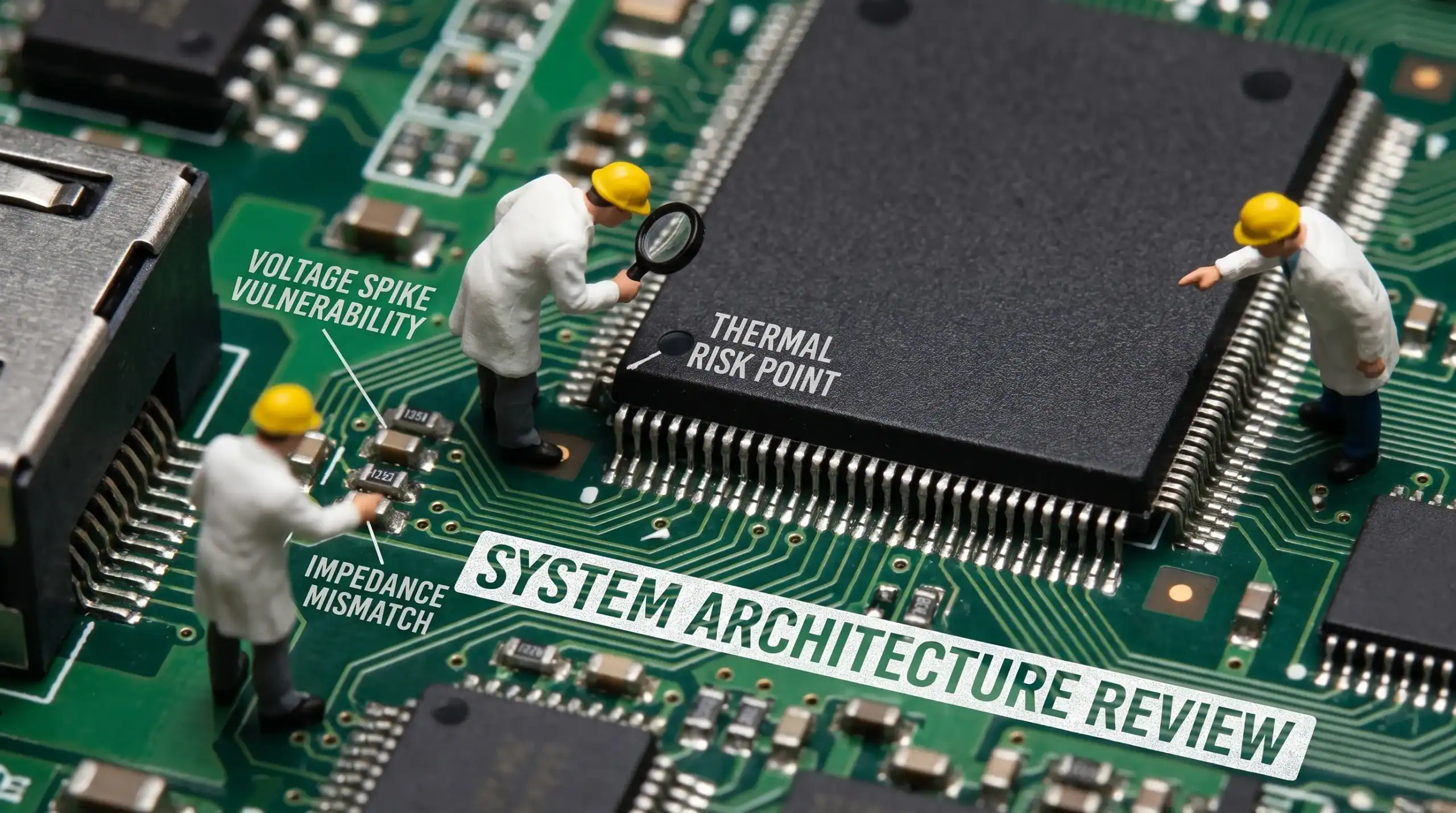
Power electronics and analogue electronics are often where hidden risks become visible. A product can have correct digital logic but still fail because of unstable power rails, poor grounding, excessive ripple, thermal stress, inaccurate sensing or susceptibility to interference.
PCB layout is therefore not just an implementation step. It is part of the risk control strategy. Current loops, return paths, creepage and clearance, isolation, component placement, thermal spreading, connector location and signal routing all affect real-world behaviour. In systems with motor drives, high currents, precision measurement or wireless communication, layout choices can strongly influence reliability and compliance readiness.
Experienced embedded design engineers consider these interactions before the board is routed. They think about how power flows through the system, how analogue signals are protected, how switching noise is contained, and how the PCB will fit within the enclosure. This helps prevent a common development problem: a schematic that looks acceptable on paper but performs poorly when assembled into the actual product.
Thermal design is another important area. Components do not operate in a data sheet environment. Enclosures trap heat, installations vary, and duty cycles may be more demanding than expected. Considering thermal paths, component derating and real operating profiles early can improve long-term reliability.
Designing with compliance in mind from the start
Compliance uncertainty is a major source of schedule risk. EMC, RED, CE marking and product safety considerations can expose design weaknesses late in the project, when changes are expensive and time-consuming.
CE marking is not a single design activity. The European Commission explains CE marking as an indication that a product has been assessed to meet relevant EU safety, health and environmental protection requirements. For embedded products, the relevant requirements depend on the product type, use case, electrical design, radio functionality and market.
A design partner should not promise certification outcomes before proper assessment and testing. However, they can design with compliance in mind. That means considering emissions, immunity, radio integration, power safety, documentation, traceability and intended use during architecture and detailed design.
| Compliance-related risk | Why it happens | Design response |
|---|---|---|
| EMC failure | Switching circuits, cabling, grounding or layout create emissions or susceptibility | Use EMC-aware architecture, PCB layout, filtering and enclosure integration |
| RED-related delay | Wireless functionality is added without considering radio module integration and antenna environment | Evaluate radio technology, antenna placement, documentation and test implications early |
| Safety concern | Fault behaviour, insulation, thermal limits or user access are not fully considered | Define safe states, protection concepts and relevant design margins |
| Documentation gap | Decisions are not recorded throughout development | Maintain design rationale, test evidence and technical documentation |
Late compliance problems are often symptoms of early design decisions. ProMicro also discusses this issue in its article on embedded system design mistakes that delay certification.
Prototyping and validation reduce uncertainty before production
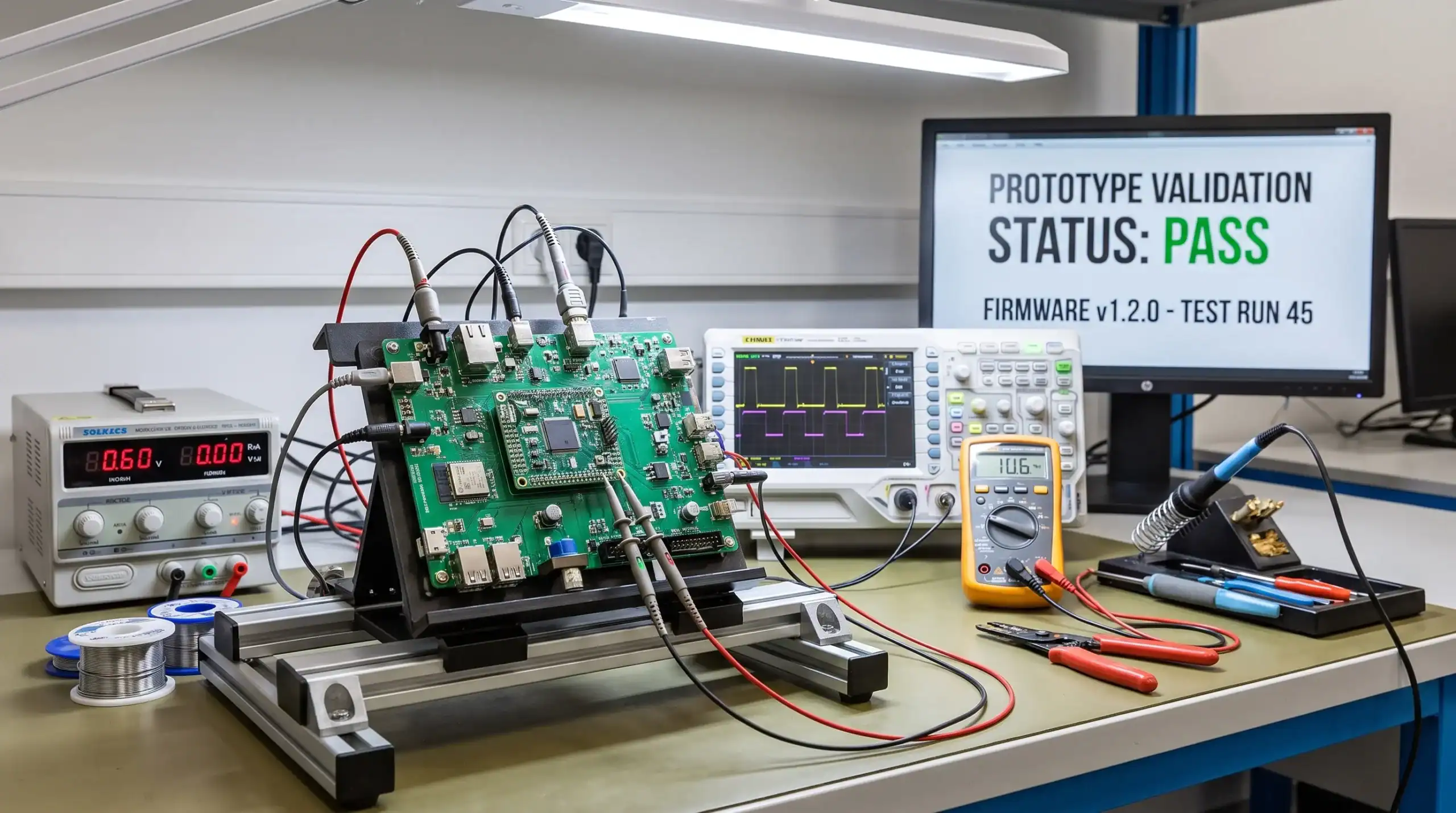
A prototype should answer specific engineering questions. It should not simply demonstrate that the product can function once under favourable conditions. Risk-reducing prototyping focuses on validating critical assumptions.
For example, a prototype might be used to test sensor accuracy under noise, evaluate thermal behaviour in an enclosure, measure power consumption over realistic duty cycles, assess wireless range in the intended environment, or validate motor control under load. The test plan should reflect the product risks identified earlier.
There is also an important difference between a functional prototype and a production-intent prototype. A functional prototype may prove that the concept is possible. A production-intent prototype checks whether the design can be built, tested, assembled and maintained in a repeatable way.
This distinction matters for companies planning to move from innovation to volume manufacturing. If the prototype ignores assembly constraints, test access, calibration, component sourcing or enclosure integration, the next phase can become a redesign rather than a scale-up.
Manufacturing readiness prevents the prototype trap
One of the most common development risks is building a prototype that cannot be manufactured reliably. This does not always happen because the design is technically poor. It often happens because manufacturing requirements were not considered early enough.
Manufacturing readiness includes PCB panelisation considerations, assembly process constraints, component packaging, test points, programming access, calibration procedures, enclosure assembly, cable routing and quality control. It also includes realistic thinking about component availability and alternatives.
For professional products, even modest production volumes require repeatability. A machine control module, maritime electronics unit or high-tech measurement device must perform consistently across batches. If production depends on manual adjustments, unavailable components or undocumented engineering knowledge, commercial and operational risk increases.
An end-to-end partner can help bridge the gap between development and manufacturing by designing for test, designing for assembly and preparing the documentation needed for suppliers and production teams. This does not replace manufacturing expertise, but it makes the design more suitable for a controlled production process.
Lifecycle risk matters before launch
Embedded products often remain in use for many years. This makes lifecycle thinking a development risk issue, not just a support issue. Component obsolescence, firmware maintainability, security updates, service procedures and product variants can all affect long-term cost and reliability.
Technology choices should therefore be assessed for future availability and support. A component that is attractive during prototyping may create risk if it has uncertain supply, limited documentation or weak long-term support. Similarly, firmware that is built quickly without clear structure can become difficult to maintain when variants, bug fixes or new features are needed.
Lifecycle management is also connected to documentation. Future engineers, manufacturing partners and service teams need to understand why decisions were made. Clear schematics, firmware structure, test reports, configuration records and design rationale reduce dependency on individual engineers and make the product easier to support.
What a risk-reducing embedded design partner should bring
The value of embedded systems design services is not only extra capacity. It is the combination of capacity, specialist knowledge and cross-disciplinary judgement. A strong partner should challenge assumptions, identify hidden risks and help the internal team make better technical decisions.
| Task-focused supplier | Risk-reducing embedded design partner |
|---|---|
| Executes a defined PCB or firmware task | Reviews the wider product context and application environment |
| Optimises for immediate function | Considers reliability, compliance, manufacturing and lifecycle |
| Treats hardware, firmware and mechanics separately | Integrates electronics, embedded software, power, analogue and enclosure considerations |
| Reacts to problems during testing | Identifies likely failure modes earlier in the design process |
| Delivers files only | Supports decisions, validation and preparation for production |
This distinction is important for CEOs, CTOs, technical directors and engineering managers. If the internal team already has a clear design and only needs a small execution task, a narrow supplier may be enough. But when the product is complex, safety-relevant, connected, exposed to harsh environments or intended for long-term production, broader engineering support can reduce risk significantly.
When embedded systems design services add the most value
External design support is most useful when the product contains technical uncertainty or when internal capacity is stretched. This often applies to products with motor drives, sensors, precision analogue electronics, wireless communication, IoT connectivity, power conversion, embedded control or demanding environmental conditions.
It is also valuable when a company is moving from a successful proof of concept to a product that must be certified, manufactured and supported. The engineering mindset changes at that point. The question is no longer only whether the idea works. The question becomes whether it can work reliably, safely and repeatably in real use.
For many organisations, the best model is collaboration rather than full outsourcing. Internal teams bring product knowledge, market insight and user understanding. An embedded design partner brings specialist electronics, firmware, power, analogue, PCB, prototyping and manufacturing-readiness expertise. Together, they can reduce blind spots and make better design decisions.
Frequently asked questions
What are embedded systems design services? Embedded systems design services cover the development of electronics and firmware that control a product or machine. In a professional product context, this can include system engineering, architecture, PCB design, power electronics, analogue electronics, embedded software, prototyping, testing support and preparation for manufacturing.
How do embedded systems design services reduce development risk? They reduce risk by identifying technical assumptions early, aligning hardware and software decisions, designing with EMC and safety considerations in mind, validating prototypes against real operating conditions, and preparing the design for repeatable production.
When should an external embedded design partner be involved? The highest value is usually achieved early in the project, before architecture and major component choices are fixed. Early involvement allows the partner to identify hidden requirements and prevent design choices that could create compliance, reliability or manufacturing problems later.
Can embedded design support guarantee CE, EMC or RED approval? No responsible design partner should guarantee approval without proper assessment and testing. However, experienced engineers can design with relevant standards and directives in mind, reduce avoidable compliance risks and support the technical preparation needed for testing and documentation.
Is embedded design support useful if we already have an internal engineering team? Yes, especially when the project requires specialist knowledge or extra capacity. External support can complement internal teams in areas such as power electronics, analogue design, PCB layout, embedded firmware, EMC-aware design, prototyping and manufacturing preparation.
Reduce risk before it becomes redesign
Product development risk is easiest to reduce before the design is fixed. Once the PCB is routed, the enclosure is defined and firmware assumptions are embedded in the architecture, every change becomes more expensive.
ProMicro supports companies developing reliable electronic products from first idea to volume solutions, combining embedded systems, power electronics, analogue electronics, PCB design, system engineering, prototyping and manufacturing preparation. If your next product needs to perform safely and reliably in real-world conditions, ProMicro can help you turn technical uncertainty into a structured development path.