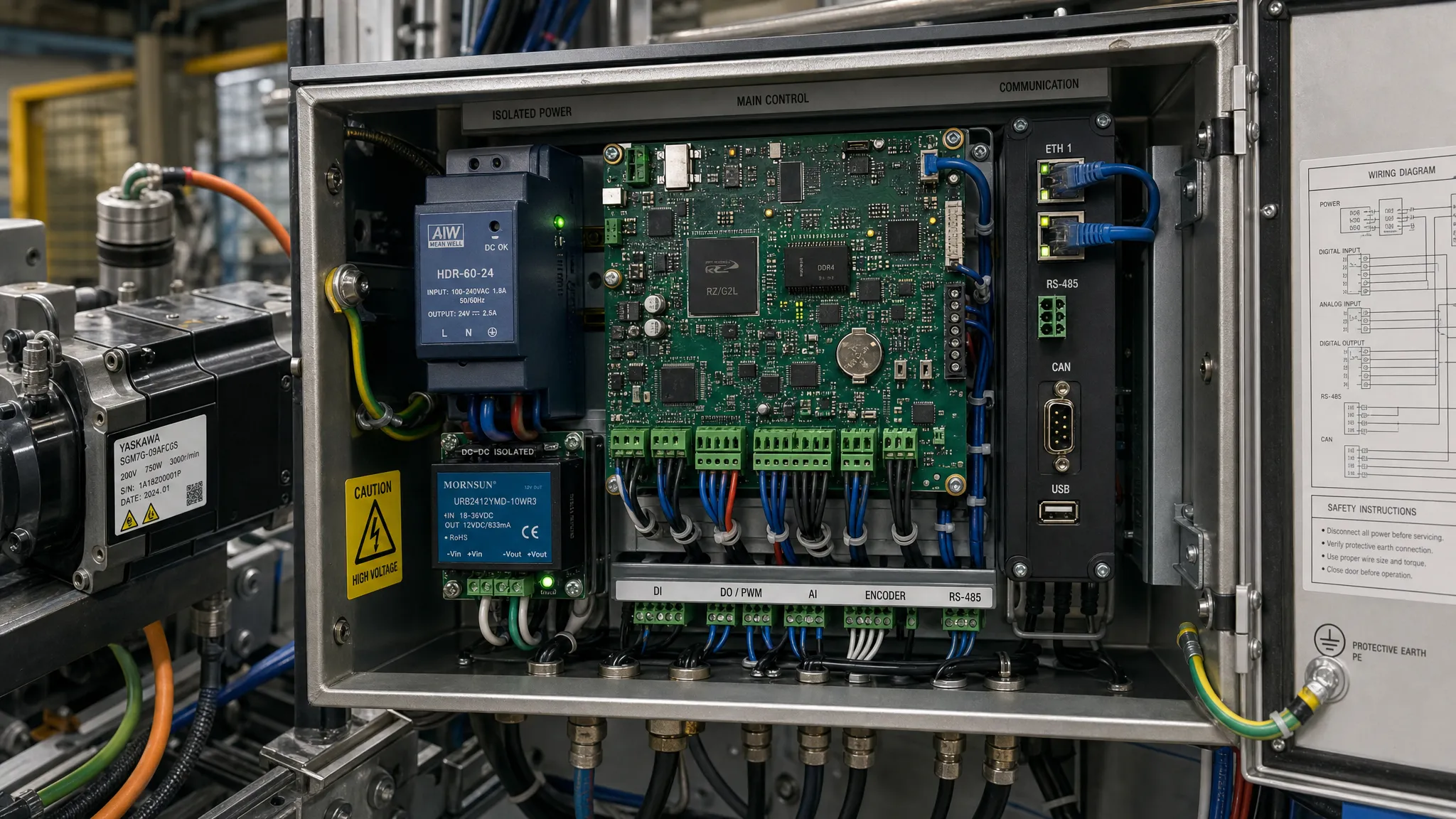
Embedded systems sit at the point where product ideas become controlled behaviour. In a machine, they synchronise motion and monitor sensors. In a vehicle, they manage power, communication and safety-related functions. In a connected device, they turn user input, wireless data and physical measurements into reliable operation.
For engineering teams and decision-makers, the application of embedded system technology is not mainly about adding a processor to a PCB. It is about designing a complete electronic system that can measure, decide, actuate, communicate and protect itself under real operating conditions. That requires close alignment between embedded software, electronics, power design, analogue interfaces, PCB layout, enclosure design, EMC behaviour, manufacturability and lifecycle support.
When these disciplines are treated separately, prototypes may work in the lab but fail during compliance testing, installation, production scaling or field use. When they are designed together, embedded systems become a foundation for safer, smarter and more scalable products.
What an embedded system does inside a product
An embedded system is a dedicated computing and control system built into a larger product. Unlike a general-purpose computer, it is designed for a specific set of tasks within a specific environment. It may be based on a microcontroller, an embedded processor, a system-on-module, an FPGA or a combination of digital, analogue and power electronics.
In practice, an embedded system often performs several roles at once:
- Measure: It reads sensors, voltages, currents, temperatures, positions, pressures, flow rates or user inputs.
- Decide: It runs firmware or software logic that determines what should happen next.
- Actuate: It controls motors, valves, relays, LEDs, heaters, pumps, drives or other outputs.
- Communicate: It exchanges data via wired buses, wireless links, industrial networks, cloud interfaces or local service tools.
- Protect: It detects abnormal conditions and can limit current, shut down safely, trigger alarms or enter a safe state.
- Diagnose: It logs faults, monitors performance and supports maintenance, service and product improvement.
This is why embedded development cannot be reduced to software alone. The behaviour of the product depends on the complete system, including power supply stability, sensor accuracy, PCB layout, thermal paths, enclosure materials, cable routing and the electromagnetic environment.
Why application context matters more than the processor
Two products can use the same microcontroller and still require completely different engineering approaches. A sensor node in a consumer device, a motor controller in a robot and a control unit in a maritime system may share similar building blocks, but their risks, operating conditions and compliance expectations are not the same.
| Product context | Typical embedded role | Design priorities | Hidden risks |
|---|---|---|---|
| Industrial machines | Motion control, sensor acquisition, operator interfaces, diagnostics and connectivity | Reliability, EMC, serviceability, deterministic behaviour and integration with machinery | Noise from drives, cable effects, unclear operating envelope, safety-related assumptions |
| Vehicles and mobile platforms | Power management, control units, communication, actuator control and monitoring | Robust power input, vibration resistance, temperature range, communication reliability and lifecycle | Transients, grounding issues, harsh environments, supply chain constraints |
| Professional devices | Measurement, secure communication, user control, data logging and embedded computing | Accuracy, compact integration, firmware reliability, update strategy and compliance readiness | Analogue interference, enclosure constraints, firmware edge cases, certification delays |
| Consumer and connected devices | User interaction, wireless control, sensing, LED or motor control and energy management | Cost-aware design, usability, wireless performance, power efficiency and long-term reliability | Antenna detuning, thermal limits, component availability, insufficient production testing |
Good embedded design starts by defining the context in which the product must operate. That includes user behaviour, installation conditions, electrical disturbances, thermal limits, maintenance expectations, regulatory constraints and the production volumes expected over time.
Application of embedded systems in industrial machines
Industrial machines depend on embedded electronics to convert mechanical processes into controlled, repeatable behaviour. In machine manufacturing and robotics, embedded systems often sit close to the physical process. They read sensors, control actuators, communicate with higher-level systems and provide local intelligence where fast response or compact integration is required.
A typical machine may contain multiple embedded subsystems. One controller may manage a motor drive, another may acquire data from sensors, while a communication board exchanges information with a PLC, HMI or cloud platform. In a robot, embedded electronics may combine motor control, position feedback, battery management, safety-related monitoring and wireless diagnostics.
The challenge is that machines are electrically noisy environments. Motors, inverters, contactors, long cables and switching power stages can create disturbances that affect sensor readings, communication lines and control electronics. A design that behaves well on a development bench may reset, drift or produce measurement errors once installed in a machine cabinet.
For machine applications, the embedded system architecture should be developed together with the power electronics, grounding concept, PCB layout, cable interfaces, enclosure and EMC strategy. Early design choices determine whether the product can be tested, serviced, manufactured and maintained efficiently later.
Common embedded functions in machines include:
- Motor and actuator control for pumps, belts, valves, grippers, drives and positioning mechanisms.
- Sensor acquisition for temperature, pressure, current, voltage, proximity, flow, force, vibration or optical signals.
- Local control logic for timing-critical behaviour that should not depend entirely on a remote controller.
- Industrial connectivity for service tools, supervisory systems, condition monitoring or fleet-level insight.
- Diagnostics and logging to help identify failures, usage patterns and maintenance needs.
When safety functions are involved, requirements must be defined carefully from the start. The embedded system may need specific architecture, diagnostics, redundancy, fault detection or validation processes depending on the product and applicable standards. These choices are difficult and expensive to retrofit after the electronics and firmware architecture have already been fixed.
Application of embedded systems in vehicles and mobile platforms
Vehicles and mobile platforms rely on embedded systems because they need local control in environments that are variable, power-constrained and physically demanding. This applies not only to road vehicles, but also to autonomous platforms, maritime systems, defence equipment, agricultural machines, mobile robots and specialist transport systems.
In these applications, embedded electronics may control lighting, displays, actuators, motors, pumps, communication modules, battery systems, charging interfaces, sensors or user controls. They may also manage data exchange between subsystems, support remote diagnostics or supervise critical operating conditions.
The design conditions are often more severe than in static equipment. Supply voltages can fluctuate. Batteries may be connected incorrectly. Load dumps, inductive loads and switching transients can stress inputs and outputs. Temperature cycles, vibration, humidity and mechanical shock can affect connectors, solder joints, enclosure sealing and sensor performance.
This means the embedded system must be designed as part of a full electrical and mechanical environment. Protection circuits, filtering, thermal management, connector selection, PCB stack-up, enclosure design and firmware fault handling all influence reliability.
For automotive and mobile systems, communication reliability is also a major factor. CAN, LIN, Ethernet, serial interfaces, wireless communication and GNSS all have different implications for EMC, cabling, diagnostics and software architecture. If wireless functionality is included, radio performance and RED-related considerations can affect antenna placement, enclosure material and test strategy.
The most reliable vehicle and mobile applications usually start with a clear operating envelope. What voltage range must the product tolerate? What happens during cranking, charging or emergency shutdown? How should the system behave if a sensor fails, a connector is disconnected or communication is lost? These questions shape the architecture long before the first PCB is routed.
Application of embedded systems in professional and connected devices
Professional devices use embedded systems to combine measurement, user interaction, connectivity and control in compact products. Examples include test instruments, secure communication platforms, particle counters, medical-adjacent equipment, high-tech tools, connected luminaires, access systems and specialised consumer electronics.
In these products, user expectations can be high even when the electronics are hidden. A device must start reliably, respond predictably, communicate correctly and survive daily use. It may need to run from mains power, battery power, USB power, PoE or a custom power stage. It may also need to support updates, calibration, logging or secure communication.
Even consumer-facing categories show how much embedded engineering is hidden behind simple interaction. In lighting, for example, customers may compare design-oriented luminaires through online retailers such as modern lighting specialists BUYnBLUE, while the actual product experience depends on embedded drivers, dimming behaviour, thermal protection, wireless control and long-term electronic reliability.
For professional devices, the main risk is often integration density. The PCB may need to fit into a compact enclosure with limited airflow, multiple connectors, antennas, sensors and user-interface elements. Analogue signals may sit near switching supplies or wireless modules. Firmware may need to handle unusual edge cases, update failures or communication interruptions.
A system-level approach is essential. Mechanical layout, thermal paths, enclosure material, connector position, antenna tuning, power architecture and software behaviour should be evaluated together rather than as separate work packages.
The engineering layers that make embedded applications reliable
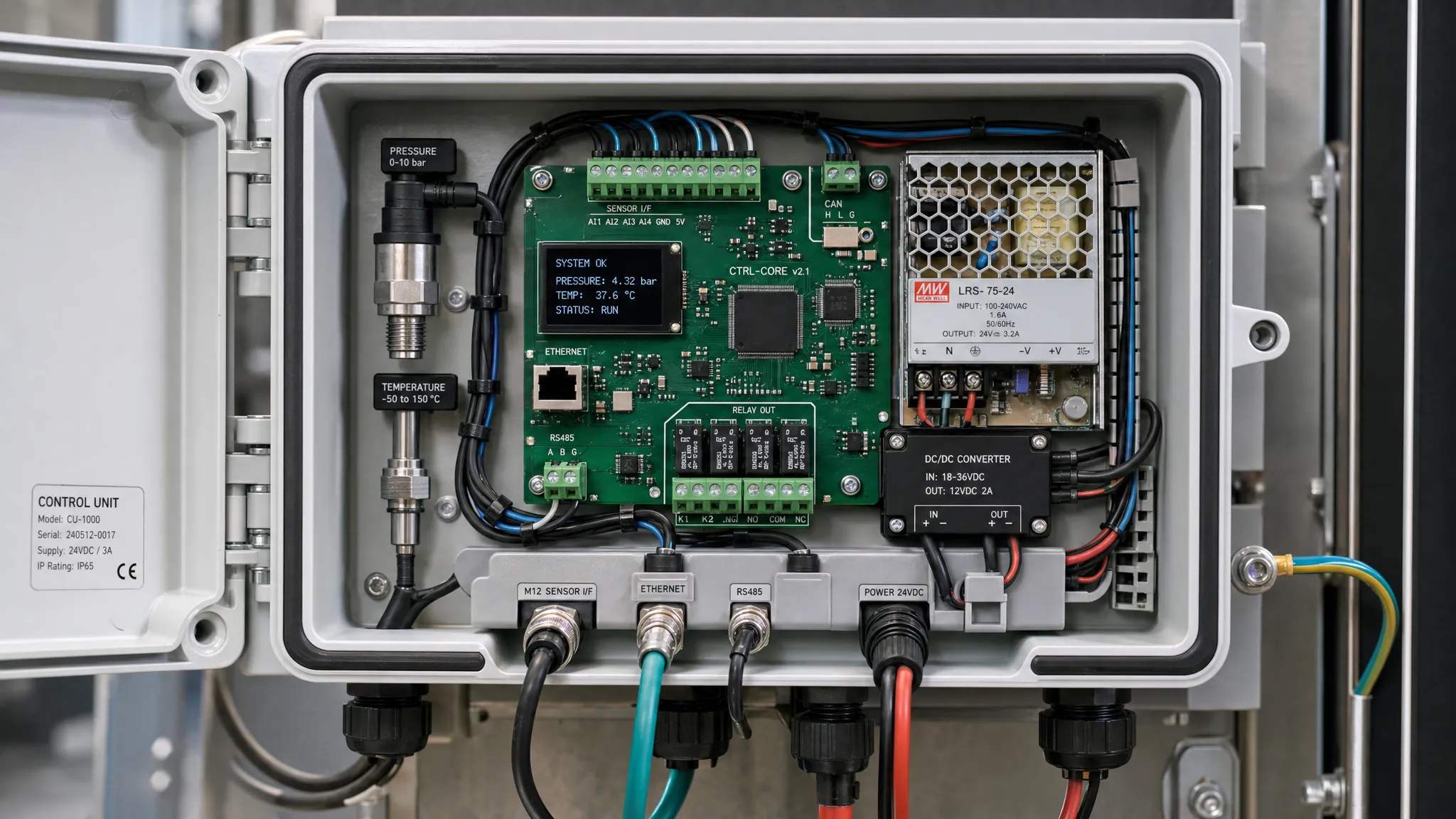
Reliable embedded products are built through many small design decisions. No single component, processor or development board guarantees success. The strongest results come from aligning requirements, architecture, hardware, firmware, power design, PCB layout, enclosure integration, testing and manufacturing preparation.
| Design layer | Key engineering decision | Risk if ignored |
|---|---|---|
| Requirements | Define the operating envelope, interfaces, users, environment and compliance expectations | Prototype works in a narrow lab setup but fails in real use |
| System architecture | Decide which functions belong in hardware, firmware, software, power electronics or mechanics | Late redesigns when timing, safety or integration limits appear |
| Power design | Select suitable converters, protection, filtering, thermal design and energy strategy | Resets, overheating, conducted emissions or unreliable operation |
| Analogue electronics | Protect signal integrity and match sensors, ADCs, references and filtering to the application | Drift, noise, false readings or poor measurement repeatability |
| PCB layout | Control grounding, return paths, impedance, creepage, clearance and high-current loops | EMC issues, parasitic behaviour, coupling and production defects |
| Enclosure and cabling | Integrate electronics with mechanics, shielding, connectors, seals, airflow and service access | Field failures due to heat, moisture, vibration or installation effects |
| Firmware | Implement deterministic behaviour, fault handling, diagnostics and update logic | Unhandled edge cases, lock-ups, difficult service and poor traceability |
| Production and lifecycle | Plan test points, programming, calibration, component availability and maintainability | Expensive production ramp-up, yield problems and redesigns due to obsolescence |
This is also why requirements definition is not an administrative step. It is an engineering risk-reduction activity. If you are starting a new electronics project, ProMicro’s guide on what OEMs should define before starting custom electronics design offers a useful checklist for clarifying product goals, environment, interfaces and manufacturing assumptions before development begins.
Common failure modes when prototypes leave the lab
Many embedded products fail not because the idea is wrong, but because the prototype was validated under conditions that were too narrow. A clean bench supply, short cables, room temperature and an open enclosure rarely represent real field conditions.
Common issues include power drops when motors start, sensor drift caused by heat, communication errors from long cables, wireless range problems inside a metal enclosure, resets caused by electromagnetic disturbances and firmware faults triggered by rare timing sequences. In production, additional risks appear, such as component tolerances, assembly variation, test coverage gaps and supplier changes.
The best prevention is to treat prototyping as structured learning, not as proof that the design is finished. A prototype should answer specific technical questions: Does the power architecture behave under load? Are sensor readings stable near switching circuits? Is the PCB layout suitable for EMC? Can the enclosure handle heat? Can the product be tested efficiently in production? Can the firmware recover from predictable faults?
For complex products, early pre-compliance testing and realistic validation can reveal risks before the design is locked. This does not guarantee certification, but it gives the engineering team better evidence and more time to make controlled design changes.
How to select the right embedded architecture
Choosing the right architecture is one of the most important early decisions. The answer is not always to use the most powerful processor. The right choice depends on timing requirements, interfaces, environmental conditions, software complexity, power budget, lifecycle expectations, production volume and certification context.
| Architecture option | Fits well when | Watch-outs |
|---|---|---|
| PLC or industrial controller | The product is a one-off machine or requires standard industrial control with limited custom electronics | May be too large, expensive or inflexible for compact series products |
| Microcontroller-based system | The product needs deterministic control, low power, compact design and close integration with sensors or actuators | Requires careful firmware architecture, hardware design and test strategy |
| Embedded Linux or system-on-module | The product needs high-level connectivity, user interfaces, data processing or advanced communication | Boot time, cybersecurity, update strategy, lifecycle and power integrity need attention |
| FPGA or specialised digital logic | The product needs high-speed parallel processing, precise timing or specialised signal handling | Development complexity, verification effort and component lifecycle must be justified |
| Mixed control and power architecture | The product combines embedded control with motor drives, converters or high-current switching | EMC, thermal behaviour, protection and layout are central to success |
For some industrial products, embedded computing offers major advantages over a PLC or industrial PC. For others, it adds unnecessary complexity. The decision should be based on the product’s function, scale and lifecycle. ProMicro has also written about when embedded computing is the right choice for industrial devices for teams comparing these options.
From concept to volume-ready electronics
The route from idea to production-ready embedded system should be structured but not rigid. Requirements evolve as assumptions are tested. Mechanical, electronic and software decisions influence each other. Suppliers and component availability may also change during the project.
A practical development route usually includes concept clarification, feasibility analysis, system architecture, schematic and PCB design, firmware development, enclosure integration, prototype build, functional validation, EMC-aware testing, design iteration, production test planning and manufacturing preparation.
The key is to make important risks visible early. If a product depends on a wireless module, antenna performance should not be checked only after the enclosure is final. If a power stage drives an inductive load, transient behaviour and thermal limits should be tested before the PCB is released for volume build. If a device must be maintained for many years, component lifecycle and service diagnostics should be part of the architecture discussion.
This lifecycle thinking is especially important for OEMs developing their own product range. A single embedded platform may need to support variants, future features, different regions, multiple communication options or long-term component replacements. Modular architecture and documented design choices can reduce engineering effort in future product generations.
Where ProMicro fits in complex embedded system development
ProMicro supports companies that need more than a standalone PCB layout or a short-term engineering task. Many embedded products require a partner who can connect software behaviour, electronics design, power electronics, analogue interfaces, mechanical constraints, compliance awareness and manufacturing preparation into one coherent development process.
This is particularly valuable when internal engineering teams have limited capacity or when a project includes specialist challenges such as motor drives, sensors, wireless communication, IoT connectivity, EMC-sensitive layouts, compact enclosures or power electronics. Early collaboration can help identify hidden requirements, reduce technical uncertainty and avoid design choices that become expensive later.
ProMicro’s work spans embedded system development, power electronics, analogue electronics, PCB design services, system engineering, enclosure design, rapid prototyping, volume manufacturing support and lifecycle management. The goal is not only to make the first prototype function, but to help create electronics that are robust, scalable, maintainable and suitable for real-world use.
For decision-makers, this means the discussion should start before the design is fixed. The earlier system-level risks are identified, the more freedom there is to solve them efficiently.
Frequently asked questions
What is an application of embedded system technology in an industrial product? A common example is a machine controller that reads sensors, controls motors, monitors power, communicates with a supervisory system and logs diagnostic data. The embedded system is dedicated to the machine’s function and must be designed for its electrical, mechanical and environmental conditions.
How is an embedded system different from a PLC? A PLC is a robust industrial controller used widely in automation. An embedded system is custom-designed into a product and can be smaller, more integrated and more application-specific. The right choice depends on production volume, form factor, timing, cost structure, interfaces, lifecycle and compliance requirements.
Why do embedded systems sometimes fail after successful lab tests? Lab tests often use clean power, short cables, stable temperatures and open access to the electronics. Real products face noise, vibration, heat, long cables, installation variation, user behaviour and production tolerances. Testing should therefore include realistic operating conditions and early attention to EMC, power integrity and thermal behaviour.
When should EMC, CE or RED considerations be addressed? They should be considered during requirements and architecture definition, not only at the end of the project. PCB layout, enclosure design, cable interfaces, grounding, shielding, power conversion, wireless integration and firmware behaviour can all influence compliance readiness.
Can ProMicro support only part of an embedded development project? ProMicro is positioned as an end-to-end electronic design partner, but many projects start with a specific challenge, such as system architecture, PCB design, power electronics, embedded development, prototyping or manufacturing preparation. The right scope depends on the product, internal team capacity and technical risks.
Need support with an embedded application in a machine, vehicle or device?
If your team is developing a product that combines embedded control, sensors, power electronics, connectivity, analogue electronics or compact mechanical integration, early engineering choices will strongly influence reliability and production readiness.
Talk to ProMicro about your product idea, prototype or existing design challenge. Together, we can review the technical requirements, identify hidden risks and define a practical route towards robust, scalable embedded electronics.