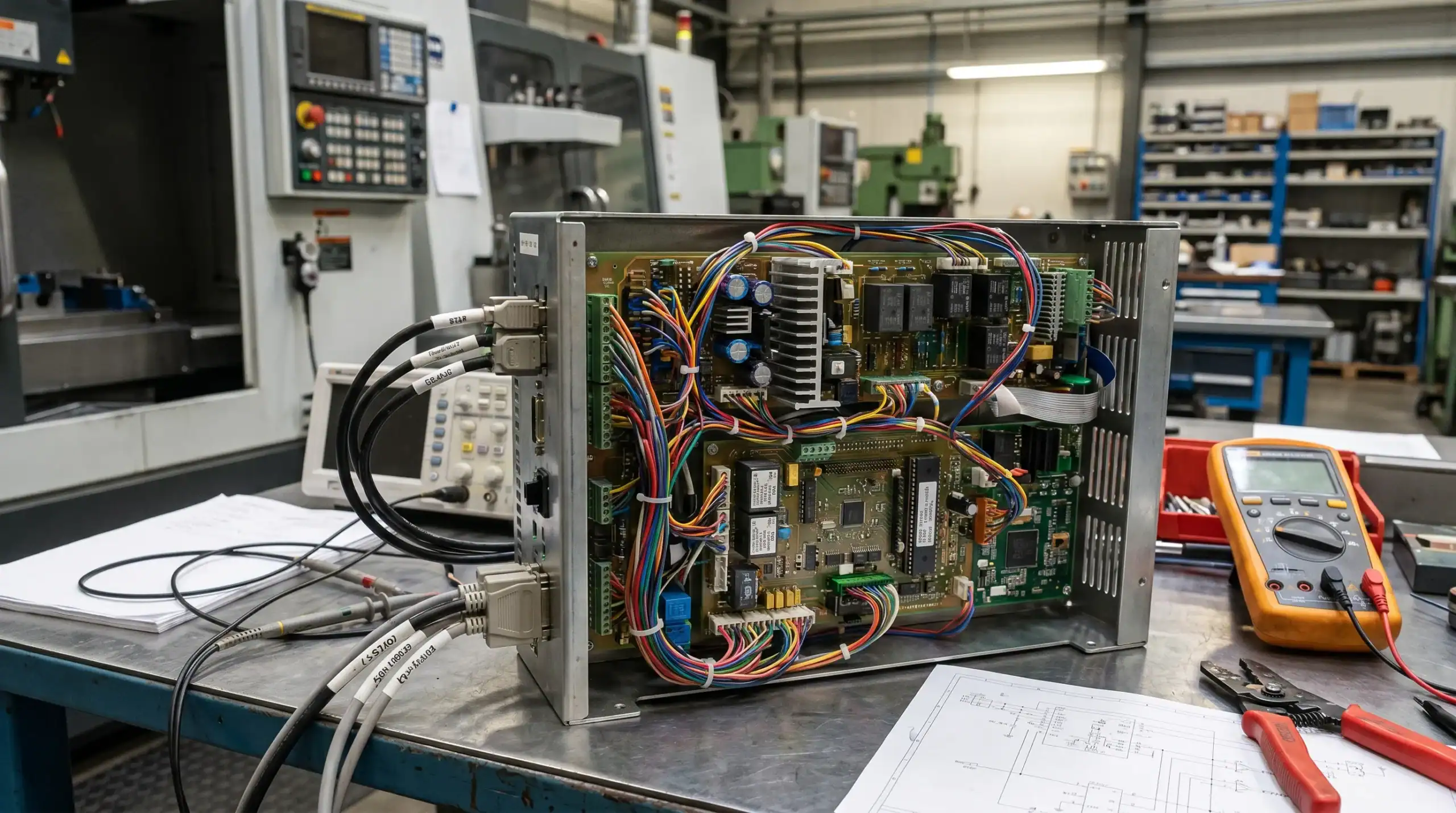
Industrial devices are becoming more intelligent, connected and data-driven. Machine modules, maritime systems, robotic platforms, defence equipment and high-tech instruments increasingly need to sense, decide, communicate and control locally. That often leads to one important architecture question: should the device use embedded computing, or would a simpler controller, PLC, gateway or industrial PC be the better choice?
The answer is not “always use more compute”. In professional electronics, unnecessary processing power can add cost, heat, certification complexity, software maintenance and supply chain risk. But choosing too little compute can limit product performance, make future updates difficult and force expensive redesigns once the device moves from prototype to field use.
The right decision depends on the function of the product, the operating environment, production volume, compliance requirements and lifecycle expectations. For engineering managers, CTOs and product owners, the goal is not to select a processor first. The goal is to define what the device must reliably do in the real world, then design the electronics, software, power architecture and mechanical integration around that need.
What embedded computing means in an industrial device
Embedded computing is the use of a dedicated processing platform inside a product or machine, designed to perform specific functions reliably within defined constraints. Those constraints may include real-time control, low power consumption, thermal limits, electromagnetic compatibility, shock and vibration, enclosure size, long component availability and safe operation.
In an industrial context, embedded computing may take many forms. It can be a microcontroller running firmware for a motor drive, a real-time processor controlling sensors and actuators, a Linux-based compute module handling data processing and connectivity, or a custom board that combines analogue measurement, power electronics and digital control.
What makes it “embedded” is not the chip type alone. It is the fact that computing is part of the product’s function, not a separate office IT layer. The hardware, firmware, PCB, enclosure, power supply, interfaces and update strategy must all work as one engineered system.
That distinction matters. A development board may be useful for early experiments, but an industrial device usually needs a production-ready architecture. Connectors, cabling, IO protection, power sequencing, EMC behaviour, diagnostics, test points and component lifecycle all become part of the design decision.
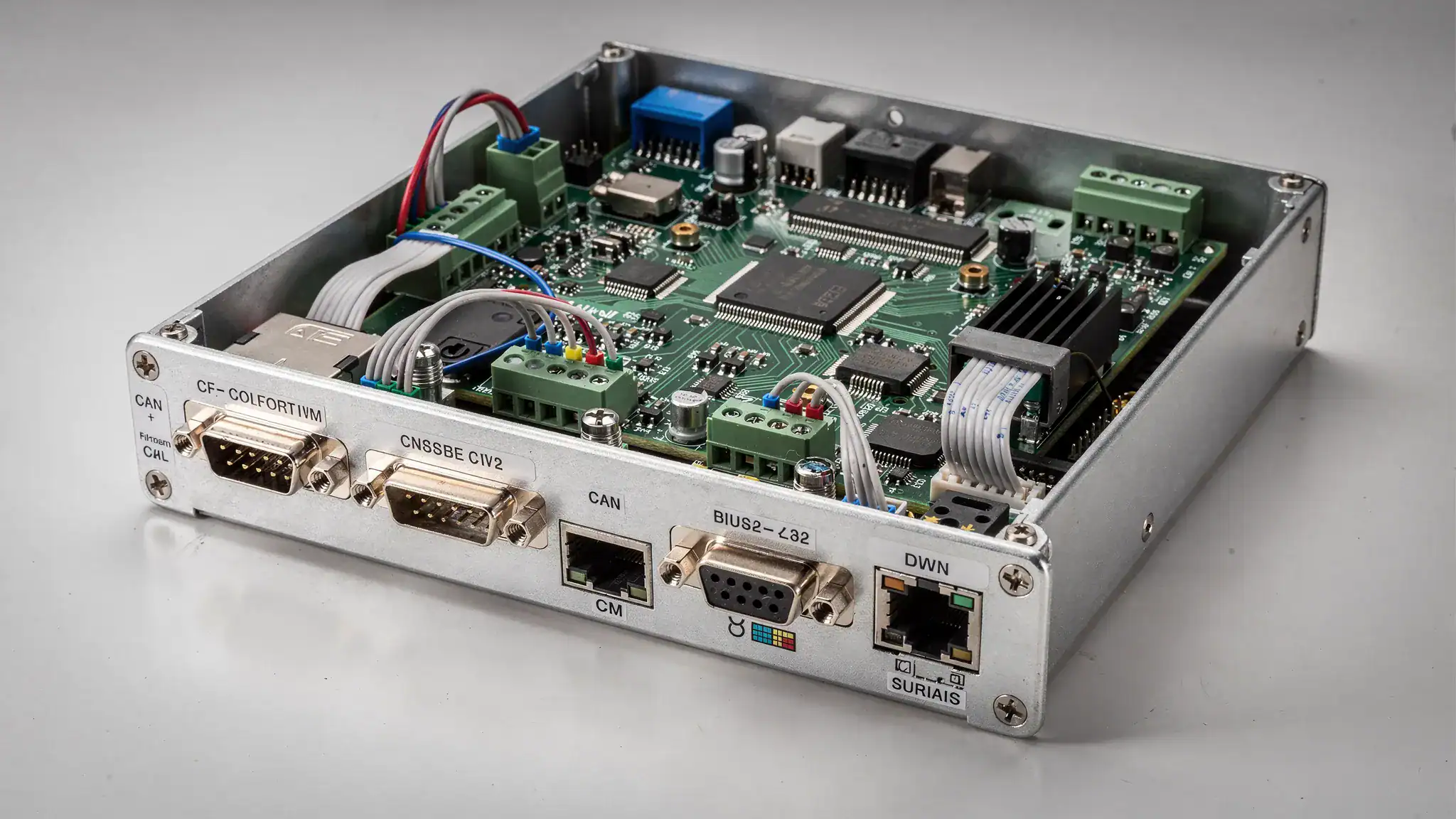
When embedded computing is the right architectural choice
Embedded computing is most valuable when the product must perform local, application-specific processing that cannot be handled cleanly by simple control logic or an external computer. The following situations often indicate that an embedded approach is justified.
The device must make decisions locally
If the product needs to react quickly to sensor data, actuator feedback or safety-related conditions, relying on a remote server or external PC may introduce unacceptable latency or dependency. Local processing allows the device to continue operating even when connectivity is unavailable or limited.
This is common in robotics, machine control, maritime systems and high-tech measurement equipment. A robotic actuator, for example, may need to process encoder data, current measurements and control loops in real time. A maritime monitoring system may need to filter sensor data locally before transmitting only relevant information. A defence or security product may need to operate autonomously in environments where networks are unreliable or restricted.
In these cases, embedded computing supports robustness. It keeps essential decision-making close to the physical process.
The product combines sensors, power electronics and communication
Many modern industrial devices are not purely digital. They combine analogue measurement, motor control, battery or power conversion, wireless communication and embedded software. This integration creates design dependencies that are difficult to solve by treating the PCB, firmware and enclosure as separate tasks.
For example, a sensor front-end may be sensitive to switching noise from a power stage. A wireless module may be affected by enclosure material and antenna placement. A motor drive may require carefully timed current measurements and a PCB layout that minimises parasitic effects. In such products, embedded computing is not just about processing data. It is about coordinating the full electronic system.
A well-designed embedded architecture can define clear boundaries between analogue electronics, power electronics, digital processing and communication interfaces. That makes the design easier to test, debug and industrialise.
The device needs a compact, product-specific form factor
Industrial devices often need electronics that fit inside a constrained enclosure, integrate with mechanical parts or survive specific environmental conditions. A standard industrial PC or generic controller may be too large, too power-hungry or difficult to mount.
Embedded computing allows the processing platform to be tailored to the product. The PCB can be shaped around the enclosure. Connectors can be selected for the application. Thermal paths can be designed intentionally. The power supply can be sized for the real load profile instead of overdimensioned around a generic module.
This is particularly relevant in professional equipment where electronics must become part of the product identity and long-term manufacturing strategy, not an add-on hidden in the cabinet.
The product will be manufactured in series
For one-off machines, a PLC or industrial PC may be the most practical solution. For a product that will be manufactured repeatedly, embedded computing often becomes more attractive.
Series production changes the economics and the risk profile. A custom embedded system can reduce unnecessary hardware, optimise the bill of materials, improve repeatability and simplify assembly. It also gives the product owner more control over lifecycle, firmware updates, diagnostics and future product variants.
This is where early architecture decisions matter. A prototype that works in the lab with multiple modules, adapters and development boards may become expensive or fragile when scaled. Designing for production from the start helps avoid a late transition from “it works” to “it can be built, tested, certified and maintained”.
The same end-to-end thinking is seen in other product sectors, where partners such as specialist apparel development and manufacturing providers help brands connect concept, sourcing, sampling and production. In industrial electronics, that integrated approach is even more critical because hardware, software, compliance and lifecycle choices are tightly connected.
Compliance and reliability must be considered from the beginning
Industrial electronics must often be designed with EMC, CE, RED, safety and sector-specific requirements in mind. Embedded computing can support compliance when it is integrated properly, but it can also create problems if the architecture is chosen casually.
High-speed processors, switching regulators, wireless modules, long cables and dense PCB layouts can all influence electromagnetic behaviour. If these topics are addressed only during final testing, the result may be redesign work, delayed certification or difficult field issues.
A design for compliance approach considers these factors early: grounding, shielding, filtering, PCB stack-up, cable interfaces, enclosure design, power architecture and software behaviour during abnormal conditions. For a deeper look at this topic, ProMicro has also explained why EMC should be considered early in electronic product design.
When a simpler solution may be better
Embedded computing is powerful, but it is not always the right choice. A good engineering decision includes knowing when not to add complexity.
If the device only needs simple sequence control, standard IO and well-known machine logic, a PLC may be the most maintainable option. Maintenance teams are familiar with PLC environments, spare parts are widely available and integration with factory automation systems is straightforward.
If the application requires high-level computing but has low production volume and enough physical space, an industrial PC may be suitable. This can be especially practical for vision systems, data logging or user interface-heavy applications where the environment is controlled and the hardware cost is acceptable.
If the device is an early research prototype, using development boards or off-the-shelf modules can help validate the concept quickly. The risk starts when those prototype choices are carried into production without reviewing power, EMC, thermal behaviour, availability, security and manufacturability.
| Situation | Likely best fit | Reason |
|---|---|---|
| Simple machine sequence control with standard IO | PLC | Reliable, maintainable and familiar for industrial automation teams |
| High-volume product with custom sensors, connectivity and local control | Embedded computing | Optimised for size, cost, function, lifecycle and production repeatability |
| Vision or analytics system with ample space and low volume | Industrial PC | Provides high compute capacity with less custom hardware development |
| Early proof-of-concept with uncertain requirements | Development boards or modules | Fast validation before committing to a production architecture |
| Compact product requiring low power and real-time control | Embedded computing | Enables tight integration between hardware, firmware and physical constraints |
| Retrofit data gateway for an existing installation | Gateway or industrial module | Often sufficient when the main task is connectivity rather than product-level control |
The practical question is not whether embedded computing is “better”. The question is whether it creates a more reliable, scalable and maintainable product for the specific use case.
Key engineering factors before choosing embedded computing
Once embedded computing appears to be the right direction, the next step is to evaluate the architecture carefully. This is where many projects become more complex than expected. The processing platform is only one part of the system.
Processing performance and real-time behaviour
The required computing performance should be derived from the application, not from the most capable chip available. Important questions include how fast control loops must run, how much sensor data must be processed, whether deterministic timing is required and whether the device needs a full operating system.
A microcontroller may be sufficient for deterministic motor control or sensor acquisition. A real-time operating system may be needed for more complex task management. A Linux-based embedded platform may be appropriate when the device needs advanced networking, a user interface, data storage or integration with higher-level software.
Choosing too much compute can increase boot time, thermal output, software maintenance and cybersecurity obligations. Choosing too little can limit future features and force a hardware redesign. The right balance depends on both current requirements and credible future variants.
Power architecture and thermal design
Industrial embedded systems often combine processors, communication modules, sensors and power electronics. Each part has different power demands and noise characteristics. A robust architecture must handle input voltage variation, transients, protection, sequencing and heat dissipation.
Thermal behaviour is especially important in sealed enclosures, maritime environments, vehicles, outdoor devices or equipment mounted near motors and drives. A processor that performs well on a lab bench may throttle, reset or age prematurely when placed inside a compact enclosure at elevated ambient temperature.
Power and thermal design should therefore be evaluated together with enclosure design, PCB layout and expected duty cycles.
Analogue performance and signal integrity
Many industrial devices depend on accurate measurement. Current sensing, pressure sensing, optical detection, temperature measurement and other analogue functions can be affected by noise, grounding, layout and component placement.
When embedded computing is placed close to sensitive analogue circuitry, the design must prevent digital noise, switching transients and communication interfaces from degrading measurement accuracy. This requires careful PCB partitioning, filtering, reference design, grounding strategy and validation under realistic operating conditions.
For measurement-heavy products, the quality of the analogue design may be just as important as the processor selection.
Connectivity, updates and cybersecurity
Connected devices need more than a communication interface. They need a strategy for secure data exchange, firmware updates, diagnostics and long-term support. This is relevant for IoT products, remote monitoring systems, connected machines, maritime equipment and professional devices used in regulated or security-sensitive environments.
Wireless communication also introduces compliance considerations. If radio technology is used, the design may need to account for RED requirements, antenna placement, coexistence, shielding and enclosure effects. These topics should not be left until the final product test.
A future-proof embedded design should also consider how firmware will be updated in the field and how failures can be diagnosed without returning every unit to the factory.
Component availability and lifecycle management
Industrial products often need to remain available and serviceable for many years. This makes component lifecycle a serious design factor. A processor, memory device, wireless module or power component with uncertain long-term availability can create production and maintenance problems later.
Lifecycle thinking includes second-source options where possible, clear documentation, controlled firmware dependencies and a plan for redesign if key components become unavailable. It also includes designing variants intelligently, so future products can reuse parts of the architecture rather than starting again each time.
ProMicro has written more about this in the context of scalable embedded system development, where modular design, component selection and production readiness are treated as part of the same engineering challenge.
Common mistakes when adding embedded computing to industrial products
Many embedded projects start with a successful demonstration and still encounter problems later. The reason is usually not that the concept was wrong. It is that production, compliance or field conditions were not reflected in the early design.
A common mistake is selecting a development board because it is convenient, then discovering that it is unsuitable for long-term supply, EMC performance, mechanical integration or volume manufacturing. Another mistake is separating hardware and software decisions too strongly. For example, software may assume certain processing resources while the hardware team is trying to reduce power, size or cost.
A third risk is underestimating interfaces. Cables, connectors, sensors, displays, antennas, motors and power inputs are often where real-world disturbances enter the system. If these are not considered early, the processor may behave correctly while the total product remains unreliable.
Finally, teams sometimes treat certification as a final checkbox. In practice, compliance is influenced by architecture decisions made months earlier. PCB layout, enclosure design, grounding, filtering and operating modes all shape test outcomes. Designing with compliance in mind does not guarantee a pass, but it reduces avoidable risk.
How to decide before committing to the architecture
A structured decision process helps avoid both overengineering and underengineering. Before selecting a compute platform, define the product context in practical terms: what the device controls, what it measures, what happens if communication fails, what disturbances it may experience and how long it must remain in production.
It is also useful to separate prototype goals from product goals. A prototype may prove that the algorithm works. A production design must prove that the device can be built consistently, tested efficiently, pass relevant compliance work and operate reliably in the field.
The following questions are often a good starting point:
- Does the device need local decision-making, real-time control or offline operation?
- Are sensors, power electronics, wireless communication or motor drives tightly integrated?
- Will the product be manufactured in series or used as part of a long-term product family?
- Are size, power consumption, heat, EMC or enclosure constraints important?
- Does the design need a controlled update, diagnostics or lifecycle strategy?
- Would a PLC, gateway or industrial PC meet the requirement with less risk?
If several answers point towards local processing, custom interfaces and production scaling, embedded computing is likely worth evaluating seriously. If the need is mainly standard automation, data forwarding or temporary experimentation, a simpler architecture may be the better first step.
The role of an electronics design partner
Choosing embedded computing is not only a software or processor decision. It affects system engineering, PCB design, analogue electronics, power electronics, enclosure design, compliance preparation, prototyping and manufacturing support. That is why industrial product teams often benefit from involving an electronics design partner early, especially when internal capacity is limited or the application combines multiple technical domains.
A good partner should challenge assumptions, not only execute a predefined PCB task. Hidden requirements often appear in the user environment, installation conditions, cable lengths, power supply quality, thermal constraints, maintenance model or certification route. Identifying those requirements early can prevent expensive changes later.
For companies developing professional devices, the most valuable collaboration is usually one where product vision remains with the client while technical risks are addressed through structured engineering. That includes architecture definition, prototyping, testing, design iterations, production preparation and lifecycle considerations.
Frequently asked questions
Is embedded computing the same as using a microcontroller? Not exactly. A microcontroller can be part of an embedded computing solution, but embedded computing refers to the complete product-specific processing architecture, including hardware, firmware, power, interfaces, PCB, enclosure and lifecycle considerations.
When should an industrial device use embedded computing instead of a PLC? Embedded computing is usually a better fit when the device is a product manufactured in series, requires compact integration, local processing, custom sensors, connectivity, low power or tight control over hardware and software. A PLC is often better for standard machine automation and maintainability in factory environments.
Can a development board be used in a production industrial device? Sometimes, but it should be reviewed carefully. Development boards are useful for prototypes, but production devices need attention to supply availability, EMC, thermal behaviour, mechanical integration, testability and compliance-related design.
Does embedded computing make certification more difficult? It can, especially when high-speed processors, wireless modules or switching power supplies are involved. However, a well-designed embedded architecture can reduce risk by considering EMC, RED, CE and safety-related requirements from the beginning.
How early should manufacturability be considered? As early as the architecture phase. Connector choices, PCB stack-up, component availability, test points, enclosure design and assembly strategy can all affect whether the product can move smoothly from prototype to volume manufacturing.
Build industrial devices with the right level of intelligence
Embedded computing is the right choice when local intelligence, reliable control, compact integration and production readiness are central to the product. It is not the right choice simply because more processing power is available. The strongest industrial devices are designed from the application outward, balancing function, risk, compliance, manufacturability and long-term support.
ProMicro supports companies developing professional electronic products from first idea to volume solutions. With expertise in embedded systems, power electronics, analogue electronics, PCB design, system engineering, enclosure design, prototyping and manufacturing preparation, ProMicro helps teams turn complex product ideas into robust, scalable electronics.
If you are evaluating whether embedded computing is the right architecture for your industrial device, contact ProMicro to discuss your requirements, application environment and development risks early in the process.