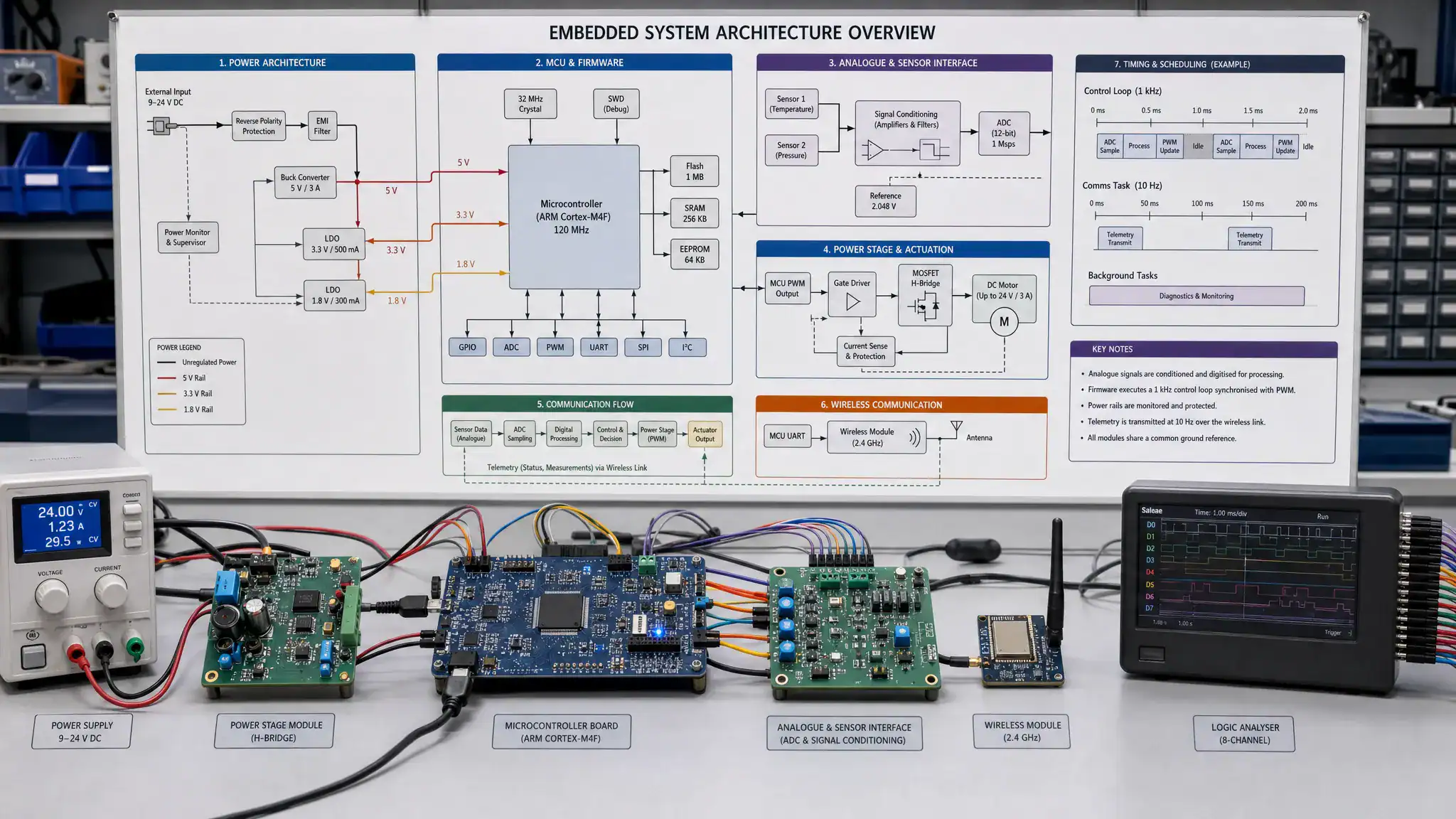
Embedded products rarely fail because the hardware or software is weak in isolation. More often, risk appears in the boundary between them: a processor is chosen before real-time behaviour is understood, a wireless module is added before the enclosure is assessed, or firmware compensates for analogue noise that should have been solved in the circuit.
Hardware-software co-design in embedded systems addresses that boundary deliberately. It treats electronics, firmware, power behaviour, sensors, communication, enclosure constraints, compliance and manufacturing as one connected design problem. For OEMs, machine builders, robotics companies, maritime suppliers, defence integrators and high-tech product teams, this approach can make the difference between a promising prototype and a reliable, production-ready product.
What hardware-software co-design really means
Hardware-software co-design is the practice of developing hardware and software architecture together instead of sequentially. Rather than designing a PCB first and then asking the firmware team to make it work, the engineering team makes trade-offs across processing, memory, timing, power, analogue performance, communication interfaces, diagnostics and testability from the beginning.
This matters because embedded hardware is not just a carrier board for code. It includes processing choices, power supply design, analogue front ends, connectors, communication interfaces, protection circuits, thermal behaviour, production test points and many other elements. A broader explanation of this scope is covered in ProMicro’s article on what embedded hardware includes in a complete design.
In practice, the hardware-software co-design of embedded systems answers questions such as:
- Which functions belong in hardware, firmware, an SoC, an FPGA or a dedicated analogue circuit?
- How much timing margin is needed for real-time control, safety monitoring or communication?
- What happens to power consumption, heat and EMC behaviour when the software changes operating mode?
- How will the product be tested, updated, calibrated and maintained after production?
- Which early design choices could become certification, manufacturing or lifecycle risks later?
The value is not only technical optimisation. It is risk reduction. Co-design helps teams make decisions while they are still affordable to change.
Why co-design matters for reliable embedded products
Many embedded products operate in demanding environments. A motor drive in a machine, a sensor node in a maritime application, a secure communication unit, an automotive module or a connected consumer device all combine electrical, mechanical, environmental and software constraints. A lab prototype may behave correctly under ideal conditions, but field use introduces voltage variation, temperature changes, vibration, moisture, electromagnetic disturbances, user behaviour and component tolerances.
If hardware and software are developed separately, these realities often appear too late. Firmware may need to handle unstable power rails. Hardware may need a redesign because communication latency was underestimated. A housing may detune an antenna. A sensor may perform well on the bench but become unreliable when placed near a motor, inverter or switching regulator.
Co-design does not remove every uncertainty, but it makes uncertainty visible earlier. That is especially important when products must be designed with EMC, RED, CE, safety and reliability in mind. Compliance should not be treated as paperwork at the end of a project. It is influenced by layout, grounding, filtering, shielding, cable routing, firmware switching patterns, radio behaviour, enclosure design and production consistency.
| Co-design question | Hardware perspective | Software perspective | Risk if treated separately |
|---|---|---|---|
| Processing architecture | MCU, MPU, SoC, FPGA, memory and interfaces | Task scheduling, latency, update strategy and diagnostics | Processor is underpowered, over-specified or difficult to maintain |
| Power budget | Regulators, protection, battery behaviour and thermal load | Sleep modes, peak loads, duty cycles and fault handling | Product overheats, drains power or fails during transients |
| Sensor interface | Analogue front end, filtering, grounding and calibration access | Sampling rate, compensation, algorithms and plausibility checks | Measurements drift, become noisy or fail in real environments |
| Wireless connectivity | Antenna placement, RF layout, enclosure and coexistence | Protocol stack, pairing, retries, security and updates | Connectivity works in the lab but fails after integration |
| Test and production | Test points, programming access, fixtures and tolerances | Self-test, logging, calibration and traceability | Production scale-up becomes slow, inconsistent or expensive |
Key engineering decisions that benefit from co-design
Architecture and partitioning
The first major decision is architectural: which parts of the system should be handled by hardware, firmware or a dedicated subsystem? A real-time motor control loop, for example, may need tight timing and predictable behaviour. A user interface, cloud connection or diagnostic layer may tolerate more latency but require secure update paths and maintainable code.
A good architecture does not simply choose the fastest processor available. It matches performance, cost, power, safety, development effort and lifecycle expectations. In some high-performance products, a heterogeneous architecture can be more suitable than a single central controller. This may combine a microcontroller, application processor, FPGA, analogue circuitry and dedicated power electronics, each handling the tasks it is best suited for.
Timing, control and fault behaviour
Timing is one of the most common friction points between hardware and software. A hardware interface may technically support a data rate, while the actual firmware stack cannot process data within the required deadline. A control loop may pass unit tests but fail when interrupts, communication tasks and diagnostics run simultaneously.
Co-design forces the team to define timing budgets early. That includes normal operation, start-up, shutdown, brownout recovery, communication loss, sensor faults and safe-state behaviour. This is particularly relevant in robotics, machine manufacturing, automotive systems and safety-related professional equipment, where uncontrolled behaviour can damage machinery or create liability.
Power electronics, thermal load and software behaviour
Power design is never purely a hardware task. Firmware affects current peaks, switching patterns, sleep states, charging behaviour, motor operation and thermal distribution. A product may meet its average power target while still failing during short high-current events. Conversely, a careful software strategy can reduce stress on power components and extend operating life.
For products with motors, actuators, batteries, wireless modules or high-current switching, hardware and software decisions must be evaluated together. Gate drive choices, current sensing, protection circuits, control algorithms and diagnostic thresholds all influence each other.
Analogue electronics and sensor performance
Sensor-based products often expose the cost of separating disciplines. Analogue design determines the quality of the signal before software ever sees it. Firmware can filter, compensate and validate data, but it cannot fully recover information lost through poor grounding, bad layout, inadequate shielding or inappropriate sensor placement.
Co-design helps define the full measurement chain. This includes sensor selection, analogue front end, ADC resolution, sampling strategy, calibration, environmental compensation and diagnostic checks. The goal is not to push every problem into software, but to decide where each problem is best solved.
Requirements, data and lifecycle control
Co-design also depends on disciplined information management. Requirements, test results, firmware versions, component choices, field issues and production changes must remain traceable. If the system architecture changes, both hardware and software teams need to understand the impact.
That level of data discipline is not unique to engineering. Similar governance is visible in disciplined CRM data import and migration processes, where ownership, field mapping, validation and privacy constraints must be clear before information is moved between systems. In embedded development, the same mindset helps prevent obsolete requirements, undocumented assumptions or unverified field data from becoming design inputs.
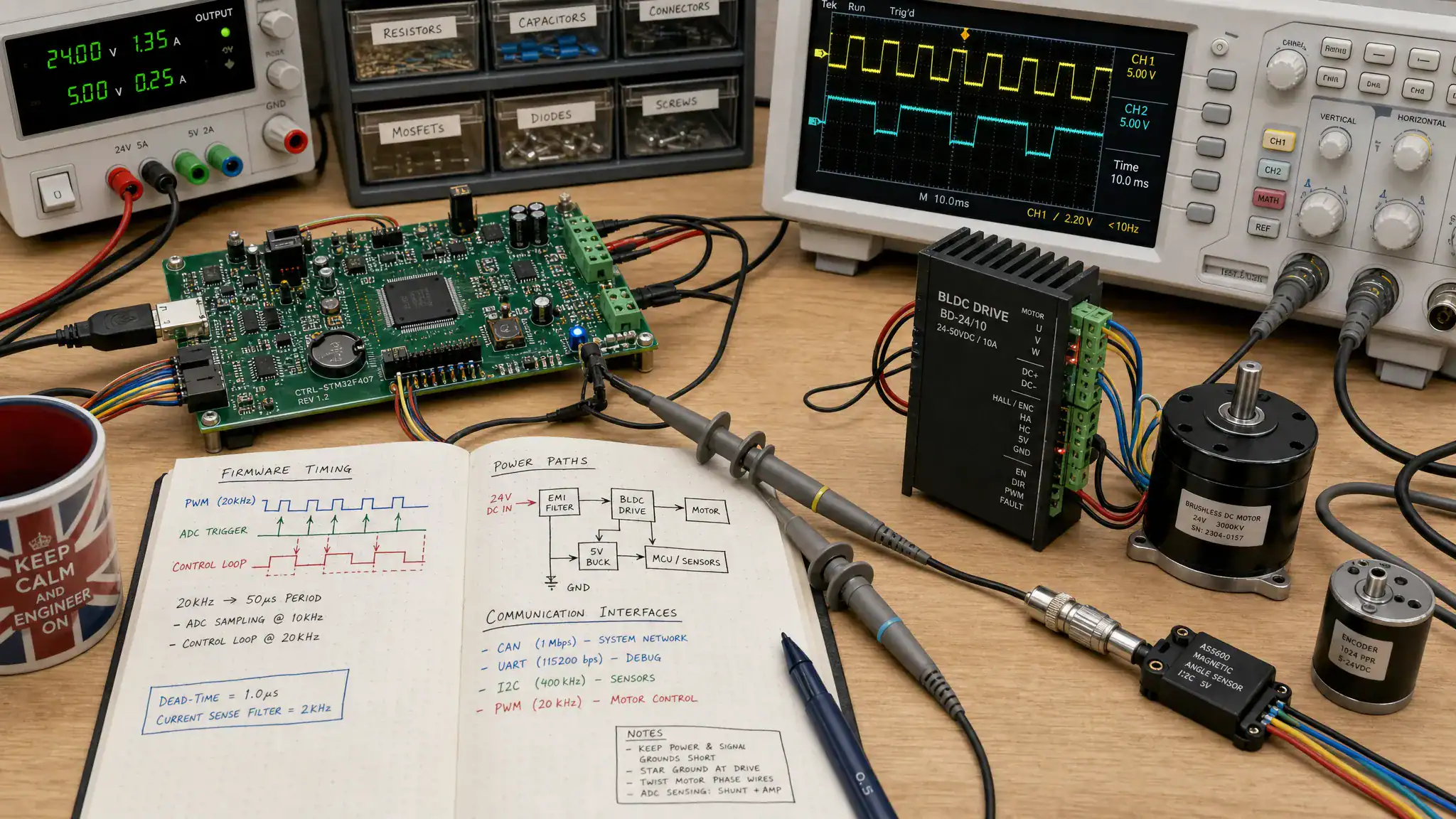
A practical workflow for hardware-software co-design
A useful co-design process starts before components are selected. It begins with system-level thinking: what the product must do, where it will operate, how users interact with it, what can go wrong, and how it will be produced and supported. ProMicro has written more about why system-level thinking from day one is so important in embedded product development.
The first stage is to define the operating context. Temperature, vibration, moisture, cable length, electrical noise, radio environment, power source quality and maintenance expectations all influence architecture. A product for a controlled indoor environment has different hidden requirements from a maritime installation or a machine module placed near drives and motors.
The second stage is to partition functions. Teams should decide which tasks need deterministic timing, which can run asynchronously, which require hardware acceleration, which need analogue precision and which must remain updateable over the product lifecycle. This is where early simulations, proof-of-concept boards and timing analysis can prevent expensive architectural mistakes.
The third stage is to prototype around risk, not only around features. A prototype that demonstrates the user interface but ignores power transients, EMC behaviour or sensor noise may create false confidence. A more useful prototype tests the uncertainties that could later block certification, field reliability or production scaling.
The fourth stage is to design for test and manufacturing. Programming access, production test points, calibration methods, serialisation, firmware loading, logging and service diagnostics should be considered before the PCB is finalised. These details may seem small during development, but they strongly affect manufacturing yield, serviceability and lifecycle cost.
The final stage is to keep verification continuous. Hardware revisions, firmware releases and mechanical changes should be tested against the same system requirements. Co-design works best when test results feed back into architecture, not when verification is reserved for the end.
Common failure patterns when hardware and software are separated
When embedded development is split into isolated work packages, the same problems tend to repeat. A PCB is laid out before firmware timing is understood. A processor is selected without a clear memory and update strategy. A wireless module is placed without considering enclosure effects. A power supply is specified using average loads while firmware creates short current peaks. A sensor is chosen for datasheet performance without validating noise, drift and calibration in the real application.
These issues are not signs of poor engineering. They are usually signs of missing integration. Each individual decision may seem reasonable within one discipline, but the full product exposes the trade-offs.
For example, EMC problems often appear to be hardware-only issues. In reality, software can influence emissions through switching frequency, communication patterns, PWM strategy, processor load and sleep transitions. Similarly, safety and reliability are not purely firmware tasks. They depend on protection circuits, watchdogs, reset behaviour, diagnostic coverage and predictable failure modes.
This is why late-stage certification surprises are often expensive. Redesigning a PCB, changing an enclosure, replacing a radio module or rewriting core firmware after pre-compliance testing can delay launch and consume engineering capacity. ProMicro’s article on embedded system design mistakes that delay certification explains several of these risks in more detail.
When should an OEM involve a co-design partner?
Internal engineering teams often have strong product knowledge, but they may not have capacity or specialist expertise across every discipline. This is common when a product combines embedded software, analogue electronics, power electronics, sensors, wireless communication, enclosure integration and manufacturing preparation.
A co-design partner is particularly valuable when the product must operate reliably in demanding environments, when certification uncertainty could delay launch, or when early architecture decisions will affect a full product range. It is also useful when a company needs extra development capacity without fragmenting the project across too many separate suppliers.
The right partner should not only execute a requested PCB or firmware task. They should challenge assumptions, clarify hidden requirements, identify integration risks and think about the path from concept to prototype, testing, production and long-term support. For technical directors, CTOs and engineering managers, that broader view can reduce rework and create a more maintainable product architecture.
Frequently asked questions
What is hardware-software co-design in embedded systems? It is an integrated development approach where hardware architecture, firmware architecture, power behaviour, interfaces, diagnostics, compliance assumptions and test strategy are designed together instead of in separate phases.
When should hardware-software co-design start? It should start at concept and requirements definition. The earlier the team understands operating conditions, timing constraints, power needs and lifecycle expectations, the easier it is to avoid costly redesigns.
How does co-design support EMC and compliance readiness? Co-design helps teams consider layout, grounding, filtering, switching behaviour, radio placement, firmware timing and enclosure effects early. It does not guarantee certification, but it reduces avoidable risks before formal testing.
Is co-design only needed for complex embedded products? It is most valuable in products with real-time control, sensors, wireless communication, power electronics, safety-related behaviour or demanding environments. Simpler products can also benefit if reliability, manufacturability or long-term support matter.
What should a company prepare before starting a co-design project? Useful inputs include product goals, operating environment, user scenarios, expected production volume, compliance targets, power source information, interface requirements and known technical risks. A complete specification is helpful, but early collaboration can also clarify missing requirements.
Strengthen your next embedded product with integrated engineering
Hardware-software co-design is not just a development method. It is a way to reduce technical uncertainty before it becomes expensive. By connecting electronics, firmware, power behaviour, analogue performance, testing and manufacturing preparation, teams can build embedded products that are more robust in real-world conditions.
If your organisation is developing a professional embedded product and needs specialist capacity across electronics design, embedded systems, power electronics, PCB design, prototyping and preparation for volume manufacturing, ProMicro can support the development process from early concept to production-ready solution.