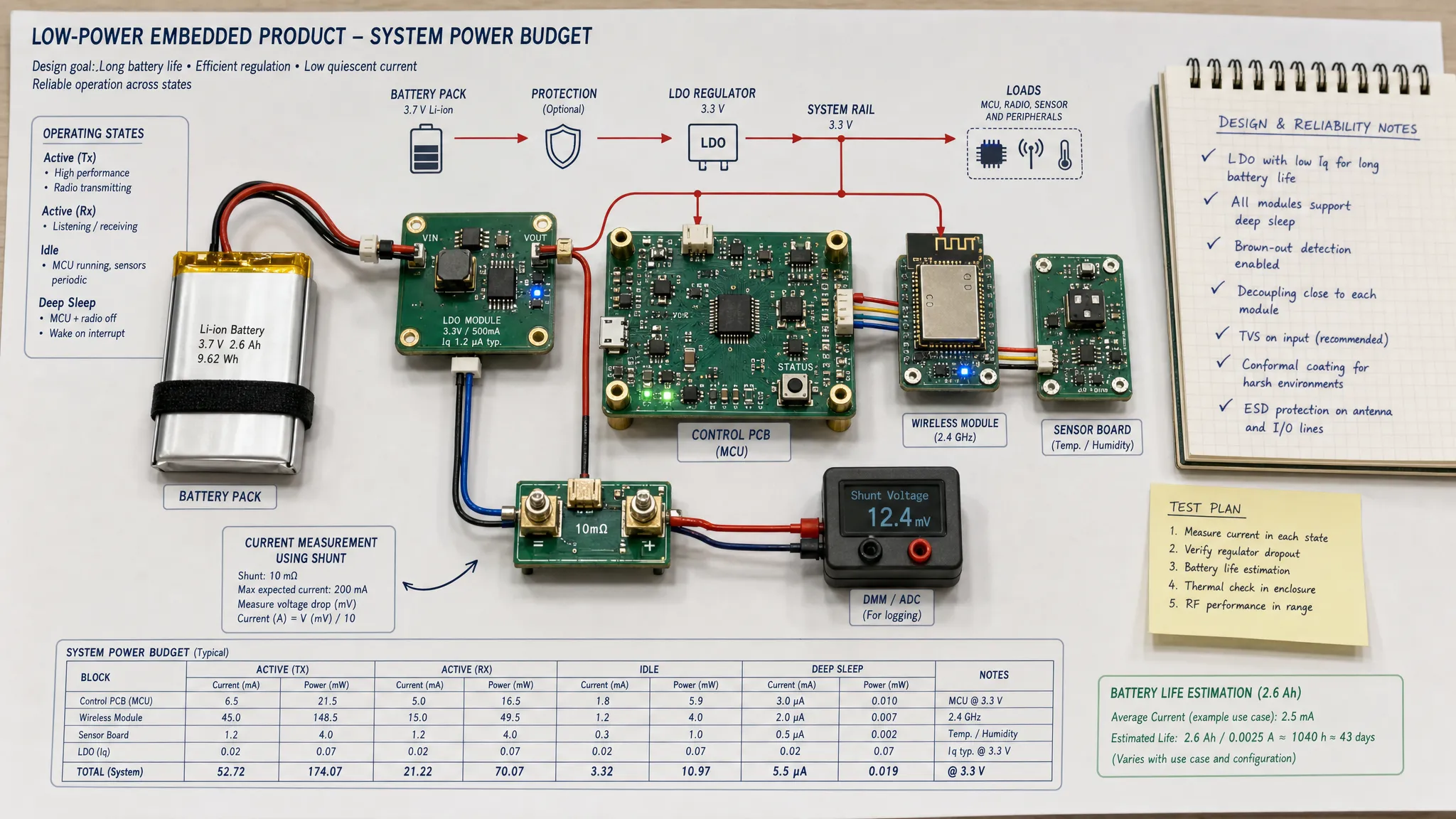
Low-power embedded system design is often framed as a way to extend battery life. That is true, but it is only part of the value. In professional products, lower power consumption can also improve reliability, reduce heat, simplify enclosure constraints, support EMC performance and extend service life.
For OEMs, machine builders, robotics companies, maritime suppliers, defence contractors and high-tech product teams, power consumption is rarely an isolated design parameter. It affects architecture, firmware, component selection, PCB layout, thermal behaviour, certification risk and manufacturing readiness. A prototype that appears efficient on the bench may still fail in the field if the operating profile, environmental conditions and power modes were not properly designed from the start.
A reliable low-power product therefore starts with system thinking. The question is not simply: “Which microcontroller has the lowest sleep current?” The more useful question is: “How should the complete embedded system behave across its full lifecycle, in all realistic operating states?”
Why low power is a reliability decision, not only an energy decision
Every watt that enters an embedded product eventually becomes heat, work, communication, stored energy or loss. In compact products, sealed enclosures, battery-powered devices or electronics mounted near motors and power converters, those losses matter. Lower dissipation can reduce internal temperature rise, which in turn can improve component lifetime and reduce stress on batteries, connectors, sensors and analogue front ends.
This is particularly relevant for products that operate continuously, intermittently wake from sleep, or spend long periods in standby. A maritime sensor node, a smart actuator, a wireless industrial monitor and a handheld measurement tool may all have different duty cycles, but each depends on controlled energy use to remain predictable.
Low power also influences safety and compliance. Current peaks, poorly controlled switching events and unstable power rails can create EMC issues or intermittent faults. If these behaviours are discovered only during certification testing or pilot production, the redesign can affect PCB layout, enclosure grounding, firmware timing and component availability.
That is why low-power embedded system design should be treated as a reliability and risk-reduction activity. Energy efficiency is the visible result. Stable behaviour across real-world operating conditions is the deeper engineering outcome.
Start with the operating profile before selecting components
A common mistake is to begin with a processor data sheet and work backwards. Data sheets are essential, but they describe component capabilities under defined conditions. They do not describe how your final product will behave in a cold machine hall, inside a vehicle, near a motor drive, at sea, or after years of field use.
Before architecture decisions are made, the development team should define the product’s operating profile. This includes active modes, sleep modes, wake-up triggers, communication intervals, sensor sampling rates, peak loads, environmental limits and expected user behaviour.
| Design question | Why it matters for low power | Example impact |
|---|---|---|
| How often does the system need to wake up? | Determines duty cycle and average current | A sensor product may use more energy waking too often than measuring |
| Which functions must remain alive in standby? | Defines always-on power domains | Real-time clocks, safety monitors or wireless receivers may dominate standby consumption |
| What are the peak current events? | Affects battery, regulator and PCB design | Wireless transmission or motor actuation can cause voltage dips |
| What environment will the product face? | Changes battery behaviour and component losses | Low temperature can reduce available battery capacity |
| How long must the product remain serviceable? | Influences component derating and lifecycle planning | A design optimised only for launch may become difficult to maintain |
This early definition also helps align technical teams and business stakeholders. A CTO may care about field reliability, a product manager about service intervals, a compliance specialist about emissions, and a manufacturing manager about repeatability. Low-power decisions affect all of them.
For broader architectural decisions, it is useful to consider choosing embedded systems technology with long-term product success in mind, because processor choice, communication strategy and lifecycle planning are closely connected.
Architecture choices that shape low-power performance
Low-power design is not achieved by one component. It is the combined result of architecture, hardware design, firmware behaviour and mechanical integration. The earlier these disciplines are connected, the easier it is to avoid power-related compromises later.
Processor and controller selection
The processor should match the workload. A high-performance MPU may be justified for vision processing, AI inference, advanced connectivity or complex user interfaces. For deterministic control, sensing and long battery life, an MCU or heterogeneous architecture may be more appropriate.
The lowest sleep current is not always the deciding factor. Wake-up time, peripheral autonomy, memory retention, clock stability, analogue performance, toolchain maturity and long-term availability can be equally important. In some products, a slightly higher sleep current is acceptable if it reduces active time, simplifies firmware or improves reliability.
Power domains and load switching
A well-designed low-power embedded system often separates functions into power domains. Sensors, communication modules, displays, motor drivers and analogue circuits do not always need to be powered simultaneously. By switching domains intelligently, the system can reduce average current while keeping critical monitoring functions active.
This approach requires careful design. Load switches, regulators, inrush current, brownout detection and wake-up sequencing must be considered together. If a sensor takes too long to stabilise after power-up, or if a wireless module pulls down the supply during transmission, the apparent energy saving can become a reliability problem.
Communication strategy
Wireless communication can dominate the energy budget in IoT and connected products. Transmission power, protocol overhead, network registration time, antenna performance and retry behaviour all matter. A device with poor RF performance may consume more energy because it retransmits data or stays awake longer.
Wired communication can also affect power. Industrial interfaces, isolation, termination networks and always-on bus transceivers may draw significant current if not designed for the intended operating mode.
The right strategy depends on the product’s context. A machine-mounted device may prioritise deterministic communication and immunity. A remote sensor may prioritise long sleep intervals and robust reconnection. A professional portable product, including equipment used in field workflows such as location-based video production, may need predictable battery behaviour during long operating sessions where charging is not always available.
Power architecture, analogue design and PCB layout
Low-power performance depends heavily on the power architecture. Regulator efficiency at light load, quiescent current, conversion topology, ripple, noise and transient behaviour all influence the final result. A regulator that is efficient at full load may be inefficient during standby, while a very low-current regulator may perform poorly during fast load steps.
Analogue circuits add another layer of complexity. Sensor front ends, measurement circuits and signal conditioning stages often require clean supplies and predictable reference voltages. Aggressive power switching can introduce offset errors, noise or settling delays if the analogue design is not coordinated with the firmware.
PCB layout is equally important. Return paths, grounding strategy, decoupling placement, switching loops, trace impedance and separation between noisy and sensitive circuits all affect both energy efficiency and EMC behaviour. In low-power products, designers sometimes underestimate peak events because the average current is small. Yet those short events can define voltage stability and emissions behaviour.
For products that combine embedded control with converters, actuators or higher-current loads, the principles of designing power electronics for reliability, EMC and scale become especially relevant. The low-power part of the system cannot be isolated from the higher-power behaviour around it.
Firmware turns low-power hardware into predictable behaviour
Hardware creates the possibility for low power. Firmware determines whether that possibility becomes a reliable product behaviour.
A robust firmware strategy defines states clearly. The system should know when it is measuring, communicating, idle, sleeping, waking, fault handling or performing maintenance tasks. Each state should have defined power rails, clocks, peripherals, interrupts and exit conditions.
Important firmware considerations include:
- Clear state machines for active, idle, sleep and fault modes
- Controlled wake-up sources, with filtering against false triggers
- Peripheral shutdown and reinitialisation sequences
- Watchdog behaviour that supports recovery without unnecessary restarts
- Data logging or diagnostics to understand field power behaviour
- Firmware update processes that avoid leaving products in high-current states
Poorly structured firmware can defeat good hardware. For example, an unused peripheral may remain clocked, a sensor may stay powered between measurements, or a communication stack may repeatedly retry in poor signal conditions. These issues can be difficult to detect unless current consumption is measured over realistic time periods.
Firmware also affects safety. If low-power modes disable monitoring functions that are needed for safe operation, the design may save energy at the expense of unacceptable risk. For professional equipment, energy optimisation must always respect functional requirements, safety expectations and user context.
Designing with EMC, CE, RED and safety in mind
Low-power operation can help EMC performance, but it does not automatically solve EMC challenges. Switching regulators, clocks, radios, motor drivers and fast digital edges can all generate emissions. Sleep and wake transitions can create bursts of activity that are not visible in simple average-current measurements.
For wireless products, RED considerations should be addressed early. Antenna placement, enclosure materials, grounding, coexistence with other electronics and firmware-controlled transmission behaviour can all affect compliance readiness. For products sold in Europe, CE-related requirements should influence the design process rather than being treated as a final administrative step.
The key is not to promise that a design will pass every test without iteration. The practical goal is to design with compliance in mind from the beginning, reducing avoidable surprises. Early pre-compliance testing, thoughtful layout reviews and realistic operating modes during testing can all reduce uncertainty.
This is where system-level decisions matter. The relationship between firmware timing, PCB layout, power integrity, enclosure design and test modes is direct. Teams that want to reduce late-stage risk should consider how embedded design decisions affect EMC, safety and lifecycle before the product architecture becomes fixed.
Verification: proving low-power behaviour under realistic conditions
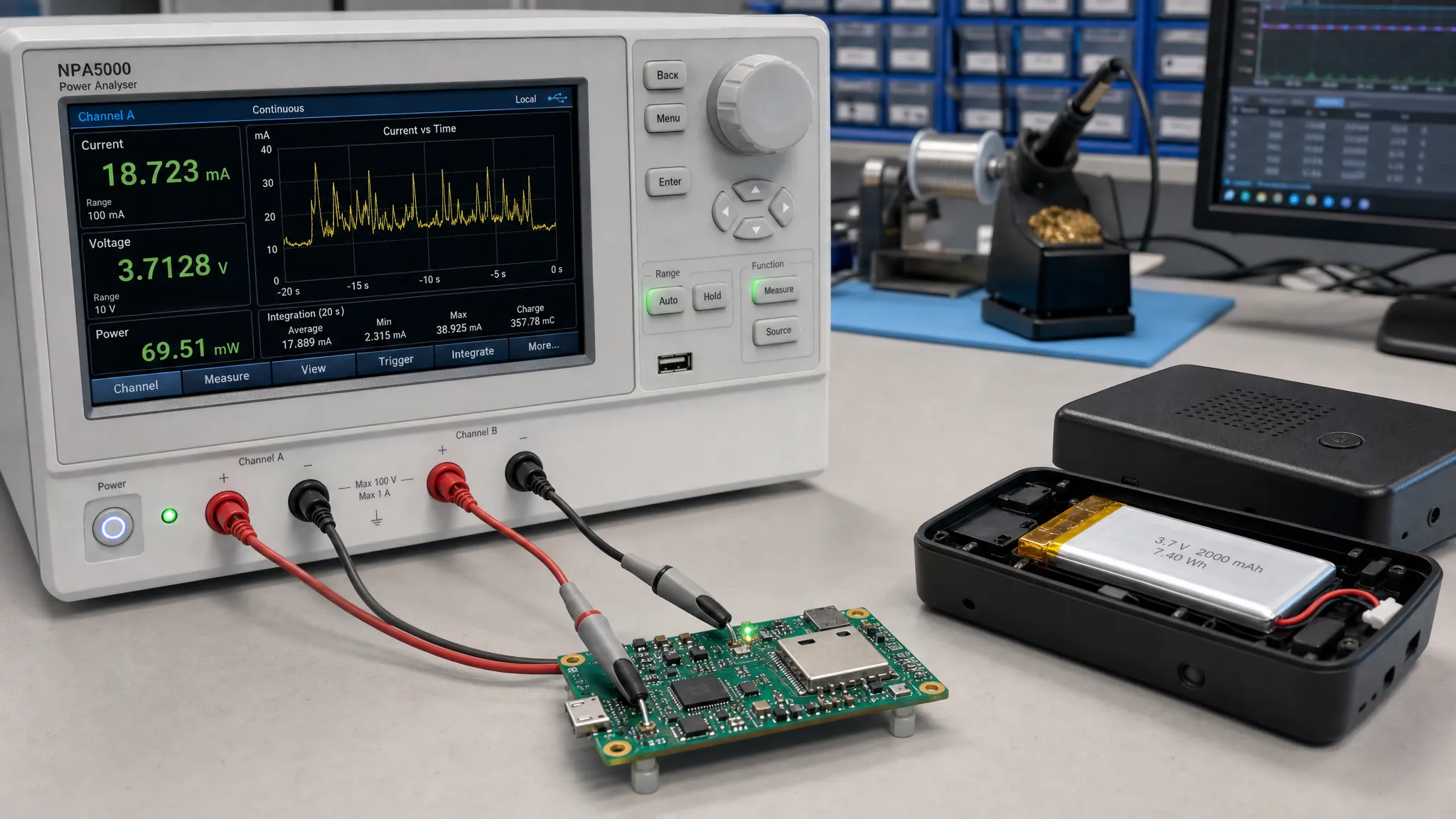
A low-power claim is only useful if it can be measured and repeated. Average current measured during a short bench test rarely tells the full story. The verification plan should include current profiles, peak events, sleep leakage, wake-up behaviour, environmental variation and production tolerances.
| Verification stage | What to measure | Why it reduces risk |
|---|---|---|
| Concept prototype | Main power modes and peak current events | Confirms that the architecture can meet the energy target |
| Engineering prototype | Rail-level current, wake-up timing and communication energy | Identifies inefficient subsystems before layout and firmware freeze |
| Pre-compliance build | EMC behaviour during active, sleep and transition modes | Reveals emissions or immunity issues linked to power behaviour |
| Pilot production | Unit-to-unit variation and standby leakage | Checks manufacturability and component tolerance effects |
| Field trial | Real duty cycle, battery life and fault recovery | Validates assumptions against user behaviour and environment |
Measurement equipment should capture both long-duration trends and short transients. A product that consumes microamps in sleep may still experience amp-level pulses during radio transmission, motor start-up or capacitor charging. Both extremes matter.
Environmental testing is also important. Temperature can change battery impedance, oscillator behaviour, leakage current and sensor response. Vibration and moisture can affect connectors, seals and mechanical stress. In demanding sectors such as maritime, defence, robotics and machine manufacturing, these conditions should be considered early enough to influence design choices.
Common low-power design mistakes that create late-stage problems
Many low-power problems are not caused by a lack of effort. They are caused by optimisation in the wrong place. Teams may spend time reducing microcontroller sleep current while overlooking a regulator with high quiescent current, a pull-up network that is always active, or a communication module that remains registered on the network longer than expected.
Another frequent issue is designing for nominal conditions only. A product may meet its power target at room temperature with a new battery, then fail to meet service-life expectations in cold conditions, with aged cells or when signal strength is poor.
Late firmware integration can also create problems. If low-power modes are added after the main functionality is working, the architecture may not support clean transitions. Developers may then rely on partial shutdowns, timing workarounds or undocumented dependencies, which can reduce maintainability.
Manufacturing readiness is often underestimated. Test fixtures, programming procedures and end-of-line checks should be able to verify power behaviour. If standby current is critical, production testing needs a practical way to detect leakage, assembly faults or incorrect component variants.
Finally, lifecycle management should not be ignored. A low-power design that depends on a specialised component with uncertain availability can create long-term supply risk. For professional products expected to remain in use for years, component availability, second sources and redesign paths should be part of the decision process.
How to approach low-power embedded system design in a structured way
A structured development process helps avoid fragmented decisions. It also makes trade-offs visible to stakeholders who may not be involved in the day-to-day engineering work.
A practical approach typically includes:
- Defining the operating profile and energy budget before detailed design
- Selecting architecture based on workload, environment, lifecycle and compliance needs
- Designing power domains, regulators and analogue circuits as part of one system
- Building firmware state models early, not as an afterthought
- Measuring current profiles across realistic operating modes and environments
- Reviewing EMC, RED, CE and safety implications throughout development
- Preparing production tests that can verify critical power behaviours
This does not mean every product needs the same level of complexity. A compact industrial controller, a connected sensor platform and a battery-powered medical accessory will have different requirements. The principle is that low-power behaviour should be engineered, measured and maintained, not assumed.
Frequently asked questions
What is low-power embedded system design? Low-power embedded system design is the process of creating embedded electronics and firmware that minimise energy consumption while maintaining reliable function, safety, communication, sensing and lifecycle requirements. It includes hardware architecture, firmware states, power supply design, PCB layout and verification.
Is low power only important for battery-powered products? No. Battery life is a common driver, but low power also matters in mains-powered equipment where heat, enclosure size, standby consumption, EMC behaviour, reliability and energy regulations are relevant.
When should low-power requirements be defined? They should be defined at the start of the development process. Early requirements help guide processor selection, power architecture, firmware structure, enclosure constraints and verification planning. Adding low-power behaviour late often creates compromises.
How does low-power design affect EMC? Low-power design affects EMC through regulator selection, switching behaviour, clock activity, PCB layout, grounding, wake-up events and communication timing. Lower average current does not automatically mean lower emissions, so EMC should be considered throughout the design.
Can a prototype prove the final battery life of a product? A prototype can provide useful evidence, but final battery life depends on firmware maturity, component tolerances, environmental conditions, production variation and real user behaviour. Field trials and production-level verification are often needed for confidence.
Building reliable low-power products with the right engineering partner
Low-power embedded system design is most effective when it is integrated into the complete product development process. The best results come from aligning embedded software, electronics, power architecture, analogue design, PCB layout, enclosure constraints, compliance thinking and manufacturing preparation.
For companies developing professional products, the value is not just lower current consumption. It is fewer hidden risks, more predictable field behaviour and a clearer path from concept to production-ready electronics.
ProMicro supports electronic product development from early concept through prototyping and volume manufacturing support, with expertise in embedded systems, power electronics, analogue electronics, PCB design and system engineering. If your product needs reliable low-power behaviour in demanding real-world conditions, ProMicro can help turn the technical requirements into a robust, scalable design approach.