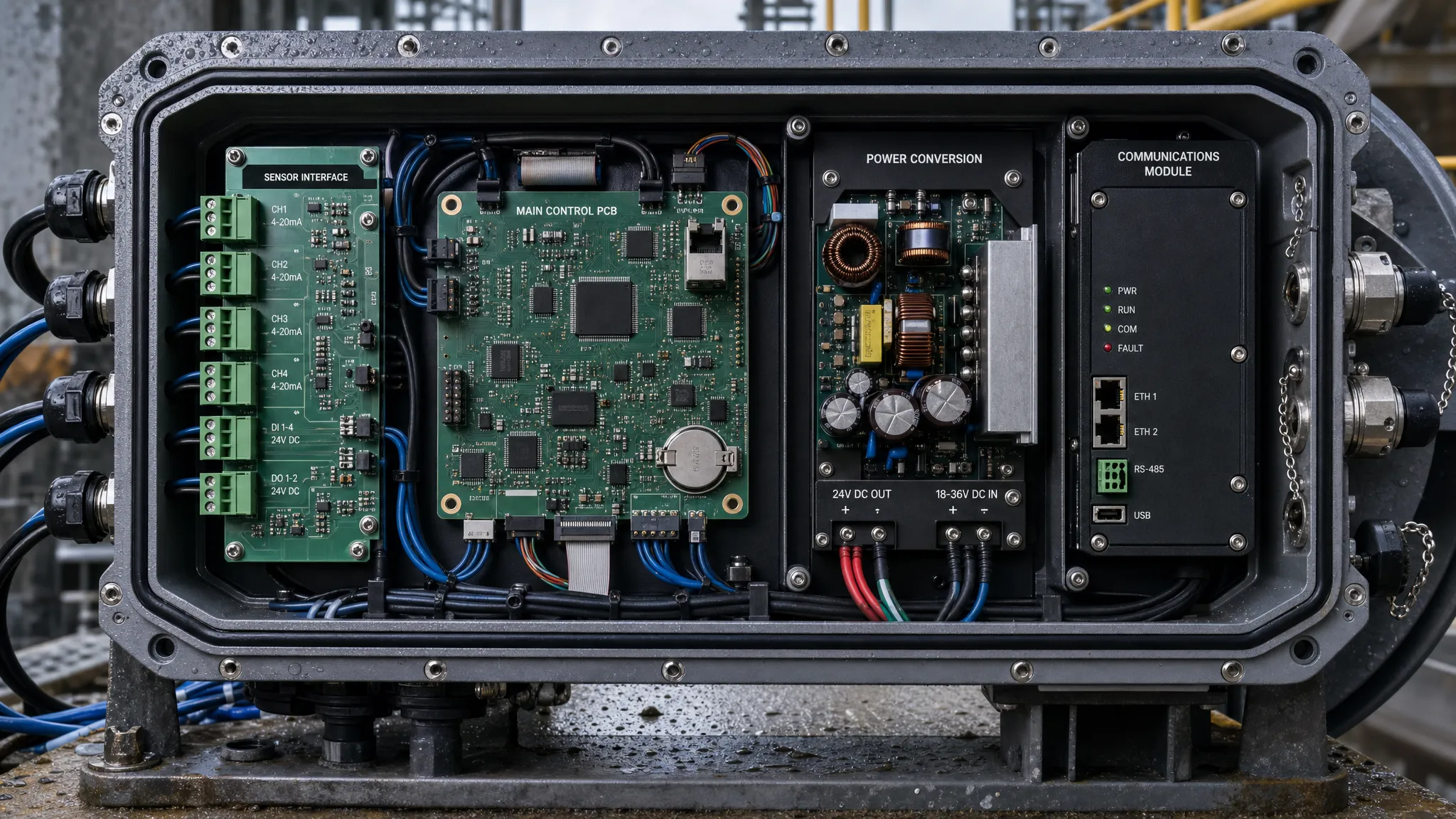
Embedded hardware is often described too narrowly. In many product discussions it becomes shorthand for “the PCB” or “the processor board”. In a complete professional design, however, embedded hardware includes every physical electronic element that allows a product to sense, process, communicate, control, protect itself and survive in its intended environment.
For OEMs, machine builders, robotics companies, maritime suppliers, defence contractors and high-tech product teams, that distinction matters. A prototype can appear to work with a development board, a few cables and a power supply on the bench. A production-ready embedded product must perform reliably under electrical noise, temperature variation, vibration, moisture, user misuse, manufacturing tolerances and long-term component availability constraints.
This article explains what embedded hardware includes in a complete design, why each layer matters and where hidden risks often appear when hardware is treated as a small task rather than a system-level responsibility.
What is embedded hardware?
Embedded hardware is the physical electronics inside an embedded system. It includes the processor or controller, memory, power supply, analogue interfaces, sensors, communication circuits, actuator drivers, connectors, PCB, protection components and the supporting design choices that allow embedded software to run safely and reliably.
In practice, embedded hardware is not isolated from software, mechanics or compliance. The hardware defines what the firmware can measure, how fast it can respond, how much power the product consumes, which faults can be detected, how the device behaves during disturbances and whether the product can be manufactured and serviced consistently.
A complete embedded hardware design therefore answers more than “which microcontroller should we use?” It answers questions such as:
- What must the product do in normal and abnormal conditions?
- Which sensors, loads, motors, valves or communication interfaces must be supported?
- What electrical disturbances, EMC risks and safety constraints are present?
- How will the electronics fit into the enclosure, cabling and thermal environment?
- How will the product be tested, programmed, calibrated and manufactured at scale?
- What happens when components reach end of life or production volumes increase?
For technical directors and development managers, this broader view is essential. It helps prevent a common development failure: building hardware that demonstrates a function, but cannot become a robust product without expensive redesign.
Why a complete embedded hardware design is more than a PCB
PCB design is a critical part of embedded hardware, but it is not the whole design. A PCB is the integration platform where processing, power, analogue, communication and protection choices become real. If the surrounding architecture is weak, even a neatly routed PCB can suffer from noise problems, thermal stress, unreliable measurements or certification delays.
A complete design starts with the intended application. A sensor node in a maritime environment, a motor controller in a robot, a secure communication unit in defence equipment and a connected consumer product may all use microcontrollers and PCBs. Yet their hardware requirements can be completely different because their operating conditions, risks and lifecycle expectations differ.
This is where context becomes part of engineering. Other fields also show how the environment shapes the final result. For example, Stories by DJ plans Mediterranean elopements around location, movement, weather and narrative rather than the camera alone. Embedded hardware follows a similar principle: the processor or PCB is only one element, while the real design is shaped by the full use case.
In professional electronics, ignoring that use case often leads to prototypes that behave correctly in a controlled test setup but fail when exposed to real loads, noisy cables, voltage dips, incorrect installation or production variation.
The main building blocks of embedded hardware
Every embedded product is different, but most complete designs contain several recurring hardware layers. The exact implementation depends on performance, cost, compliance, lifecycle and manufacturing requirements.
Processing and memory
The processing section is the decision-making core of the embedded hardware. It may be based on a microcontroller, microprocessor, system on chip, FPGA, compute module or a combination of devices.
A microcontroller is often suitable for real-time control, sensing, low power operation and deterministic behaviour. A microprocessor or compute module may be needed for higher-level functions such as image processing, Linux-based applications, advanced connectivity or local data processing. FPGAs can be appropriate for fast parallel processing, precise timing or specialised interfaces.
The hardware design must also include the right memory architecture. This can involve internal flash, external flash, RAM, EEPROM, removable storage or non-volatile memory for calibration data, logs and configuration. Memory choices affect boot behaviour, update strategy, data integrity, cybersecurity options and long-term availability.
Power supply and power electronics
Power is one of the most underestimated parts of embedded hardware. A product may need to convert, regulate, isolate, filter, monitor and protect multiple voltage rails. It may also need to drive motors, actuators, heaters, pumps, relays or high-current loads.
A complete power design considers input voltage range, inrush current, brownouts, reverse polarity, load dumps, short circuits, battery behaviour, efficiency, thermal dissipation and fault recovery. In high-power or motor-driven products, switching behaviour, parasitic effects, layout and grounding are central to reliability and EMC performance.
Power integrity is also important for digital and analogue performance. A processor that resets during a transient, an ADC that receives a noisy reference voltage or a wireless module that draws peak current beyond the regulator margin can all cause intermittent failures that are difficult to reproduce.
Analogue electronics and signal conditioning
Many embedded systems interact with the physical world through analogue signals. Sensors may measure current, pressure, temperature, vibration, position, force, light, humidity or chemical properties. These signals often need amplification, filtering, protection, isolation or level shifting before they reach an ADC or processor.
Analogue hardware choices strongly influence measurement accuracy and repeatability. Component tolerances, offset, drift, noise, grounding, shielding and PCB layout can matter as much as the selected sensor. In demanding products, calibration strategy and diagnostics should be considered during hardware design rather than added at the end.
For products that combine power electronics and precision sensing, separation between noisy and sensitive domains is critical. A motor drive placed too close to a low-level analogue front end can create disturbances that are not visible in early functional tests but appear during EMC testing or field operation.
Communication and connectivity
Embedded hardware usually needs to communicate with other devices, machines, cloud platforms, user interfaces or service tools. This can involve wired interfaces such as CAN, RS-485, Ethernet, USB, SPI, I2C and UART, or wireless technologies such as Bluetooth, Wi-Fi, cellular, LoRa or other radio systems.
Connectivity hardware includes transceivers, impedance control, isolation, ESD protection, antennas, RF layout, connectors and cable strategy. For wireless products, antenna placement, enclosure material and radio coexistence can determine whether a design performs reliably in the field.
Where radio communication is involved, compliance considerations such as RED in Europe should be part of the architecture from the beginning. Using a pre-certified module can reduce effort, but it does not remove all integration risks. The final product still depends on antenna implementation, power supply quality, enclosure effects and software behaviour.
Inputs, outputs and actuator control
Embedded hardware often controls real loads. These may include motors, solenoids, valves, LEDs, displays, relays, braking systems, pumps or heating elements. Output stages must be designed for the actual load profile, not only the nominal current.
Inductive loads can generate voltage spikes. Motors can create high inrush currents and EMC noise. Long cables can act as antennas. Mechanical switching can introduce contact bounce and transients. A complete hardware design includes protection, diagnostics and fault handling so that the product behaves predictably when something goes wrong.
The same applies to inputs. User buttons, limit switches, encoders, safety interlocks and external signals need debouncing, filtering, protection and clear electrical definitions. Floating inputs or poorly protected connectors are common causes of unpredictable behaviour outside the lab.
| Hardware area | Typical elements | Key design risk if ignored |
|---|---|---|
| Processing | MCU, MPU, FPGA, SoC, compute module, memory | Insufficient performance, poor lifecycle fit or difficult firmware integration |
| Power | DC-DC converters, regulators, protection, isolation, motor drives | Resets, overheating, EMC issues or unsafe fault behaviour |
| Analogue | Sensors, ADCs, filters, amplifiers, references | Inaccurate measurements, noise sensitivity or calibration problems |
| Communication | Ethernet, CAN, USB, RS-485, RF modules, antennas | Data errors, poor range, interface damage or compliance delays |
| PCB and interconnect | Layer stack, routing, grounding, connectors, cables | Signal integrity, manufacturability or field reliability problems |
| Test and lifecycle | Test points, programming, diagnostics, component strategy | Slow production, poor traceability or redesign due to obsolete parts |
The PCB as the integration platform
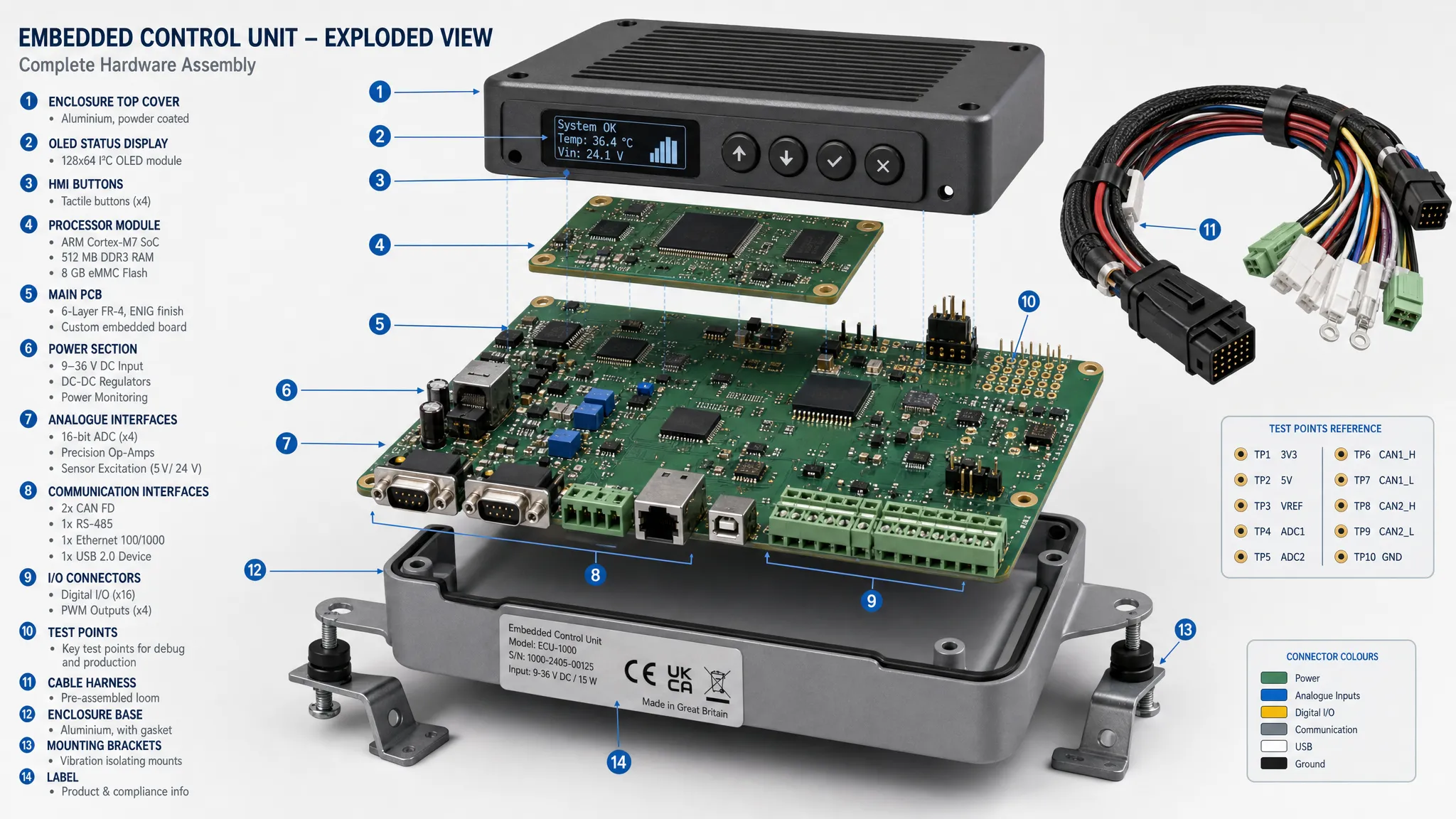
The PCB turns the hardware architecture into a manufacturable electronic assembly. It defines how signals, power, heat and electromagnetic energy move through the product. This makes PCB layout a core engineering activity, not a drafting step.
A complete PCB design considers layer stack-up, grounding strategy, current paths, impedance control, creepage and clearance, thermal relief, component placement, connector orientation, mechanical mounting, test access and manufacturing constraints. It also considers how the board will be assembled, inspected, programmed and repaired.
For embedded products with mixed signal electronics, the layout must balance digital processing, analogue measurement and power switching. Return currents, decoupling placement, reference planes and separation between noisy and sensitive circuits directly affect EMC and functional stability.
Good PCB design also supports scalability. If a prototype board is designed without test points, panelisation strategy, clear documentation or component alternatives, the move to volume manufacturing becomes harder. The earlier these details are considered, the fewer surprises appear during industrialisation.
Enclosure, cabling and mechanical integration
Embedded hardware does not operate in free air. It sits inside an enclosure, connects to cables, interfaces with users or machines and may be exposed to vibration, moisture, dust, salt, impact or temperature extremes.
Mechanical integration can influence electrical performance significantly. Enclosure material affects shielding and antenna behaviour. Cable routing affects EMC. Connector choice affects ingress protection, serviceability and vibration resistance. Heat paths determine whether components remain within their operating limits.
This is why enclosure design and electronics design should not be separated too late in the process. A PCB that works on the bench may need major changes if the enclosure blocks airflow, detunes an antenna, forces poor connector placement or leaves insufficient clearance for high-voltage areas.
For maritime, defence, automotive, robotics and machine manufacturing applications, these physical realities are not secondary details. They are part of the embedded hardware design because they determine whether the electronics can survive real use.
Hardware support for firmware, diagnostics and updates
Although embedded hardware is physical, it must be designed with firmware needs in mind. Firmware teams need reliable access to programming, debugging, timing references, reset control, boot modes, logs and diagnostics. If these are missing, development and production testing can become unnecessarily slow or risky.
Useful hardware provisions can include programming connectors, debug headers, watchdog circuits, reset supervisors, status LEDs, test pads, configuration memory, measurement points and safe boot mechanisms. In connected products, the hardware may also need to support secure updates, cryptographic functions or protected storage, depending on the risk profile.
Diagnostics are especially important in professional products. A machine controller, power stage or connected device should not only fail silently. It should help detect undervoltage, overtemperature, communication loss, sensor faults or abnormal load behaviour where relevant. Some of this is firmware, but the firmware can only monitor what the hardware makes measurable.
This hardware and firmware co-design approach reduces troubleshooting time, improves serviceability and supports a more controlled route to production.
EMC, safety and compliance-minded hardware choices
Compliance is not something that can be added after the hardware is finished. EMC, safety and radio performance are influenced by early architecture decisions, including power topology, PCB layout, grounding, shielding, cable interfaces, enclosure design and firmware behaviour.
Designing with compliance in mind does not guarantee a successful certification result, because testing depends on the final product, standards and use case. It does reduce avoidable risk. For example, filtering and surge protection are easier to include early than to retrofit after a failed test. The same applies to separation distances, protective earth strategy, isolation barriers, antenna placement and cable shielding.
For products that require CE marking, EMC testing, RED assessment or safety-related design measures, the hardware should be evaluated against the intended regulatory route as early as possible. ProMicro has written separately about what EMC means for electronic product design and why late EMC discovery can create redesigns and project delays.
In complex embedded products, compliance-minded design is not only about passing tests. It is also about reducing liability, improving field reliability and making the product easier to maintain over its lifecycle.
Production readiness and lifecycle management
A complete embedded hardware design includes the decisions needed to build the product consistently, not just once. This includes component selection, bill of materials control, manufacturing documentation, assembly tolerances, inspection strategy, test fixtures, calibration procedures and traceability.
Production readiness should be considered during architecture and PCB design. If a product requires manual tuning, inaccessible test points or rare components with poor availability, scaling production becomes difficult. If programming and testing are not integrated into the design, each unit may require excessive handling or specialist knowledge.
Lifecycle management is equally important. Many professional products remain in service for years. During that time, components may become obsolete, suppliers may change specifications, standards may evolve and customers may request product variants. A design that includes second-source thinking, modularity and documentation is easier to sustain.
For OEMs, this is a business issue as much as an engineering issue. Hardware decisions influence warranty risk, service cost, production continuity and the ability to create future product versions.
A practical checklist for complete embedded hardware design
Before committing to detailed design, product teams should verify that the hardware scope covers the full system. The following checklist can help expose missing requirements and hidden risks.
| Design question | Why it matters |
|---|---|
| What is the full operating environment? | Temperature, moisture, vibration and electrical noise affect component choice and protection. |
| What are the normal and fault load conditions? | Motors, cables and inductive loads can create transients, heat and EMC risks. |
| Which standards or compliance routes are likely? | EMC, RED, CE and safety considerations influence architecture from day one. |
| How will firmware be developed and debugged? | Programming access, logs and diagnostics must be supported by hardware. |
| How will each unit be tested in production? | Test points, fixtures and calibration features reduce manufacturing risk. |
| What is the expected product lifetime? | Component availability and lifecycle planning prevent future redesign pressure. |
| How will the enclosure and cabling affect performance? | Mechanical integration changes thermal, EMC and RF behaviour. |
This kind of review is valuable even when internal teams have strong electronics expertise. It creates a shared understanding between product owners, hardware engineers, firmware developers, mechanical engineers and manufacturing partners.
How ProMicro approaches embedded hardware as part of a complete system
ProMicro supports embedded hardware development as part of a broader electronic product design process. That means looking beyond the immediate schematic or PCB task and considering the complete path from idea to prototype, compliance preparation, manufacturability and volume support.
This integrated approach is especially useful when products combine several demanding disciplines, such as embedded processing, power electronics, analogue measurement, sensors, wireless communication, motor drives and enclosure integration. In these projects, hidden risks often sit at the boundaries between disciplines.
A power stage may disturb a sensor. A cable may create an EMC issue. A mechanical constraint may affect thermal performance. A component choice may look attractive in a prototype but create lifecycle problems later. By addressing these interactions early, development teams can reduce iterations and build hardware that is more suitable for real-world use.
For companies with limited internal capacity or specialist knowledge gaps, an external electronics design partner can also provide structured support without taking ownership away from the product team. The customer remains responsible for product vision and market priorities, while the engineering partner helps translate those goals into reliable embedded hardware and production-ready electronics.
Frequently asked questions
What is embedded hardware in simple terms? Embedded hardware is the physical electronics inside a product that allow embedded software to sense, process, communicate and control. It includes the processor, PCB, memory, power supply, analogue circuits, interfaces, protection, connectors and supporting test features.
Is embedded hardware the same as PCB design? No. PCB design is one important part of embedded hardware, but a complete design also includes architecture, component selection, power electronics, analogue design, communication interfaces, enclosure integration, testability, compliance considerations and lifecycle planning.
What should be defined before starting embedded hardware development? Teams should define the product function, operating environment, power requirements, loads, sensors, interfaces, compliance expectations, enclosure constraints, production volume, service needs and expected product lifetime. These requirements strongly influence architecture and risk.
How does embedded hardware affect EMC and CE compliance? EMC and CE-related risks are shaped by hardware choices such as power topology, PCB layout, grounding, filtering, shielding, cabling, enclosure design and radio integration. Considering these factors early helps reduce the chance of late redesigns, although final compliance depends on the complete tested product.
When should an OEM involve an external embedded hardware partner? An external partner is useful when the product involves specialist power, analogue, connectivity, EMC, safety, manufacturability or lifecycle challenges, or when internal teams lack capacity. Early involvement is usually most valuable because architecture decisions have the greatest impact on later reliability and cost.
Turning embedded hardware into a reliable product
Complete embedded hardware design is about much more than selecting a processor or laying out a PCB. It is the disciplined integration of processing, power, analogue electronics, communication, protection, mechanics, firmware support, testability, compliance awareness and lifecycle planning.
For professional products, that system-level view is what separates a promising prototype from electronics that can be manufactured, certified, maintained and trusted in the field.
If your team is developing an embedded product and wants to reduce technical risk from the first architecture decisions through to production readiness, ProMicro can support the process with embedded system development, power electronics expertise, analogue design, PCB design, prototyping and volume manufacturing support.