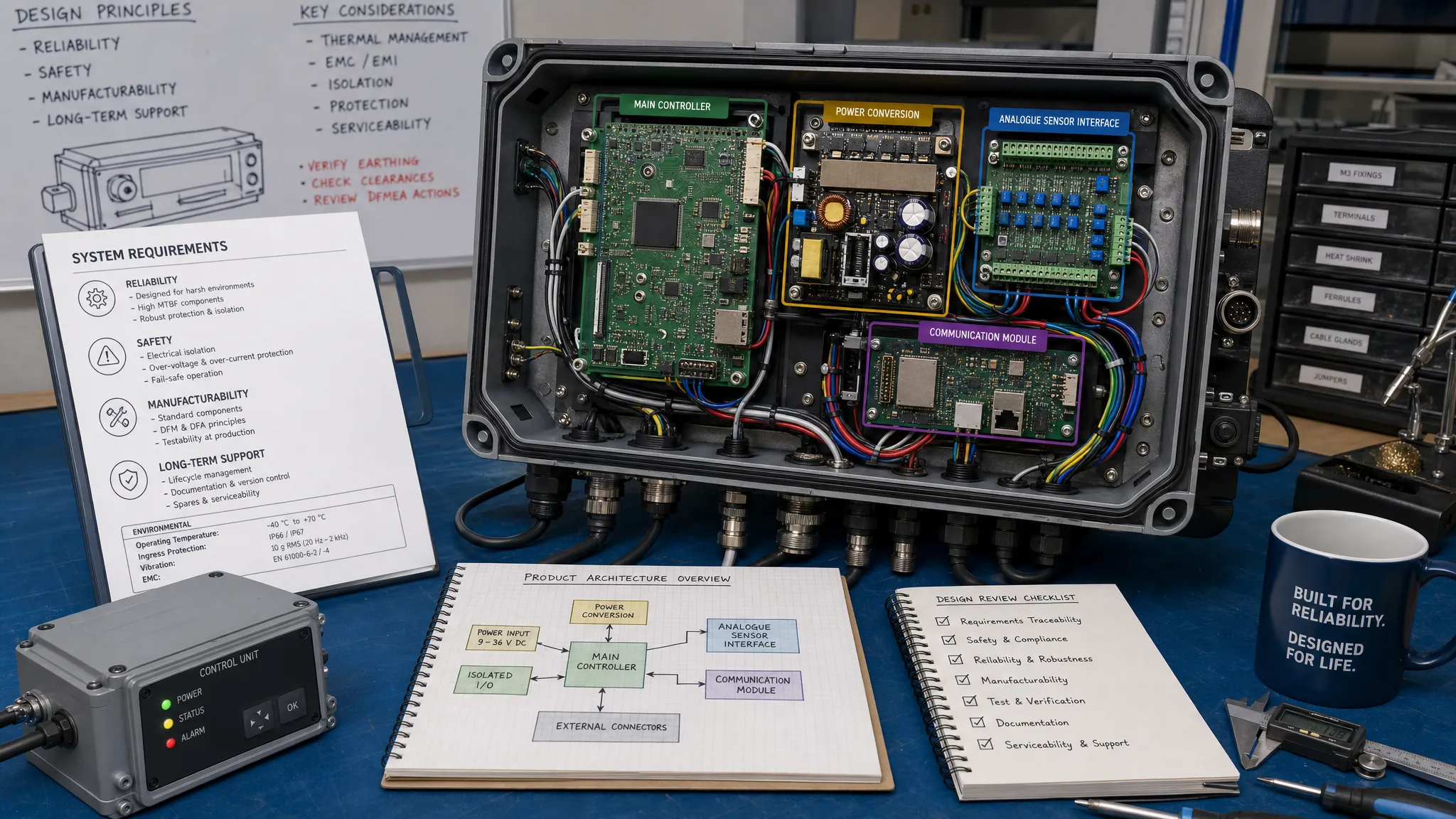
Embedded electronics is where an OEM’s product idea becomes controlled, reliable physical behaviour. It is the part of the product that senses, decides, drives, communicates, protects and records, often inside equipment that must work for years in demanding environments.
For an Original Equipment Manufacturer (OEM), that makes embedded electronics much more than a technical detail. It influences product architecture, user experience, safety, power consumption, EMC behaviour, serviceability, manufacturing cost and long-term maintainability. A prototype may prove that an idea works, but embedded electronics determines whether the product can be produced, certified, supported and trusted in the field.
This is why the question “what is embedded electronics?” matters for product design teams. The answer is not simply “a PCB with software”. In modern OEM products, embedded electronics is an integrated design discipline that connects hardware, firmware, power electronics, analogue electronics, mechanical integration and lifecycle thinking.
What is embedded electronics in an OEM product?
Embedded electronics refers to the electronic hardware and software built into a product to perform dedicated functions. Unlike a general-purpose computer, it is designed for a specific task within a larger machine, device or system.
In a professional product, embedded electronics can include microcontrollers or processors, sensors, analogue front-ends, motor drivers, power supplies, communication interfaces, memory, safety circuits, firmware, diagnostic functions and PCB layout. It may also include wireless connectivity, data logging, user interfaces and test points for manufacturing or service.
A motor controller in a robotic joint, a battery management system in an electric vehicle, a sensor module in maritime equipment, a control board in a machine tool and a connected medical device all rely on embedded electronics. The technology may be hidden from the user, but it defines much of the product’s behaviour.
There is a close relationship between embedded electronics and embedded systems. If you want a broader explanation of the complete system context, ProMicro’s article on what an embedded system means in real products explains how sensors, processing, firmware, power and interfaces work together inside real applications.
Why embedded electronics changes the way OEMs should design products
OEM product development often starts with a functional ambition: measure something, move something, connect something, automate a process or make a machine easier to operate. Embedded electronics translates that ambition into repeatable behaviour under real-world conditions.
That translation is rarely straightforward. A product may need to deal with vibration, temperature variation, moisture, electrical noise, cable length, operator errors, supply voltage changes or limited space inside an enclosure. It may also need to comply with EMC, RED, CE marking, safety or sector-specific requirements.
When embedded electronics is treated as a late-stage implementation task, design teams often discover problems too late. The PCB does not fit the enclosure. A radio module creates EMC concerns. A sensor signal is too noisy in the field. A motor drive causes disturbances elsewhere in the machine. A component becomes unavailable before the product reaches volume production.
The alternative is to treat embedded electronics as a core product design discipline from the beginning. That means defining not only what the product must do, but also how it will behave when conditions are imperfect.
| Design area | Key OEM question | Risk if left too late |
|---|---|---|
| System architecture | Which functions belong in hardware, firmware, mechanics or the cloud? | Expensive redesign when performance or reliability is insufficient |
| Power electronics | How will power be converted, protected and managed? | Heat, instability, electrical stress or poor efficiency |
| Analogue electronics | How will weak or noisy signals be measured accurately? | Unreliable sensor data and inconsistent product behaviour |
| PCB layout | How will signal integrity, grounding, creepage, clearance and EMC be handled? | Certification delays, interference or production issues |
| Firmware | How will the product handle normal, abnormal and failure modes? | Unpredictable behaviour, difficult debugging or safety concerns |
| Enclosure integration | How will electronics fit, cool and survive the environment? | Thermal problems, moisture ingress or assembly difficulties |
| Manufacturing readiness | How will the product be tested, assembled and scaled? | Slow ramp-up, unclear quality control or high rework rates |
| Lifecycle support | How will components, updates and maintenance be managed? | Obsolescence risks and avoidable service costs |
Embedded electronics turns requirements into controlled behaviour
Good embedded electronics design starts before schematics and PCB layout. It starts with the product requirements, the operating environment and the use cases that may not be obvious at first.
For example, a machine manufacturer may specify that a controller must drive a motor at a certain speed and torque. That is only the visible requirement. The embedded design team also needs to understand start-up conditions, braking behaviour, overload situations, cable routing, operator interaction, emergency stops, maintenance access, thermal limits and how the system should fail safely.
In automotive, maritime, defence and high-tech equipment, hidden requirements often matter as much as explicit requirements. A product can pass a basic functional test and still be unsuitable for its application if it is sensitive to electromagnetic interference, difficult to diagnose, hard to manufacture or dependent on components with poor long-term availability.
This is why early definition is so important. Before committing to a design path, OEMs benefit from clarifying product goals, interfaces, environmental constraints, power requirements, analogue signals, communication needs and expected production volumes. ProMicro covers these early decisions in more detail in its guide to what OEMs should define before starting custom electronics design.
Hardware, firmware and enclosure design are connected
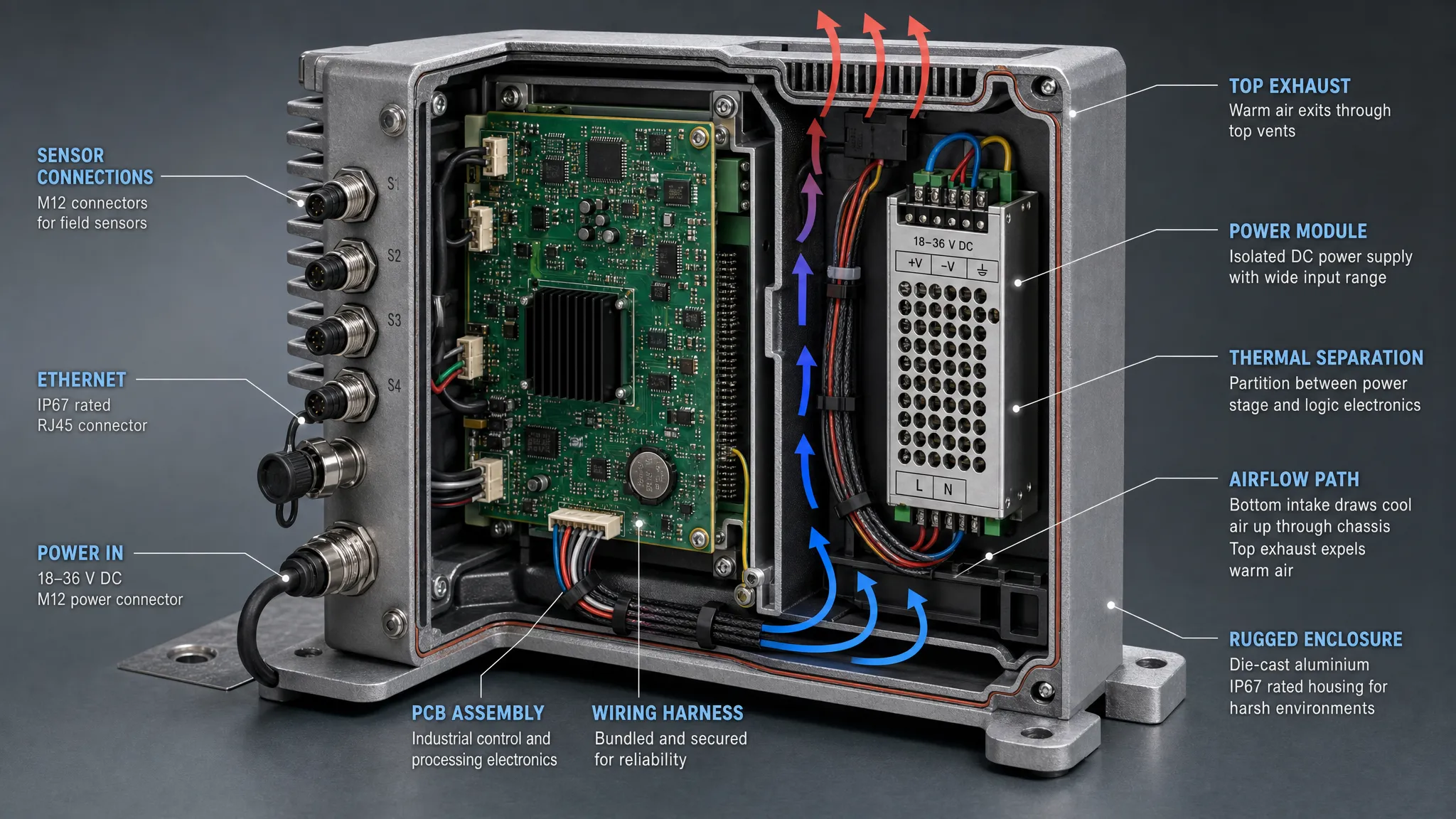
One of the most common product development risks is separating electronics, software and mechanical design too much. Embedded electronics does not operate in isolation. It sits inside a physical product, connected to power sources, actuators, sensors, cables, housings and users.
A firmware decision can affect hardware requirements. A power supply choice can affect enclosure temperature. A PCB layout decision can affect EMC performance. A connector position can affect assembly time and serviceability. A wireless antenna location can influence range and compliance testing.
This is especially important in products that combine high current, precision measurement and communication. Think of motor drives, battery systems, connected industrial sensors, automated machinery or high-power digital equipment. The same principle applies to specialised sectors such as ASIC mining infrastructure, where reliable operation depends on power conversion, thermal management, control electronics, diagnostics and maintainability, not only on processing performance.
For OEMs, the lesson is clear: embedded electronics should be developed with the complete product in mind. A board that works on a desk is not yet a production-ready embedded solution. It must also fit the enclosure, survive the environment, support compliance, be manufacturable and remain serviceable throughout the product lifecycle.
This integrated approach is particularly relevant when a product includes sensors, wireless communication, motor control, printed electronics, IoT connectivity or safety-related functions. Each discipline has its own constraints, but the final product only succeeds when those constraints are resolved together.
Designing with EMC, safety and compliance in mind
Compliance should not be treated as a final check after the product is already designed. For embedded electronics, many compliance-related risks are created by early architecture choices, component selection, grounding strategy, PCB layout, cable interfaces, power conversion and enclosure design.
EMC is a typical example. A product may generate disturbances through switching power supplies, fast digital edges, motor drives, long cables or poor return paths. It may also need to tolerate disturbances from nearby equipment, especially in industrial, maritime, automotive or defence environments.
Wireless products add another layer of consideration. If radio communication is part of the design, RED-related requirements and antenna integration need attention from the start. In practice, the mechanical enclosure, PCB layout, firmware behaviour and power system may all affect radio performance.
Safety also depends on system-level thinking. Protective functions, isolation distances, thermal behaviour, fault detection and software responses must align with the intended use and risk profile. Good design cannot guarantee certification outcomes, but it can reduce avoidable risks and improve the likelihood that testing becomes a confirmation process rather than a redesign trigger.
ProMicro discusses this relationship in its article on how embedded design decisions influence EMC, safety and lifecycle, including why architecture, PCB layout, firmware and power design should be considered together.
From prototype to volume manufacturing
A working prototype is an important milestone, but it is not the same as a product that is ready for production. Embedded electronics for OEM product design must also support assembly, testing, supply chain stability, quality control and long-term service.
During prototyping, the priority is often to validate the core function. During industrialisation, the questions become broader. Can the PCB be produced consistently? Are components available for the expected lifecycle? Is the design testable in production? Can firmware be programmed and verified efficiently? Can service teams diagnose faults? Is the enclosure practical to assemble without damaging cables, connectors or thermal interfaces?
These questions affect both cost and reliability. A product that is difficult to test may allow faults to escape into the field. A product with poor diagnostic capability may increase service time. A design based on risky components may face redesign pressure after launch.
For OEMs, embedded electronics should therefore be developed with manufacturing readiness in mind. This does not mean overengineering every product. It means making conscious decisions about tolerances, test access, component strategy, documentation, firmware update paths and production support.
When OEMs should involve an embedded electronics partner
Many OEMs have strong internal engineering teams, but not every team has enough capacity or specialist knowledge across embedded software, power electronics, analogue design, PCB layout, EMC, enclosure integration and manufacturing preparation. The complexity increases further when products combine sensing, wireless communication, motor control, connectivity and safety-related behaviour.
An external embedded electronics partner can add value when the product is technically complex, certification risk is significant, internal capacity is limited or the product must move from idea to prototype and then towards volume manufacturing. The most useful partner is not only someone who completes assigned tasks, but someone who helps identify hidden requirements and technical risks early.
For ProMicro, embedded electronics is part of a wider product development process. That can include embedded system development, power and analogue electronics, PCB design, system engineering, enclosure design, rapid prototyping, manufacturing preparation and lifecycle support. The goal is not simply to create electronics that function once, but to help OEMs develop reliable, scalable and maintainable products for real applications.
This matters because early design choices are rarely isolated. They affect certification strategy, manufacturing effort, serviceability and future product variants. A disciplined embedded electronics approach gives technical directors, CTOs, development managers and product owners a clearer route from concept to production-ready design.
Frequently asked questions
What is embedded electronics? Embedded electronics is the dedicated electronic hardware and software built into a product to control specific functions. It can include sensors, processors, firmware, power electronics, analogue circuits, communication interfaces and PCB design.
How is embedded electronics different from an embedded system? Embedded electronics usually refers to the electronic implementation inside the product, while an embedded system includes the wider functional system, including hardware, firmware, interfaces, mechanical integration and real-world behaviour.
Why is embedded electronics important for OEM product design? It affects reliability, compliance risk, manufacturability, power performance, safety, user experience and long-term serviceability. For OEMs, these factors determine whether a product can move beyond a prototype into production and field use.
When should embedded electronics be considered in the development process? It should be considered from the first product definition stage. Early decisions about architecture, power, sensors, firmware, PCB layout, enclosure and interfaces can strongly influence cost, risk and development time later.
Can an OEM outsource embedded electronics without losing control of the product? Yes, if the collaboration is structured around clear requirements, transparent design decisions, proper documentation and shared ownership of product goals. The OEM should retain strategic control while using specialist expertise to reduce technical risk.
Building better OEM products with embedded electronics
Embedded electronics is not just the technical layer inside a product. It is a major driver of product quality, reliability, compliance readiness and manufacturing success.
For OEMs developing machines, vehicles, connected devices or high-value technical equipment, the best results come from treating embedded electronics as part of system design from day one. That means looking beyond the PCB and considering power, analogue signals, firmware, enclosure, EMC, safety, testing, production and lifecycle support together.
If your organisation is developing a new product or improving an existing platform, ProMicro can support the journey from early concept and prototyping to production-ready electronics. With expertise in embedded systems, power electronics, analogue electronics, PCB design and system engineering, ProMicro helps OEM teams reduce technical risk and create products that are ready for real-world use.