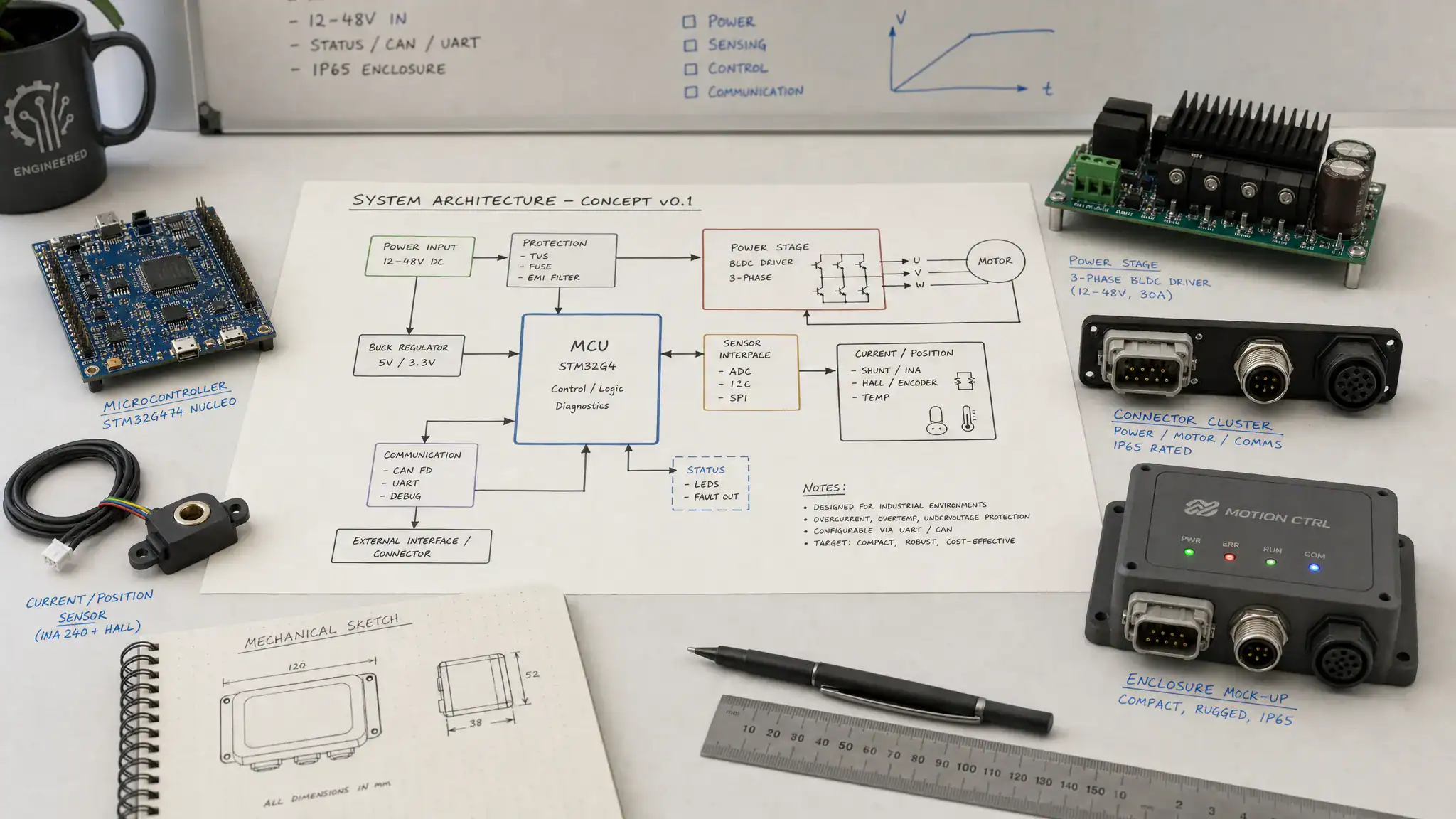
For many teams, the first answer to “what is an embedded system?” is technically correct but commercially incomplete. It is often described as a computer built into a larger product. That definition is useful, but it does not explain why embedded system decisions can determine whether a product works reliably in the field, passes compliance testing, scales into production or becomes expensive to maintain.
In real products, an embedded system is not just a processor and some firmware. It is the part of the product that senses, decides, controls, communicates and protects. It connects software behaviour to physical reality, including motors, batteries, sensors, actuators, wireless modules, user interfaces, power electronics, enclosures and harsh operating environments.
For OEMs, machine builders, robotics companies, maritime suppliers, defence technology teams and high-tech product developers, the definition matters because it shapes the development process. A prototype can often prove a concept. A well-designed embedded system must also survive noise, heat, vibration, component variation, user behaviour, manufacturing tolerances and long-term lifecycle constraints.
What is an embedded system? A practical definition
An embedded system is a dedicated combination of electronics and software, integrated into a product, machine or device to perform specific control, monitoring, communication or processing functions.
Unlike a general-purpose computer, an embedded system is designed around a defined application. It usually operates within constraints such as limited space, fixed power budgets, real-time behaviour, environmental exposure, cost targets, compliance requirements and long product lifetimes.
A practical embedded system definition should include four points:
- It is built into a larger product or machine.
- It combines hardware, firmware and often application-level software.
- It interacts with the physical world through sensors, interfaces, power stages or actuators.
- It is designed for a specific function, environment and lifecycle.
This distinction is important. A web platform, mobile app or cloud service may be central to a business process, but it does not automatically make a product embedded. For example, travel businesses may use digital services such as visa and eVisa administration APIs to simplify customer journeys, while an embedded system in a physical travel kiosk, access gate or handheld scanner would be responsible for local sensing, control, interfaces and reliable operation at the device level.
That is the key difference. Embedded systems operate where software meets hardware, and where decisions have electrical, thermal, mechanical and compliance consequences.
What an embedded system includes in a real product
In simple products, the embedded system may be a microcontroller, a few sensors and firmware. In professional products, the system is usually broader. It may include analogue measurement circuits, power conversion, motor drivers, communication interfaces, wireless modules, diagnostics, bootloaders, safety functions, production test points and mechanical integration.
| Embedded system layer | Role in the product | Typical engineering questions |
|---|---|---|
| Sensors and inputs | Measure temperature, pressure, position, current, vibration, user actions or environmental conditions | Is the signal accurate, stable and protected against noise or misuse? |
| Processing hardware | Runs control logic, communication stacks, algorithms and diagnostics | Is a microcontroller, embedded Linux module, FPGA or dedicated IC the right choice? |
| Firmware | Defines product behaviour, timing, safety states, communication and update logic | What happens during faults, power loss, unexpected inputs or version changes? |
| Power electronics | Converts, switches or regulates energy for the system and loads | Are thermal limits, transients, protection and EMC considered early enough? |
| Analogue electronics | Conditions real-world signals before digital processing | Is measurement integrity maintained across temperature, ageing and interference? |
| Connectivity | Enables wired or wireless communication with users, machines or cloud platforms | Are RED, EMC, cybersecurity and interoperability requirements relevant? |
| PCB and enclosure | Physically integrates electronics into the product | Are layout, grounding, cabling, cooling, assembly and serviceability aligned? |
| Diagnostics and test | Supports production, maintenance and fault analysis | Can the product be tested, calibrated, updated and supported over time? |
This is why embedded development cannot be reduced to “writing firmware” or “designing a PCB”. The value lies in how these layers work together as one controlled system.
Embedded systems are where product behaviour becomes real
A product specification may say that a machine must stop when a limit is exceeded, a vehicle subsystem must report a fault, a maritime device must keep communicating in a noisy environment or a motor drive must respond smoothly under changing load. The embedded system turns those requirements into measurable behaviour.
That behaviour is not only defined by code. It is influenced by component tolerances, PCB layout, grounding strategy, power supply stability, sensor placement, firmware timing, enclosure design, cable routing and the physical environment.
Consider a robot axis controller. The firmware may implement the motion logic, but reliability depends on much more than the software algorithm. The current sensing must be accurate, the motor driver must handle transients, the PCB must control switching noise, the processor must respond within timing limits and the system must enter a safe state when something unexpected happens.
The same applies to a connected industrial sensor. The embedded system must measure correctly, communicate reliably, manage power consumption, handle firmware updates, remain stable over temperature and avoid creating or suffering from electromagnetic interference.
In other words, the embedded system is the operational core of the product. If it is underdefined, the product risk remains hidden until integration, testing, certification or field use.
Examples of embedded systems in professional products
Embedded systems appear in almost every modern technical product, but their responsibilities differ widely. A consumer device may focus on user interaction and battery life, while a defence, maritime or machine manufacturing product may need robustness, traceability, controlled failure modes and long-term availability.
| Product context | Embedded system function | Risk if underestimated |
|---|---|---|
| Industrial machine | Controls actuators, reads sensors and communicates with higher-level control systems | Unstable behaviour, downtime, integration problems or difficult service diagnostics |
| Robotics platform | Manages motion, power, sensing, safety states and communication | Poor timing, thermal stress, EMC issues or unsafe fault responses |
| Maritime device | Handles sensing, communication and power management in harsh environments | Corrosion-related failures, intermittent communication or inadequate environmental protection |
| Automotive subsystem | Controls local functions and exchanges data with vehicle networks | Compliance delays, lifecycle challenges or reliability issues under temperature and vibration |
| High-tech instrument | Acquires precise signals, processes data and controls internal subsystems | Measurement drift, noise sensitivity or failure to reproduce lab performance in production |
| Connected product | Combines local control with wireless or wired connectivity | RED or EMC uncertainty, security gaps or unreliable field updates |
The visible feature may be simple, such as monitoring, controlling, switching or communicating. The engineering behind it is often complex because the embedded system has to perform the feature predictably under all relevant operating conditions.
Why the definition changes during product development
At concept level, an embedded system may be described by function: “measure pressure”, “drive a motor”, “connect to a gateway” or “control a dosing mechanism”. During development, that functional description must be translated into architecture and requirements.
This is where many product teams encounter hidden complexity. A concept that seems straightforward can require decisions about:
- Real-time performance and timing margins.
- Power consumption, start-up behaviour and brownout handling.
- Sensor accuracy, filtering and calibration.
- Motor control, switching behaviour and thermal design.
- EMC, grounding, shielding and cable interfaces.
- Firmware updates, diagnostics and service access.
- Component lifecycle, second sources and manufacturing testability.
- Enclosure constraints, sealing, cooling and mechanical stress.
These issues are not secondary details. They influence whether the product can move from prototype to certification, pilot build and volume manufacturing without major redesign.
A good embedded system definition therefore evolves from “what the product should do” into “how the product will behave, fail safely, be tested, be manufactured and be supported”.
Embedded system versus PCB, firmware and software
It is common for teams to split the work into separate tasks: electronics, PCB layout, firmware, mechanical design and application software. That can be useful for project organisation, but it can also create gaps if system ownership is unclear.
A PCB is the physical carrier for the electronics. Firmware defines behaviour on the processor. Software may provide configuration, data processing or user interaction. The embedded system is the integrated result of all these decisions inside the product.
For example, an EMC problem may appear during testing, but the root cause may involve PCB layout, switching frequency, firmware timing, cable placement, enclosure design or grounding. A power issue may look like a component failure, but it may originate from load transients, thermal derating, supply sequencing or insufficient protection.
This is why embedded system development benefits from hardware and software being designed together. The earlier the team understands the interactions, the easier it becomes to prevent late-stage surprises.
For a deeper view of risk reduction in this context, ProMicro also covers the topic in how embedded systems reduce risk in complex product development.
What makes embedded systems difficult in real products
The main challenge is not that embedded systems are always extremely complex. The challenge is that small decisions can have large consequences later.
A development board may demonstrate the basic principle, but it does not prove that the final product is ready for field conditions. Evaluation modules are designed to showcase components, not necessarily to match the exact thermal, EMC, mechanical, power and lifecycle constraints of your product.
Common reasons embedded products become harder than expected include unclear requirements, underestimated environmental conditions, insufficient power integrity, incomplete fault handling, late compliance thinking and poor separation between prototype decisions and production architecture.
This is particularly relevant for companies under pressure to launch quickly. Speed is important, but skipping early architecture work often moves risk to the most expensive phase: compliance testing, pilot production or customer deployment.
A more robust approach is to define the operating context early. That includes not only the intended function, but also the conditions in which the product must remain safe, reliable and maintainable.
From embedded system definition to production-ready design
Turning an embedded system concept into a reliable product usually requires a structured development path. The exact process depends on the product, but the following phases are common in professional electronics development.
- Requirements and context definition: Define what the product must do, where it will operate, which interfaces it needs, which standards may apply and what risks must be controlled.
- System architecture: Select processing architecture, power structure, communication interfaces, sensor approach, firmware architecture and mechanical integration principles.
- Hardware and firmware co-design: Develop schematics, PCB design, firmware functions and test strategy with attention to timing, EMC, safety, diagnostics and manufacturability.
- Prototype and integration testing: Validate the design against realistic loads, environmental conditions, interfaces and user scenarios, not only ideal laboratory conditions.
- Pre-compliance and design refinement: Identify EMC, RED, safety or reliability issues early enough to make controlled improvements before formal certification steps.
- Manufacturing preparation: Prepare documentation, test procedures, component strategy and production support so the design can scale beyond the first working units.
- Lifecycle management: Plan for component availability, firmware updates, service diagnostics, design changes and long-term product support.
This path helps keep the product definition connected to engineering reality. It also gives technical directors and product owners better visibility into risk, cost and timing.
Questions decision-makers should ask early
A useful embedded system discussion starts before the schematic is drawn. Decision-makers do not need to specify every component, but they should ensure the right technical questions are being asked.
Important early questions include:
- What physical quantities must the product sense, control or protect?
- What are the real operating conditions, including worst-case power, temperature, vibration, moisture and electromagnetic environment?
- Which communication interfaces, wired or wireless, are required now and in future product variants?
- Which compliance routes may apply, including EMC, CE marking and RED where radio equipment is involved?
- What behaviour is required during faults, power interruptions, overloads or communication loss?
- How will the product be tested during production and serviced during its lifetime?
- Which components have lifecycle, supply chain or second-source risks?
These questions reduce ambiguity. They also help reveal whether a product requires a simple embedded controller, a more advanced embedded computing platform, custom power electronics, analogue measurement design or a full system-level development approach.
When an external embedded systems partner adds value
Many companies have capable internal engineering teams. The challenge is that embedded products often require specialist knowledge across multiple disciplines at the same time. A team may have strong software capability but limited power electronics experience. Another may understand the machine application well but lack EMC, analogue electronics or PCB layout capacity.
An external embedded systems partner is particularly valuable when the product combines several risk areas, such as sensors, motor drives, wireless communication, compact PCB design, power conversion, harsh environments or compliance-sensitive interfaces.
The goal is not to remove ownership from the OEM or product company. The goal is to strengthen the development process with specialist architecture, electronics design, embedded software understanding, prototyping and manufacturing readiness.
ProMicro supports customers from early product idea to volume manufacturing support, with expertise in embedded systems, power electronics, analogue electronics, PCB design, system engineering, enclosure integration, prototyping and lifecycle thinking. That broader view is important because the embedded system is rarely isolated. It affects the complete product.
If you are preparing a new embedded product, redesigning existing electronics or facing uncertainty around compliance, reliability or production scaling, involving the right expertise early can prevent expensive redesign later.
Frequently asked questions
What is an embedded system in simple terms? An embedded system is a dedicated electronic and software system built into a product or machine to perform specific functions such as sensing, control, communication, monitoring or protection.
Is an embedded system the same as a PCB? No. A PCB is the physical circuit board. An embedded system includes the PCB, components, firmware, interfaces, power design, sensors, diagnostics and the way these elements work together inside the product.
Does every connected product contain an embedded system? Most connected physical products contain some form of embedded system because they need local electronics to sense, control or communicate. However, cloud software or an app alone is not an embedded system.
Why do embedded systems fail outside the lab? They often fail because the prototype was not designed or tested against real operating conditions, such as thermal load, EMC interference, unstable power, mechanical stress, firmware edge cases or production variation.
When should EMC and compliance be considered? EMC, safety and relevant compliance requirements should be considered from the architecture phase. Waiting until final testing can lead to redesign, schedule delays and uncertainty.
When should a company involve an embedded systems specialist? It is wise to involve a specialist when the product has demanding reliability, power, sensor, wireless, EMC, safety, manufacturing or lifecycle requirements, or when internal teams lack capacity in one of those areas.
Build embedded products with system-level confidence
An embedded system is not just a technical component. It is the part of your product that turns requirements into reliable behaviour in the real world. Defining it properly helps reduce risk, improve compliance readiness, support manufacturing and create products that can be maintained over time.
If your team is developing a product where embedded electronics, power electronics, analogue design, PCB layout, firmware and mechanical integration must work together, ProMicro can help structure the development from concept to production-ready solution.
Explore ProMicro’s expertise in embedded systems and electronics design or contact the team to discuss how to turn your product idea into a robust, scalable embedded solution.