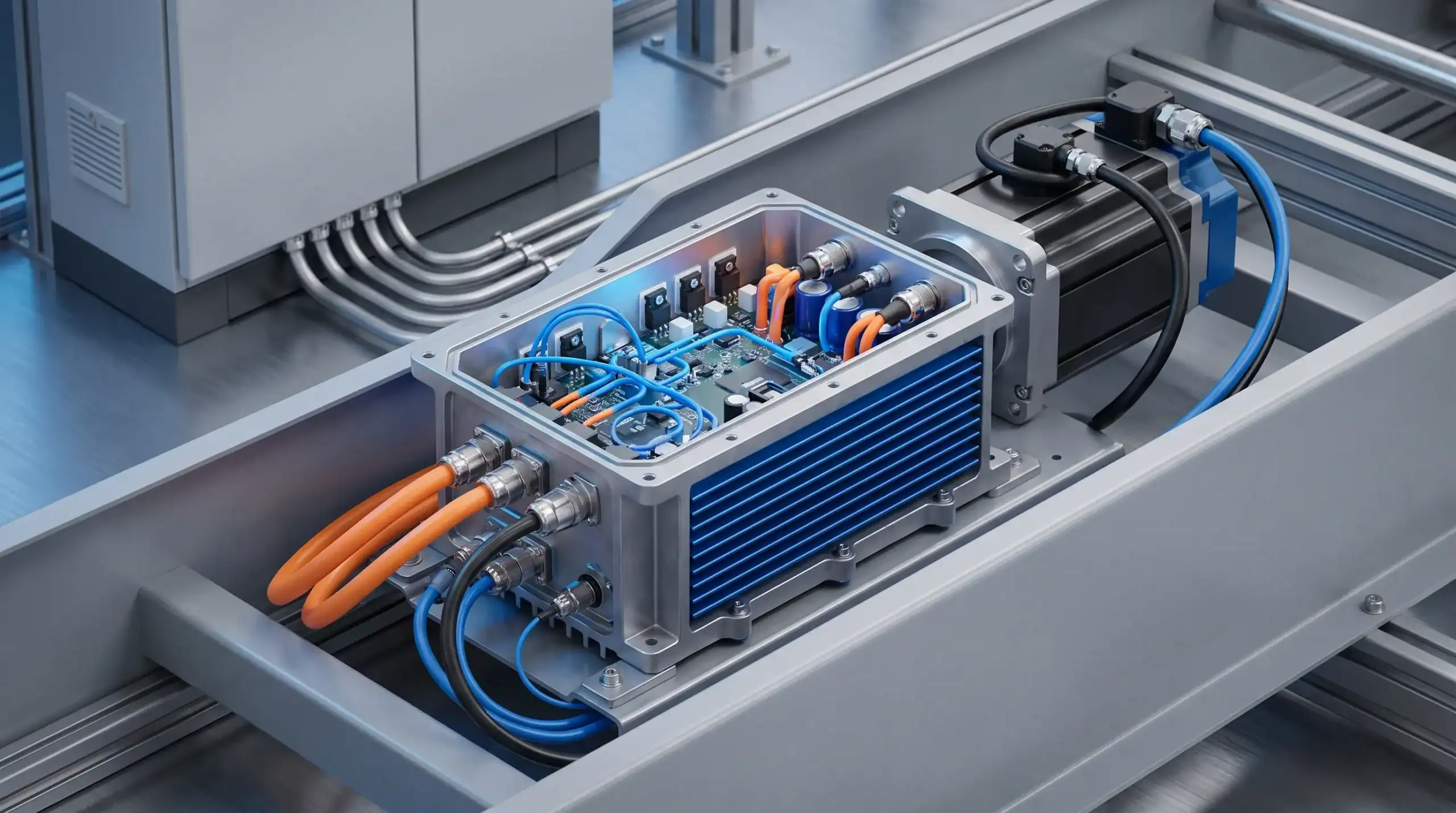
If someone asks, "what is an example of an embedded system in industry?", one of the clearest answers is an embedded motor drive controller used inside a machine, robot, pump, winch or automated production line.
It is not a general-purpose computer added as an accessory. It is dedicated electronics and firmware built into the product to control a physical process. It reads sensors, makes decisions in real time, drives power electronics and communicates with the wider machine or vehicle. In industrial products, that combination of hardware, software, power design and environmental robustness is what makes the embedded system valuable.
For engineering managers, CTOs and product development teams, the motor drive example is useful because it shows why embedded systems are rarely just about choosing a microcontroller. The design must perform reliably under electrical noise, thermal stress, vibration, load changes, maintenance conditions and certification constraints.
A practical example: an embedded motor drive in a machine
Imagine a packaging machine with several motorised axes. One axis moves a conveyor, another positions a cutter and another controls a feeder. Each motor needs precise speed, torque and position control. A central PLC may coordinate the machine, but the detailed motor control is often handled by an embedded motor drive mounted inside the equipment.
That drive contains electronics, firmware and power circuitry designed for a specific job. It measures motor current, DC bus voltage, temperature and shaft position. It then uses control algorithms to switch the power stage and regulate how the motor behaves. It may also report status and fault codes to the machine controller through an industrial communication interface.
In this example, the embedded system is not visible to the machine operator in the same way as a display or control panel. It sits inside the product and performs a dedicated function continuously. If it works well, the machine runs smoothly. If it is poorly designed, the effects can appear as unstable motion, overheating, electromagnetic interference, nuisance faults, reduced lifetime or certification problems.
ProMicro has a separate overview of embedded system examples engineers see every day if you want broader examples across vehicles, sensors, power supplies and professional equipment. The motor drive example is especially useful because it combines embedded software, analogue measurement, power electronics, PCB layout, EMC thinking and manufacturing readiness in one system.
What the embedded motor drive contains
An industrial embedded motor drive is a compact system with several engineering domains working together. The exact architecture depends on the motor type, power level, safety requirements, operating environment and communication needs, but the main building blocks are typically similar.
| Building block | Role in the embedded system | Key design considerations |
|---|---|---|
| Microcontroller, DSP or processor | Runs the control firmware and coordinates the system | Processing margin, real-time behaviour, peripheral support and long-term availability |
| Power stage | Switches current to the motor using devices such as MOSFETs or IGBTs | Efficiency, thermal performance, switching behaviour, protection and layout |
| Current and voltage sensing | Measures electrical conditions for control and protection | Accuracy, noise immunity, isolation, calibration and fault detection |
| Position or speed feedback | Provides encoder, resolver, Hall sensor or sensorless feedback | Resolution, latency, cable effects, robustness and diagnostics |
| Embedded firmware | Implements motor control, fault handling, communication and updates | Deterministic timing, safe states, maintainability and testability |
| Communication interface | Connects the drive to a PLC, controller or wider system | Protocol choice, isolation, EMC, diagnostics and interoperability |
| Power supply electronics | Generates stable internal voltages for logic, sensors and drivers | Transient immunity, efficiency, thermal margin and startup behaviour |
| PCB and enclosure integration | Turns the circuit into a manufacturable, serviceable product | Creepage, clearance, grounding, heat flow, assembly and protection |
This table also shows why industrial embedded development sits between several disciplines. A motor drive that looks correct in a schematic can still fail if the PCB layout creates noise coupling, if firmware fault handling is incomplete or if the enclosure traps heat near sensitive components.
How the system behaves during operation
During startup, the embedded system checks its own supply voltages, sensor signals and stored configuration. It may verify communication with the machine controller before enabling the power stage. These checks are not only convenient for diagnostics. They help prevent unsafe or damaging operation when a cable is disconnected, a sensor is out of range or a configuration parameter is wrong.
During normal operation, the firmware runs control loops at fixed intervals. The processor samples current and feedback signals, calculates the required output and updates the switching signals for the power stage. This has to happen predictably. In a motor drive, timing jitter, measurement noise or slow fault response can affect torque quality, positioning accuracy and component stress.
When something abnormal happens, the embedded system must move to a defined response. That could mean reducing output, stopping the motor, reporting a fault or entering a safe state depending on the application. A fault may come from overcurrent, overtemperature, undervoltage, blocked motion, lost feedback or unexpected communication behaviour.
The important point is that the embedded system is responsible for behaviour, not only electronics. It translates product requirements into controlled physical action. That is why ProMicro often describes embedded systems in relation to the complete product context rather than only the processor. For a deeper explanation, see what an embedded system means in real products.
Why this example matters in industrial product development
A motor drive is a strong industrial example because it exposes many of the risks that appear in embedded product development. It has sensitive measurements, fast switching, firmware timing, heat generation, electrical safety considerations and mechanical consequences. Those risks often stay hidden during early prototyping, then become expensive during certification, field testing or production scaling.
A lab prototype may prove that the motor turns. A production-ready industrial system must do more. It must behave reliably with long cables, variable loads, imperfect power supplies, temperature variation, nearby contactors, ESD events, service mistakes and component tolerances. The design must also be manufacturable and maintainable.
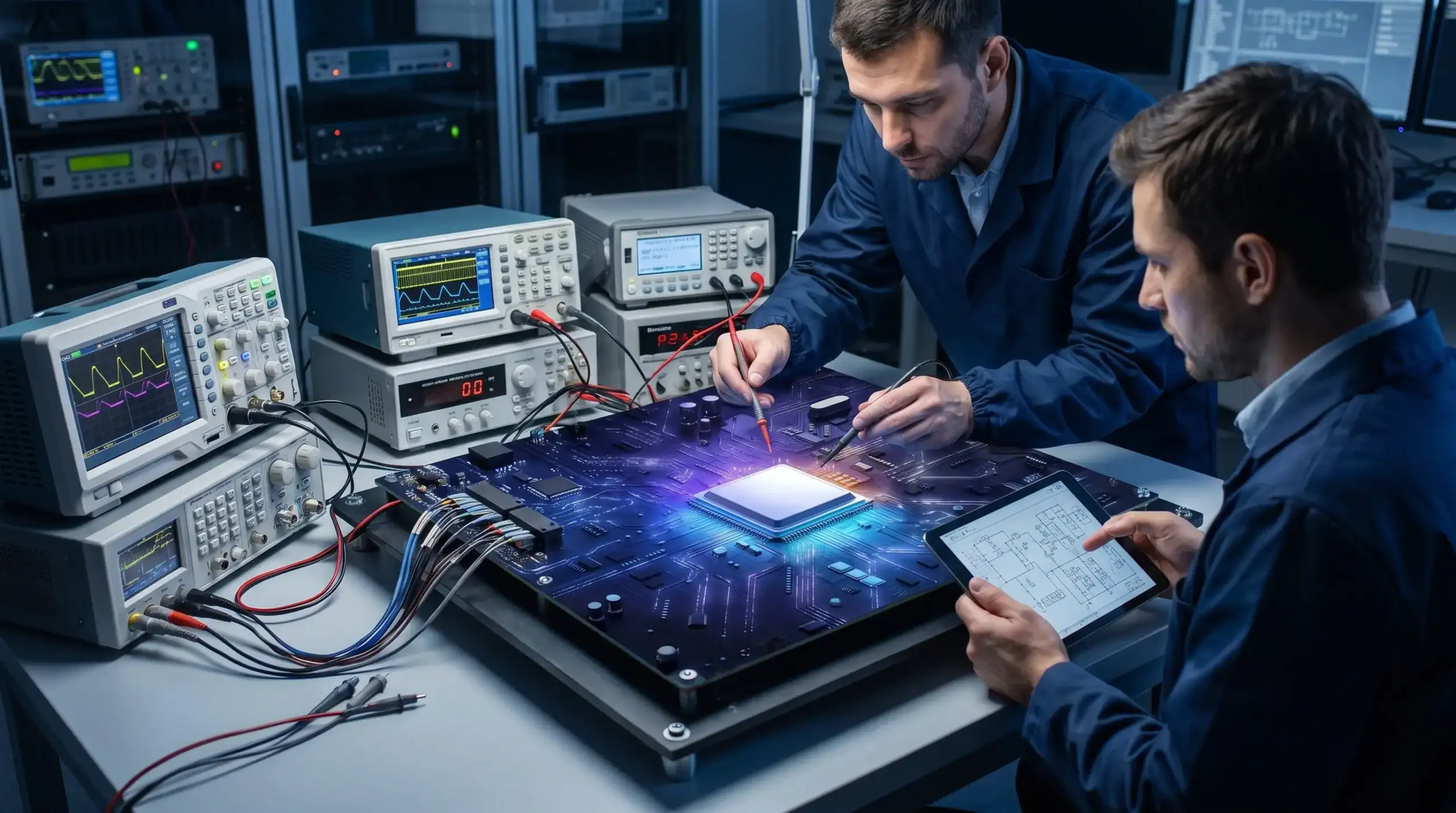
The difference between a prototype and a robust product is often found in the details: grounding strategy, analogue front-end filtering, thermal paths, firmware diagnostics, connector choice, enclosure design, test points, software update strategy and component lifecycle planning. These choices influence reliability long before the first production batch is built.
Compliance and EMC are part of the design, not a final step
Industrial embedded systems need to operate in electrically demanding environments. A motor drive can generate electromagnetic disturbance because it switches significant currents quickly. At the same time, it must remain immune to disturbances from the surrounding machine, supply network and cabling.
In the European market, products may need to be designed with requirements such as the EMC Directive 2014/30/EU in mind. If wireless communication is included, the Radio Equipment Directive can also become relevant. Depending on the product, machinery, safety and sector-specific standards may also apply.
Good engineering does not mean promising that certification will be effortless. It means making architecture, component, PCB, enclosure and firmware choices that reduce avoidable compliance risks from the start. For a motor drive, that can include input filtering, shield termination, careful separation of noisy and sensitive areas, controlled current loops, isolation where needed and diagnostic behaviour that supports predictable fault handling.
EMC is a good example of a hidden requirement. A customer may specify motor power, communication protocol and enclosure size, but not explicitly state cable routing, grounding conditions or nearby sources of interference. An experienced development partner will ask about those conditions early because they affect the architecture.
Prototype versus production-ready embedded system
The embedded motor drive may begin as a proof of concept, but industrial value comes when the design can be manufactured, tested and supported over time. This is where many product teams underestimate the step from working prototype to volume solution.
| Area | Lab prototype focus | Production-ready focus |
|---|---|---|
| Function | Demonstrate motor control and basic communication | Stable performance across tolerances, loads and environments |
| Electronics | Prove the circuit concept | Design for EMC, thermal behaviour, safety margins and assembly |
| Firmware | Implement core control logic | Add diagnostics, fault states, update strategy and maintainable code structure |
| Mechanical integration | Fit electronics into a test setup | Manage heat, protection, connector access, serviceability and enclosure constraints |
| Testing | Validate expected operation | Test edge cases, production checks, environmental conditions and failure modes |
| Lifecycle | Use available parts for development | Consider component availability, alternatives and long-term support |
This distinction is important for B2B product development. In a machine, vehicle, maritime system or professional device, the cost of redesign is not only engineering time. It can include delayed launch, failed tests, field service issues, liability exposure and production disruption.
When embedded computing is the right choice
Not every industrial control problem needs a custom embedded system. Some machines are best served with a PLC, industrial PC, standard drive or gateway. Embedded computing becomes the better option when the electronics must be tightly integrated into the product, optimised for a dedicated function or designed around specific constraints.
Typical reasons include size limits, cost at volume, precise timing, low power consumption, custom sensing, specialised motor control, harsh environments, product ownership, connectivity requirements or protection of intellectual property. If the product must behave as one coherent system rather than a collection of standard modules, embedded development becomes more relevant.
This decision is architectural. Choosing embedded computing too early can add unnecessary development work. Choosing it too late can force compromises in performance, integration, certification or manufacturing. ProMicro discusses this decision in more detail in when embedded computing is the right choice for industrial devices.
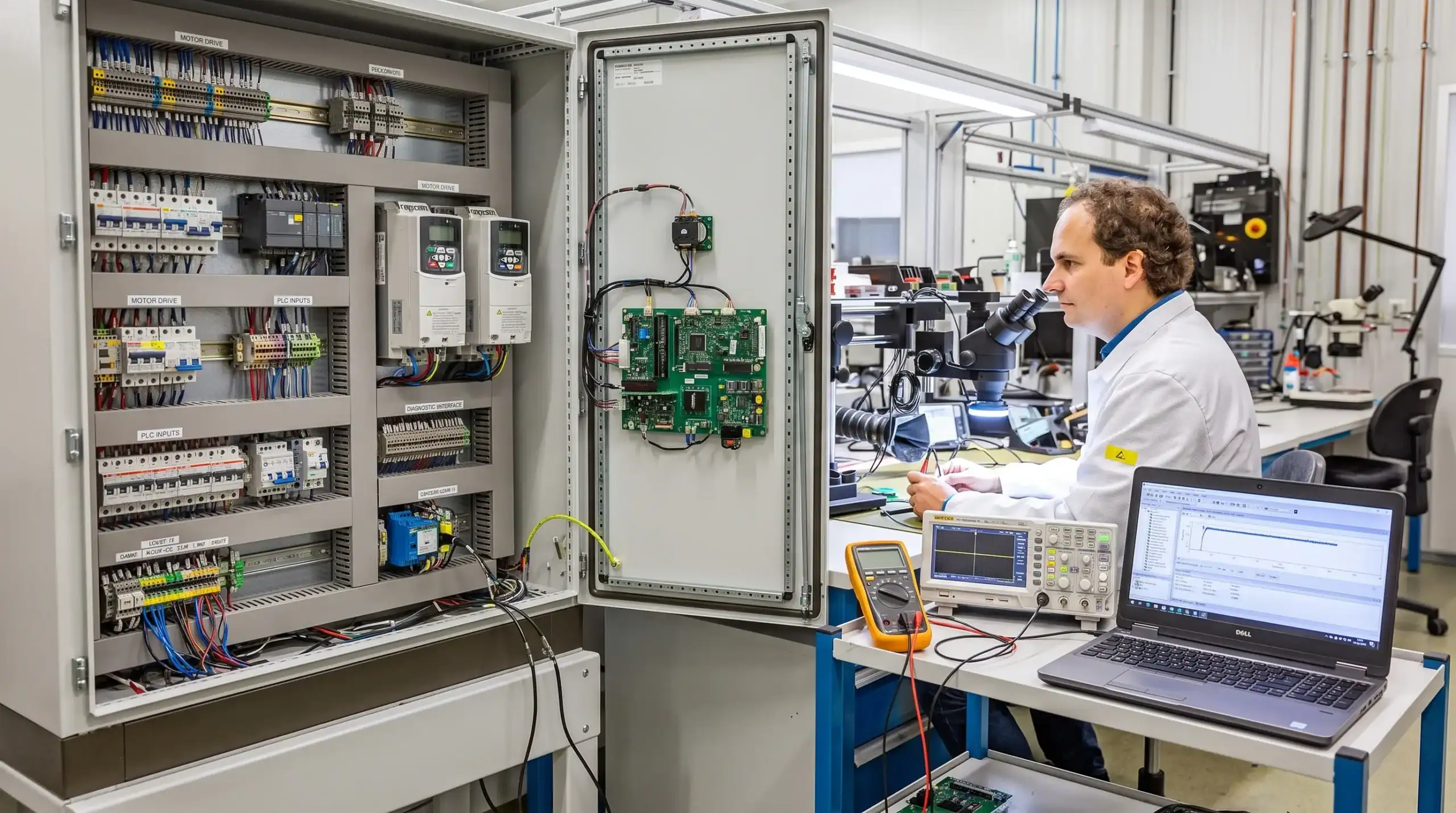
How to recognise embedded systems in your own industrial product
Many industrial products contain embedded systems even when the term is not used in the initial project brief. If the product senses a physical condition, makes decisions and controls an actuator or electrical output, it likely contains an embedded system.
Common signs include dedicated electronics inside the product, firmware that controls behaviour, sensor interfaces, power conversion, communication with other devices, fault handling and design constraints linked to the operating environment. Examples include a smart sensor module on a maritime system, a battery management controller in an electric vehicle, a drive unit in a robot, a dosing controller in medical or laboratory equipment, or a connected control board in high-tech machinery.
The technical question is not only whether a processor is present. The more relevant question is what the embedded system must guarantee. Does it need deterministic control? Must it survive vibration, moisture or wide temperature ranges? Will it be exposed to electrical transients? Does it need wireless communication? Is certification expected? Will it be produced for several years? These questions shape the design route.
Development considerations before building the first PCB
For an embedded motor drive or similar industrial system, early design choices have long consequences. Before detailed PCB design starts, the team should clarify the product environment, control requirements, interfaces, safety assumptions, manufacturing targets and lifecycle expectations.
A strong development process connects system engineering, electronics, firmware, mechanical integration and testing. This avoids a common failure pattern where separate suppliers optimise their own parts but no one owns the behaviour of the complete product. In embedded systems, the full product behaviour matters more than any single circuit or code module.
For example, the firmware team may need to understand current sensor limitations. The PCB designer must understand switching currents and analogue measurement paths. The enclosure designer must understand heat sources and cable shielding. The product owner must understand how certification, service and component availability affect commercial risk.
This integrated view is especially important in defence, maritime, robotics, automotive, machine manufacturing, high-tech and professional consumer electronics. These markets often require products that work safely and reliably outside ideal lab conditions.
Where ProMicro fits in this type of project
ProMicro supports companies developing electronic products where embedded systems, power electronics, analogue electronics and product integration need to work together. In the motor drive example, that can involve architecture choices, embedded system development, analogue measurement, PCB design, prototyping, enclosure considerations and support towards manufacturing readiness.
The value is not only extra engineering capacity. It is the ability to identify hidden technical risks early, connect hardware and software decisions, and design with reliability, compliance and lifecycle needs in mind. That is especially relevant when internal teams are under pressure to launch faster but still need robust, production-ready electronics.
If your product includes sensing, motor control, wireless communication, IoT connectivity, power conversion or complex electronic integration, working with an experienced electronics development partner can reduce uncertainty before those risks appear in certification or field use.
Frequently asked questions
What is an example of an embedded system in industry? A common example is an embedded motor drive controller inside a machine, robot, pump or conveyor system. It uses electronics and firmware to measure sensors, control a motor, communicate with other systems and respond to faults.
Why is a motor drive considered an embedded system? It is considered embedded because the control computer is built into the product and dedicated to a specific function. It is not a general-purpose PC. It performs defined control, monitoring and protection tasks as part of the machine.
Is a PLC an embedded system? A PLC contains embedded technology, but in industrial architecture it is usually treated as a programmable automation controller. A custom embedded system is normally more tightly integrated into the product and optimised for dedicated behaviour, size, cost, timing or environmental constraints.
What makes industrial embedded systems difficult to design? The difficulty comes from combining firmware, electronics, power design, sensors, communication, EMC, safety, thermal behaviour, mechanical integration and manufacturing requirements. A prototype may work in the lab but still need substantial engineering before it is production-ready.
When should a company involve an embedded systems development partner? It is useful to involve a partner when the product has complex control behaviour, harsh environmental conditions, power electronics, compliance risks, limited internal capacity or a need to move from concept to manufacturable product without avoidable redesign.
Discuss your embedded product challenge
An industrial motor drive is only one example, but it shows the broader point: embedded systems turn product intent into reliable behaviour. If your team is developing a machine, device or connected product that depends on electronics, firmware and real-world performance, early engineering decisions will strongly influence risk, certification effort and production readiness.
ProMicro helps companies develop robust embedded electronics from concept through prototyping and towards volume manufacturing. To explore how that could apply to your product, visit ProMicro and discuss the technical context behind your next development challenge.