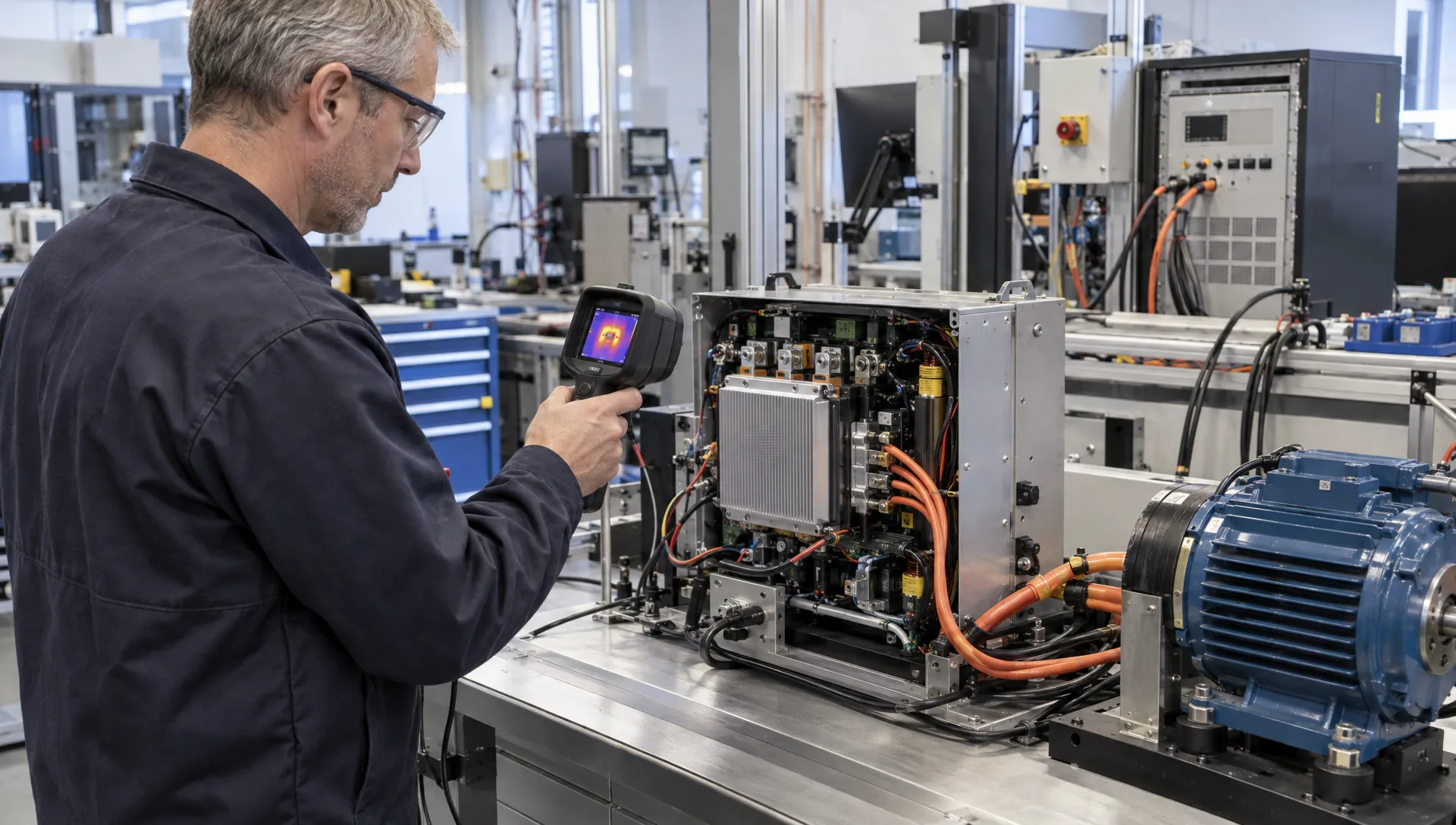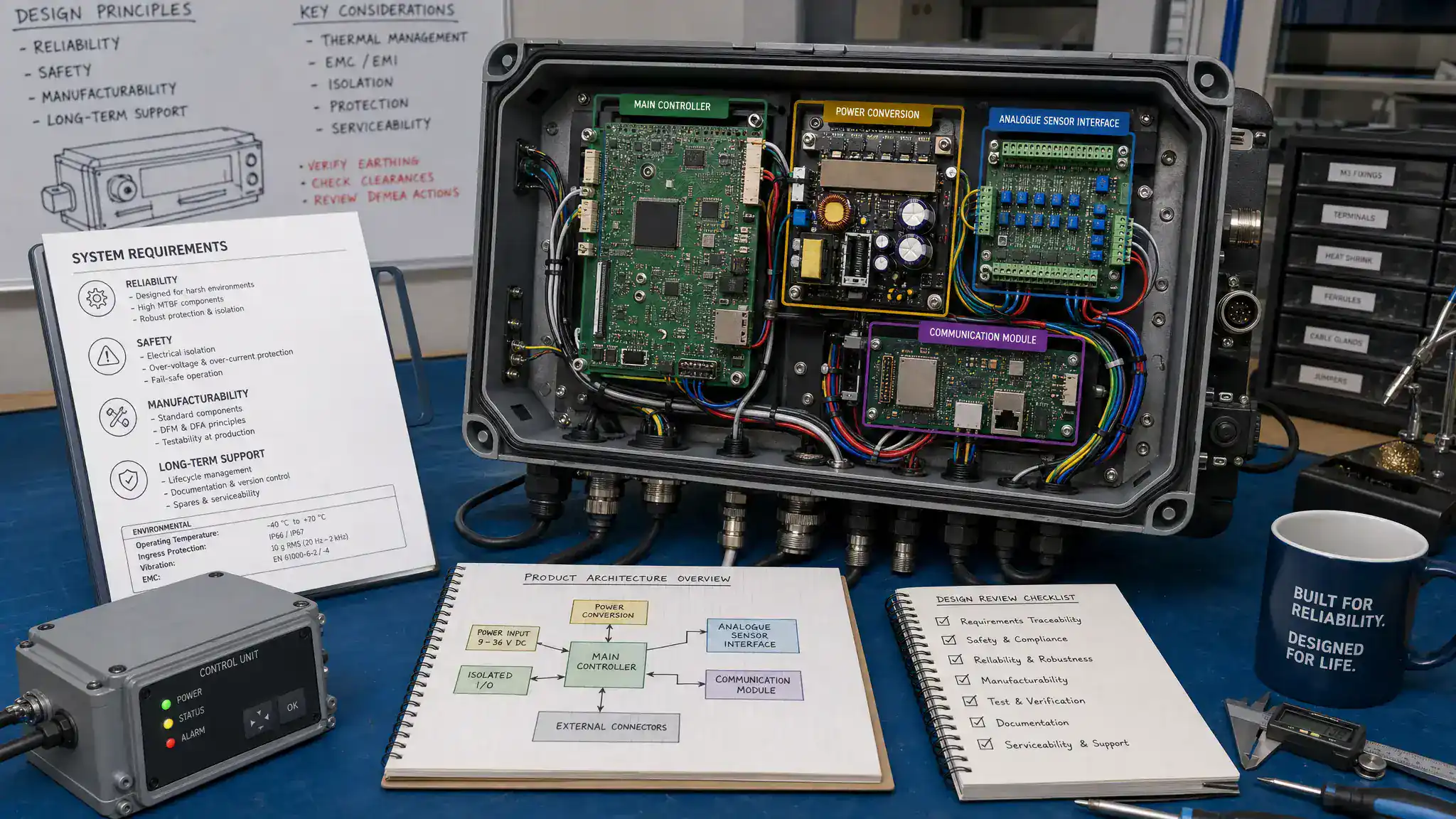
Embedded systems are the control intelligence inside modern products. They measure, decide, communicate and act, often without the user ever seeing a screen or keyboard. In a machine, vehicle, sensor device, maritime controller or professional consumer product, the embedded system is what turns mechanical and electrical parts into predictable product behaviour.
For technical leaders, this matters because embedded systems are rarely just “software on a chip”. They influence product safety, power consumption, EMC behaviour, certification risk, manufacturing readiness and lifecycle support. A prototype may appear to work in the lab, but if the embedded system has not been designed for the real application environment, problems can emerge during testing, field use or volume production.
What is an embedded system?
An embedded system is a dedicated computing system built into a larger product to perform specific functions. It usually combines electronics, firmware, sensors, actuators, communication interfaces and power management. Unlike a laptop or general-purpose computer, it is designed around a defined product task.
A simple example is a motor controller inside a machine. The user may only see a control panel, but the embedded system is reading sensor signals, controlling power electronics, responding to safety limits, managing communication and detecting faults. In more advanced products, multiple embedded systems may work together across a machine, vehicle or connected device.
A practical definition is:
An embedded system is the dedicated hardware and software inside a product that monitors inputs, controls outputs and enables reliable behaviour in a specific real-world application.
This definition is intentionally product-focused. For a deeper explanation of the role embedded systems play in real product behaviour, ProMicro has also covered what an embedded system means in real products.
Embedded systems are not just small computers
It is tempting to describe an embedded system as a “small computer”, but that is incomplete. The computing element, such as a microcontroller, microprocessor or system-on-module, is only one part of the design.
In real products, an embedded system must interact with physical signals. It may read analogue sensor values, switch motors, measure current, control heating, manage batteries, handle wireless communication or withstand electrical noise. That means the embedded design is closely connected to power electronics, analogue electronics, PCB layout, thermal behaviour, enclosure design and compliance.
This is why embedded product development is different from ordinary software development. The firmware cannot be treated separately from the hardware, and the hardware cannot be treated separately from the product environment. Timing, voltage levels, grounding, EMI, heat, vibration, moisture, connector choices and component availability can all affect whether the product works reliably.
The main building blocks of an embedded system
Most embedded systems include several engineering layers. The exact architecture depends on the product, but the following building blocks are common in professional electronics.
| Building block | Role in the product | Typical engineering considerations |
|---|---|---|
| Processing unit | Executes the control logic and firmware | Performance, real-time behaviour, memory, lifecycle availability |
| Firmware | Defines product behaviour and decision logic | Reliability, safety handling, update strategy, diagnostics |
| Sensors | Measure physical conditions or user input | Accuracy, calibration, noise immunity, environmental exposure |
| Actuators and outputs | Create physical action or product response | Motor control, switching, protection, thermal load |
| Power electronics | Supplies and controls electrical energy | Efficiency, heat, protection, EMC, safety margins |
| Analogue electronics | Conditions real-world signals | Filtering, amplification, measurement precision, interference sensitivity |
| Communication interfaces | Connects the product to other devices or systems | Wired protocols, wireless links, cybersecurity, RED implications |
| PCB and interconnects | Physically integrates the electronics | Layout, grounding, manufacturability, testability, EMC performance |
| Enclosure and mechanics | Protects and positions the electronics | IP rating, vibration, serviceability, thermal paths, connectors |
A weak decision in any of these layers can affect the rest of the product. For example, a poor PCB layout can increase EMC emissions, which can then create firmware instability, sensor errors or certification delays. Similarly, an underestimated power supply can work during a demo but fail when the product is used across temperature, load and production variation.
Why embedded systems matter in product development
Embedded systems matter because they are responsible for the behaviour that customers, operators and regulators experience. They determine not only whether a function works, but whether it works safely, repeatedly and predictably.
In many products, the embedded system is the difference between a concept and a reliable product. It turns intent into control. If the product must move accurately, communicate securely, monitor conditions, reduce energy use or respond to faults, the embedded system makes those outcomes possible.
The importance becomes clear in four areas.
First, embedded systems define functional performance. They decide how fast a motor reacts, how accurately a sensor is interpreted, how quickly a fault is detected and how smoothly the user experience feels.
Second, they influence reliability. A robust embedded design must handle brownouts, noise, unexpected inputs, communication loss, component tolerances and edge cases. These conditions are normal in real products, even if they are not always visible during early prototyping.
Third, embedded systems affect compliance. EMC, CE, RED, electrical safety and sector-specific requirements are not solved at the end of a project. They are shaped by architecture, component selection, PCB layout, enclosure design, grounding strategy, firmware behaviour and test planning.
Fourth, they affect manufacturability and lifecycle cost. A design that is difficult to test, calibrate, source or assemble can become expensive when moving from prototype to production. Embedded decisions made early often determine whether the product can be scaled and maintained over time.

What embedded systems do inside modern products
The visible product may be a robot, pump, measurement device, marine control unit or connected module. Inside, the embedded system usually performs a combination of sensing, control, communication and protection.
Common functions include:
- Measuring temperature, pressure, position, current, voltage, speed or environmental data
- Controlling motors, valves, relays, power converters, LEDs, displays or heating elements
- Managing communication via CAN, Ethernet, Bluetooth, Wi-Fi, cellular or industrial protocols
- Running diagnostics, logging faults and supporting service or maintenance workflows
- Protecting the product against overload, overheating, undervoltage, misuse or unsafe states
- Enabling updates, configuration, calibration and long-term product support
The balance between these functions depends on the application. In robotics, control loops, motor drives and sensor fusion may dominate. In maritime and defence applications, reliability, environmental robustness and clear failure behaviour may be critical. In connected consumer or high-tech devices, wireless performance, low power consumption and update strategy can become decisive.
If you want to explore this from a product-behaviour perspective, the article on the purpose of an embedded system in a product explains how embedded systems translate product intent into controlled operation.
Why early architecture decisions reduce technical risk
Many embedded product problems start early, long before a certification test fails or a field issue appears. They often begin with unclear requirements, incomplete system architecture or a decision to treat hardware, firmware, mechanics and compliance as separate work packages.
A strong embedded architecture considers the full product context from the beginning. That includes the operating environment, expected product lifetime, user behaviour, service strategy, production volumes, certification route and supply chain constraints.
For example, a connected device with wireless communication may need careful antenna placement, enclosure material choices, power budgeting, firmware update planning and RED-related design considerations. A motor-driven machine may need robust current measurement, thermal protection, EMC filtering, mechanical integration and deterministic firmware timing. These are not details to add later. They shape the architecture.
This is similar to other complex technical projects where many disciplines must align. In a high-quality building project, for example, civil work, electrical systems, plumbing, materials and finishing need to be coordinated from the start, as seen in professional villa renovation in Dubai projects. Embedded product development has the same basic lesson: integration risk increases when disciplines are handled in isolation.
For electronics, the consequence is clear. Early system thinking reduces the probability of late redesigns. It also helps teams identify hidden requirements, such as surge exposure, condensation risk, operator misuse, maintenance access, firmware recovery modes or component obsolescence.
Embedded systems in demanding real-world environments
A product that works on a desk is not automatically ready for a machine hall, vehicle, vessel, defence application or outdoor installation. Real-world conditions introduce variation and stress.
Products may face vibration, electrical transients, moisture, salt air, wide temperature ranges, long cable runs, conducted noise, radiated interference and unpredictable user behaviour. In production, every unit will also differ slightly because of component tolerances, assembly variation and supplier changes.
Embedded systems must therefore be designed with margins. That includes electrical margins, timing margins, thermal margins, memory margins and diagnostic margins. Good engineering does not assume that every input is clean, every power rail is stable or every communication message arrives on time.
In demanding environments, the firmware should also define safe behaviour. What happens if a sensor becomes disconnected? What happens if a motor stalls? What happens if wireless communication is lost during an update? What happens after a brownout? These scenarios are central to reliable product design.
This is why embedded development for professional products often requires close collaboration between system engineering, electronics design, embedded software, mechanical design and manufacturing preparation. ProMicro discusses this broader context in more detail in its article on embedded systems and applications in demanding real-world use.
Common reasons embedded products fail late in development
Late-stage failures are costly because they often require changes across multiple disciplines. A firmware change may expose a hardware limitation. A PCB change may affect enclosure fit. An EMC fix may change thermal behaviour. A component replacement may require retesting.
Common causes include:
- Requirements that describe the function but not the real operating conditions
- Prototypes built for demonstration rather than compliance and production readiness
- Firmware developed before hardware limits and failure modes are fully understood
- Insufficient attention to EMC, grounding, filtering and cable behaviour
- Power supplies designed without enough margin for transients, load steps or heat
- PCB layouts that are functional but difficult to test, manufacture or certify
- Component choices made without lifecycle, availability or second-source strategy
- Enclosures designed without enough attention to connectors, sealing, heat or antennas
These issues are not signs of poor intent. They are often the result of underestimating embedded system complexity. Modern products combine power, sensing, connectivity, firmware, mechanics and compliance in increasingly compact designs. The risk is not in any single discipline, but in the interfaces between them.

From prototype to volume manufacturing
A working prototype is an important milestone, but it is not the same as a production-ready embedded system. The transition to volume manufacturing requires additional engineering discipline.
The design must be testable. Production teams need clear procedures to verify that each unit is assembled and programmed correctly. Calibration may need to be automated or simplified. Firmware loading, serialisation, configuration and traceability should be considered before production starts.
The design must also be maintainable. Products in professional markets often remain in use for years. That means component availability, firmware update policy, diagnostics, spare parts, documentation and lifecycle management matter. A product that cannot be repaired, updated or supported can create long-term cost and reputational risk.
Design for manufacturing also affects PCB layout, connector choices, mechanical tolerances, enclosure assembly, thermal paths and test points. In embedded systems, manufacturability is not a final checklist item. It should influence architecture from the start.
When to involve an embedded systems partner
Companies often involve an external development partner when internal engineering teams lack capacity, specific domain knowledge or time to manage all product risks. This is especially relevant when a product combines embedded software, power electronics, analogue measurement, wireless communication, PCB design, enclosure integration and compliance considerations.
An experienced partner can help before detailed design begins. Early support may include feasibility analysis, requirements clarification, system architecture, risk assessment, technology selection and prototyping strategy. Later support may include schematic design, PCB layout, firmware development, testing, design iterations and preparation for manufacturing.
The value is not simply extra engineering hours. The value is recognising hidden risks before they become expensive. That may include identifying EMC-sensitive design choices, unrealistic power budgets, unclear safety states, insufficient diagnostics or manufacturing challenges that are not visible in a proof-of-concept prototype.
For teams developing machines, connected devices, high-tech equipment or product platforms, embedded system design should be approached as a complete product discipline rather than a collection of isolated tasks.
How ProMicro approaches embedded product development
ProMicro supports companies that need reliable electronics and embedded systems from early concept through to production-ready solutions. The work can include embedded system development, power electronics, analogue electronics, PCB design, system engineering, enclosure design, rapid prototyping, manufacturing preparation and lifecycle support.
The focus is on more than making a circuit function. A robust product must perform in its application environment, be practical to manufacture, be designed with compliance in mind and remain supportable over its intended lifetime. That requires collaboration between the client’s product knowledge and ProMicro’s electronics engineering expertise.
This approach is particularly relevant for professional markets such as machine manufacturing, robotics, automotive, maritime, defence, high-tech equipment and embedded software-driven products. In these sectors, reliability and risk reduction are often more important than the fastest possible prototype.
Frequently asked questions
What is an embedded system in simple terms? An embedded system is the dedicated electronics and software inside a product that controls specific functions. It may read sensors, control motors, manage power, communicate with other systems and respond to faults.
How is an embedded system different from normal software? Normal software usually runs on general-purpose computers. Embedded software runs on hardware inside a product and must interact with real-world signals, timing constraints, power limits, safety behaviour and physical operating conditions.
Why do embedded systems matter for compliance? Embedded systems influence EMC behaviour, wireless performance, electrical safety, fault handling and product reliability. Compliance cannot be guaranteed by firmware alone, but early embedded design choices can reduce certification risk.
When should embedded system architecture be defined? Architecture should be considered from the first stages of product development. Waiting until after a prototype is built can lead to redesigns when power, EMC, communication, thermal or manufacturing issues appear.
Can a prototype be turned directly into a manufactured product? Sometimes, but often not without redesign. A prototype may prove the concept, while a production-ready embedded system must also be testable, manufacturable, compliant, reliable and supportable over time.
Building products that are ready for real use
Embedded systems matter because they sit at the centre of product behaviour. They connect intent with action, and they determine whether a product can operate reliably outside the lab.
For companies developing complex machines, connected devices, professional electronics or high-value technical equipment, the key question is not only “what is the embedded system?” The more important question is whether the embedded system has been designed as part of a complete, reliable and manufacturable product.
If your team is developing a product where embedded software, power electronics, analogue electronics, PCB design, enclosure integration and compliance all need to work together, ProMicro can help structure the development process and reduce technical risk from the early stages through to volume manufacturing support.