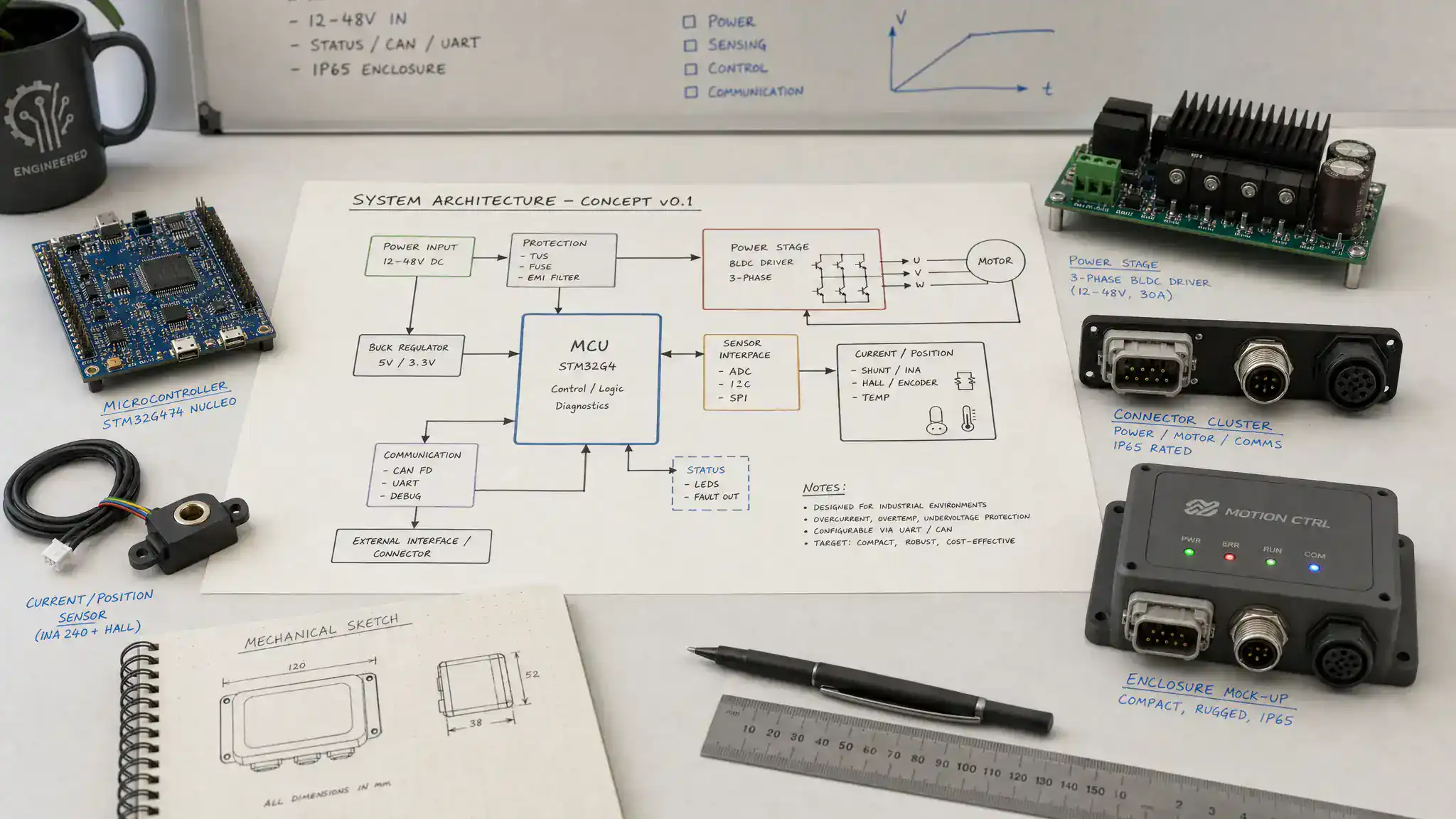
In a professional product, an embedded system is not simply a small computer hidden inside an enclosure. Its purpose is to make the product behave correctly, safely and predictably in the environment where it will actually be used.
If you ask, what is the purpose of an embedded system, the practical answer is this: it connects sensing, decision-making, control, communication and diagnostics into one dedicated system that enables the product to perform its intended function. For OEMs, machine builders, robotics companies, automotive suppliers, maritime technology firms and high-tech manufacturers, that purpose has direct consequences for reliability, compliance, manufacturability and long-term product value.
The core purpose: turning product intent into controlled behaviour
Every technical product starts with an intended behaviour. A machine must move accurately. A maritime device must operate reliably in moisture and vibration. A battery-powered sensor must measure, process and transmit data while consuming as little energy as possible. A robotic module must react to changing inputs without unpredictable delay.
The embedded system is the part of the product that translates those intentions into repeatable behaviour. It reads signals from sensors, processes information, controls actuators or power stages, communicates with other systems and handles errors when conditions move outside the expected range.
That makes the embedded system a product-defining element, not an accessory. The mechanical housing may protect the product, the PCB may carry the components and the power electronics may deliver energy, but the embedded system determines how the product responds to the world.
A useful way to view it is this: the embedded system owns the product’s operational logic. It decides what must happen, when it must happen and under which conditions it must not happen.
What an embedded system actually does inside a product
The exact function of an embedded system depends on the product, but most professional applications rely on a combination of sensing, local processing, control, communication and protection. These functions must be designed together because they influence one another.
| Product function | Purpose of the embedded system | Engineering impact |
|---|---|---|
| Sensing | Reads physical, electrical or environmental inputs | Determines accuracy, timing and noise sensitivity |
| Control | Converts software logic into actions such as switching, motion or regulation | Affects stability, safety and product performance |
| Communication | Exchanges data with users, machines, vehicles, cloud services or other devices | Influences connectivity, cybersecurity and regulatory scope |
| Diagnostics | Detects faults, abnormal use or degradation | Supports maintenance, field service and lifecycle management |
| Power management | Controls energy use, charging, conversion or standby behaviour | Impacts battery life, thermal performance and reliability |
| Protection | Prevents unsafe states, overloads or unintended operation | Reduces operational risk and supports compliance-oriented design |
In a machine manufacturing context, the embedded system may coordinate sensors, motor drives, limit switches and safety logic. In a connected device, it may combine local measurement with wireless communication. In a vehicle or maritime product, it may need to keep operating despite vibration, temperature changes, electrical noise and long service intervals.
The purpose is therefore not only to “run software”. It is to make a physical product behave in a controlled, measurable and maintainable way.
Why purpose must be defined early
Many product issues start when the embedded system is treated as a late-stage implementation task. A team may first define the enclosure, select components, draw a PCB and then ask someone to “add the software”. That approach can work for simple products, but it creates risk in systems where timing, power, EMC behaviour, thermal design, safety functions or connectivity matter.
The purpose of the embedded system should be clarified before architecture decisions are locked in. Early choices determine whether the product will need a microcontroller, microprocessor, system-on-chip, wireless module, external memory, galvanic isolation, dedicated analogue front-end, motor control stage or power conversion topology.
This is why system design with embedded thinking from day one is so important. Embedded design affects hardware architecture, firmware structure, PCB layout, enclosure constraints, component selection, test strategy and manufacturing preparation.
A clear definition of purpose helps engineering teams answer questions such as:
- What decisions must the product make locally, and what can be handled externally?
- Which functions require deterministic timing or real-time behaviour?
- What happens if a sensor fails, a communication link drops or power becomes unstable?
- Which operating conditions are normal, abnormal or unsafe?
- What information must be logged for diagnostics, maintenance or compliance evidence?
- How will the design be updated, tested and supported over the product lifecycle?
These are not only software questions. They influence the full product architecture.
Purpose in different product environments
The same embedded building blocks can serve very different purposes depending on the application. A temperature sensor in a consumer product, for example, has a different risk profile than a temperature sensor in a power converter, battery system, medical device, maritime installation or industrial robot.
| Application area | Typical embedded system purpose | Design considerations |
|---|---|---|
| Machine manufacturing | Coordinate motion, sensors, operator inputs and process control | Noise immunity, uptime, serviceability and integration with existing equipment |
| Robotics | Process sensor feedback and control movement with low latency | Real-time behaviour, motor control, safety states and compact integration |
| Automotive | Monitor, control and communicate within vehicle subsystems | Temperature range, vibration, electrical transients and lifecycle support |
| Maritime | Support reliable operation in harsh and often remote environments | Moisture, corrosion, EMC, robustness and maintainability |
| Defence | Enable dependable operation under demanding and controlled conditions | Reliability, traceability, environmental stress and system integration |
| Consumer electronics | Create user interaction, connectivity and efficient operation | Cost, size, battery life, radio performance and user experience |
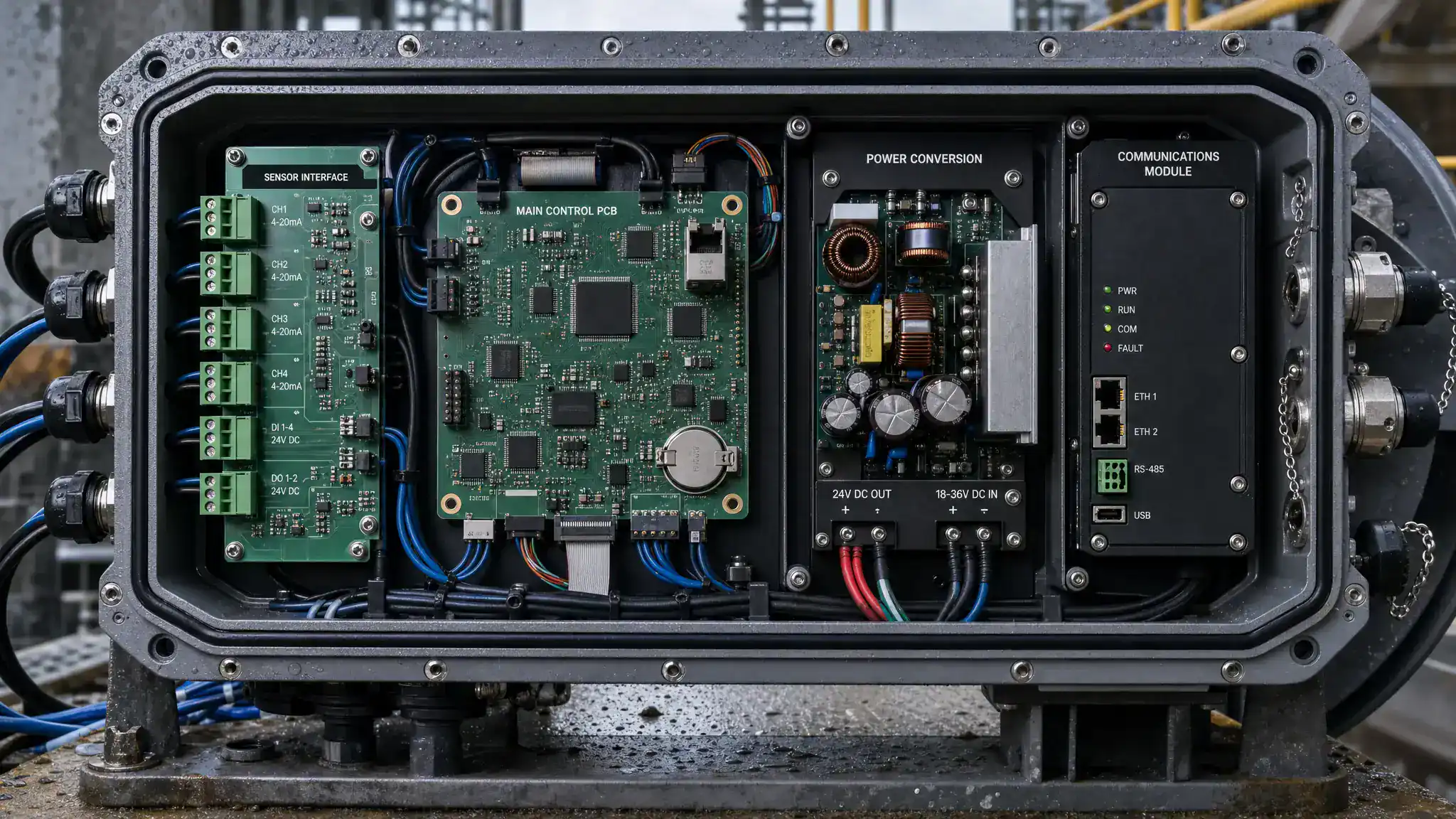
This context matters because the embedded system must be designed for the real operating environment, not only for a laboratory prototype. A prototype that works on a desk may still fail during EMC testing, field deployment, vibration exposure, production variation or long-term use.
The purpose is also risk reduction
For technical directors and product owners, an embedded system is often discussed in terms of features: measure this, connect to that, control this output, send this data. Those features matter, but the deeper purpose is risk reduction.
A well-designed embedded system reduces the chance that a product behaves unpredictably. It can detect abnormal states, limit unsafe operation, manage electrical stress, compensate for environmental conditions and support diagnostics when something goes wrong.
In compliance-oriented product development, this becomes especially important. EMC, RED, CE and safety-related requirements are not solved by one component or one test at the end. They are influenced by system architecture, PCB layout, grounding, shielding, firmware timing, wireless behaviour, enclosure design, cable routing and power electronics.
Designing with compliance in mind does not guarantee certification, because testing and documentation still depend on the final product and its application. However, it does reduce avoidable surprises. It also gives the development team a clearer path from prototype to product validation.
This is one reason why embedded systems should be considered together with electronics design, power design, analogue interfaces and mechanical integration. A weak analogue front-end can undermine sensor accuracy. Poor PCB layout can create emissions or susceptibility problems. Insufficient thermal planning can shorten component life. Firmware that ignores fault states can turn a recoverable issue into a field failure.
For OEMs, the purpose of embedded design is therefore not only to enable functionality. It is to protect product reliability, customer trust and the business case behind the product.
Embedded systems connect hardware, software and the physical world
In many organisations, hardware and software are managed as separate workstreams. That can be efficient, but only if the interfaces are defined carefully. Embedded systems sit exactly at this boundary, which is why they require combined thinking.
Firmware depends on hardware capabilities. Hardware choices depend on firmware requirements. Power electronics create switching behaviour that can affect measurement quality and EMC. Analogue electronics translate physical signals into digital information, but only if noise, calibration, protection and tolerances are handled correctly. The enclosure influences thermal behaviour, antenna performance, connector accessibility and environmental protection.
A strong embedded system design therefore includes more than code and a processor. It includes the complete technical chain from input to output, including:
- Sensors, measurement circuits and analogue signal conditioning
- Microcontrollers, processors, memory and communication interfaces
- Firmware architecture, control logic and update strategy
- Power conversion, motor drives or battery management where relevant
- PCB layout, grounding, shielding and manufacturability
- Enclosure constraints, connectors, cabling and thermal paths
- Test points, diagnostics, production testing and lifecycle support
This is why embedded electronics in OEM product design should be viewed as a system discipline rather than a PCB task. The embedded system has to work as part of the complete product.
When does a product need a more advanced embedded system?
Not every product needs a complex architecture. Some functions can be handled with simple analogue electronics, discrete logic or a basic microcontroller. Complexity should be justified by product requirements, not added for its own sake.
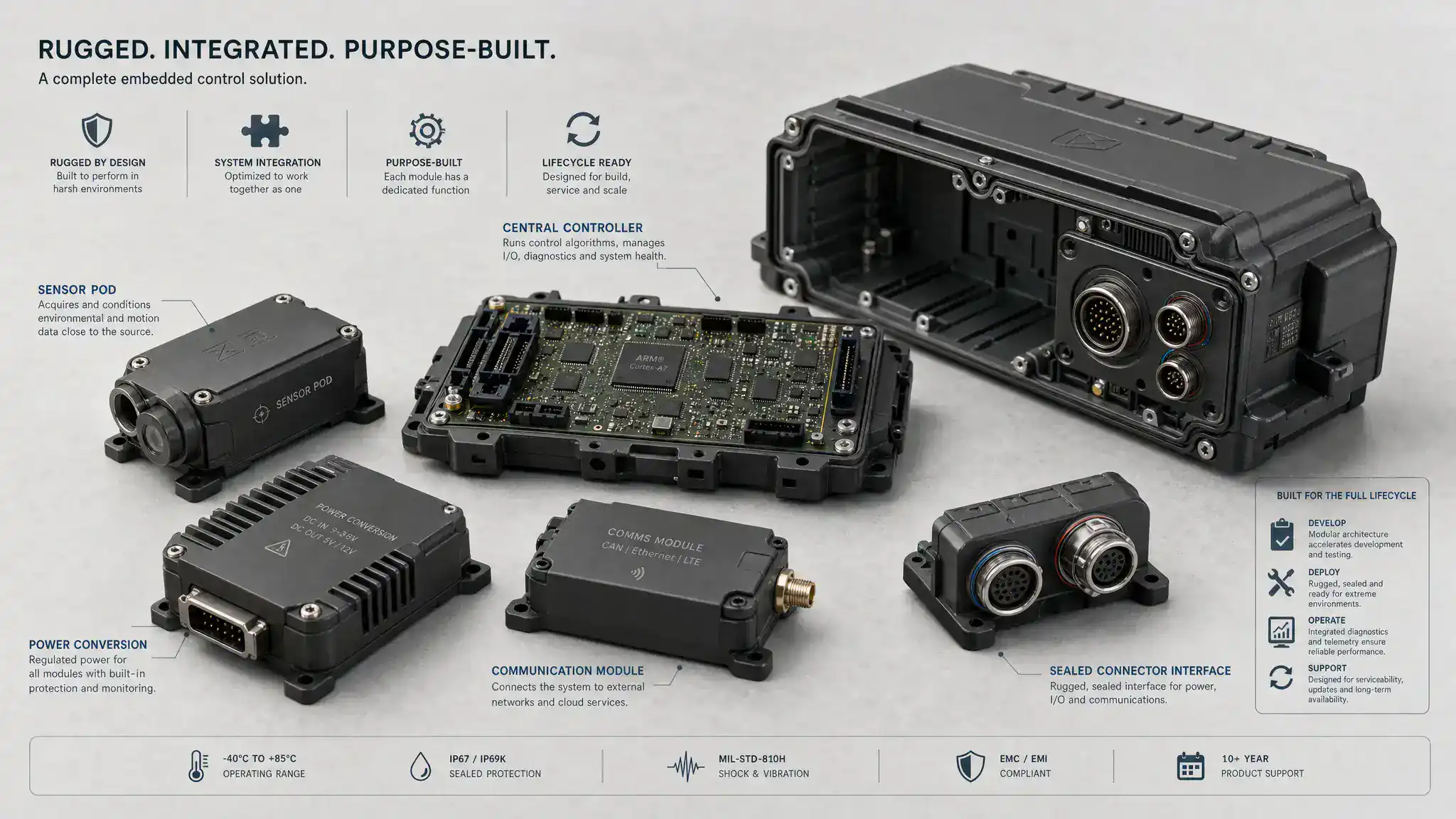
A more advanced embedded system becomes relevant when the product must process multiple inputs, control time-sensitive outputs, communicate with other systems, manage power intelligently, support updates, store diagnostic data or operate under demanding conditions.
It is also relevant when product risk is high. In machinery, robotics, vehicles, defence, maritime or high-value equipment, failure can lead to downtime, safety concerns, liability, expensive service visits or reputational damage. In those cases, the purpose of the embedded system includes resilience and fault handling, not only normal operation.
Another trigger is scalability. A prototype can often be made to work with development boards, cables and manual calibration. A volume product must be manufacturable, testable, serviceable and maintainable. That shift changes the purpose of the embedded system from proving feasibility to supporting repeatable production and long-term use.
Skills, capacity and the role of an external development partner
Many companies have capable internal engineering teams, but embedded product development can quickly demand specialist knowledge across hardware, firmware, power electronics, analogue electronics, compliance, production testing and lifecycle management. The challenge is rarely one isolated task. It is the interaction between disciplines.
Internal capability remains valuable. Engineering managers can strengthen their teams through documentation, design reviews, test discipline and targeted training. For organisations that want to build broader technical capability, structured upskilling programmes for technical teams can support continuous learning in areas such as technology, business and practical digital skills.
However, when a product must become reliable, compliant-ready and manufacturable, training alone is not always enough. External embedded system expertise can help reduce risk where the product architecture is unclear, internal capacity is limited or hidden requirements have not yet been identified.
A specialist partner can challenge assumptions early. For example, is the selected wireless technology suitable for the enclosure and target market? Will the motor drive disturb sensitive measurements? Are component choices realistic for lifecycle availability? Can the product be tested efficiently during production? Are diagnostic functions sufficient for field support?
These questions often reveal issues before they become expensive redesigns.
A practical checklist for defining embedded system purpose
Before committing to architecture, decision-makers should define the product purpose in engineering terms. The goal is not to create a perfect specification immediately. The goal is to make the main risks visible while there is still room to make good design choices.
| Development question | Why it matters | Typical risk if ignored |
|---|---|---|
| What must the product sense, decide and control? | Defines the core embedded architecture | Wrong processor, missing interfaces or unstable control behaviour |
| What conditions will the product face in real use? | Shapes environmental, EMC and mechanical design | Prototype works in the lab but fails in the field |
| What are the timing and safety-critical functions? | Determines real-time requirements and fault handling | Delays, unsafe states or unpredictable operation |
| What communication is required? | Influences radio, wired interfaces, cybersecurity and compliance scope | Connectivity issues or late regulatory complications |
| How will the product be manufactured and tested? | Connects embedded design to production readiness | Slow testing, inconsistent quality or costly rework |
| How long must the product be supported? | Affects component selection, updates and diagnostics | Lifecycle problems and difficult maintenance |
This checklist helps align technical teams, management and external partners. It also makes the purpose of the embedded system visible in business terms: lower development risk, fewer late changes and a stronger route to production.
Frequently asked questions
Is an embedded system the same as a PCB? No. A PCB is the physical carrier for electronic components. An embedded system includes the hardware, firmware, interfaces, power behaviour, sensors, control logic and diagnostics that make the product operate as intended.
Why not use a standard computer or PLC instead of an embedded system? A standard computer or PLC can be the right choice in some applications. A dedicated embedded system is often preferred when the product needs compact size, low power use, specific interfaces, controlled cost, environmental robustness or tight integration with the product hardware.
At what stage should the purpose of the embedded system be defined? It should be defined at the concept and system architecture stage. Waiting until the PCB or enclosure is mostly finished can limit design options and increase the risk of redesign.
How does an embedded system affect EMC, RED or CE compliance? It can influence emissions, immunity, radio behaviour, safety functions, power quality and fault handling. Compliance depends on the complete product, but embedded system decisions strongly affect how difficult testing and validation may become.
Can an embedded system be changed after prototyping? Yes, but changes become more expensive once hardware, enclosure, tooling, certification planning and manufacturing processes are fixed. Early system-level decisions are usually cheaper to correct than late-stage redesigns.
Build the embedded system around the product, not the other way around
The purpose of an embedded system is to make a product perform reliably in its real application. That means sensing accurately, controlling safely, communicating where needed, managing power intelligently and supporting diagnostics throughout the product lifecycle.
For companies developing machines, connected devices, robotics, automotive electronics, maritime systems or high-tech equipment, the embedded system should be treated as a central part of product strategy. It influences architecture, risk, compliance readiness, manufacturability and long-term support.
If your team is defining a new electronic product or improving an existing one, ProMicro can support the journey from concept and embedded system architecture to electronics design, prototyping and preparation for volume manufacturing.