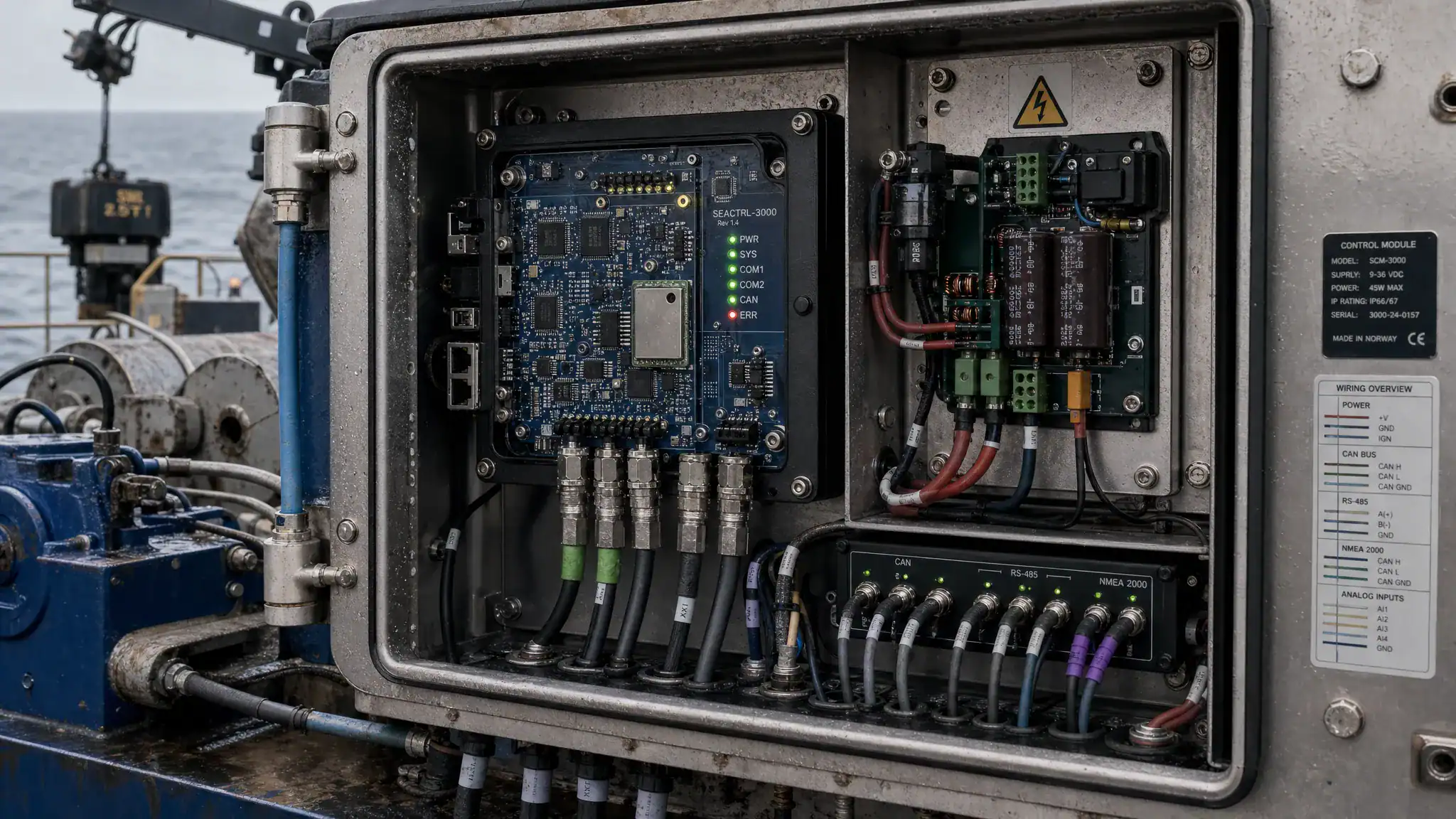
Embedded systems are often judged by what they do in a prototype: read a sensor, drive a motor, transmit data, process signals or control a machine function. In professional products, however, the real test starts outside the lab. Heat, vibration, electrical noise, moisture, user behaviour, certification requirements and production variation all influence whether the system remains reliable over time.
That is why discussions about embedded systems and applications should not stop at processors, firmware or PCB layout. The application environment determines the architecture. A controller for a robot joint, a maritime monitoring unit, a defence communication device and a connected consumer product may all use embedded electronics, but they face very different risks.
For OEMs, machine builders and high-tech product developers, the key question is not simply “can we make it work?” It is “can we make it work safely, repeatedly and maintainably in the environment where it will be used?”
What makes an embedded system demanding in real-world use?
An embedded system is a dedicated combination of hardware, firmware and often software that performs a specific function inside a product, machine or device. In demanding applications, this system must interact with physical reality: power supplies fluctuate, sensors drift, motors generate interference, enclosures trap heat and users do unexpected things.
A lab prototype usually proves technical feasibility. A production-ready embedded system must also prove robustness. That means the design needs to account for operating conditions, compliance constraints, manufacturing repeatability and long-term serviceability from the beginning.
| Real-world demand | Typical risk | Design response |
|---|---|---|
| Power disturbances | Resets, unstable behaviour or component stress | Input protection, filtering, power supervision and robust power architecture |
| EMC and electrical noise | Sensor errors, communication failures or failed compliance tests | EMC-aware layout, shielding strategy, grounding, filtering and early testing |
| Temperature and thermal cycling | Reduced component life, drift or shutdown | Thermal design, derating, enclosure analysis and realistic load testing |
| Vibration and shock | Connector issues, solder fatigue or intermittent faults | Mechanical integration, connector selection, PCB support and validation testing |
| Humidity, salt or dust | Corrosion, leakage currents or enclosure failure | Material selection, sealing strategy, coating decisions and ingress protection planning |
| Lifecycle and production variation | Redesigns, shortages or inconsistent product quality | Component lifecycle checks, DFM, production test strategy and alternative sourcing |
These are not secondary details. They shape the requirements, the PCB, the firmware architecture, the enclosure, the test plan and often the business case.
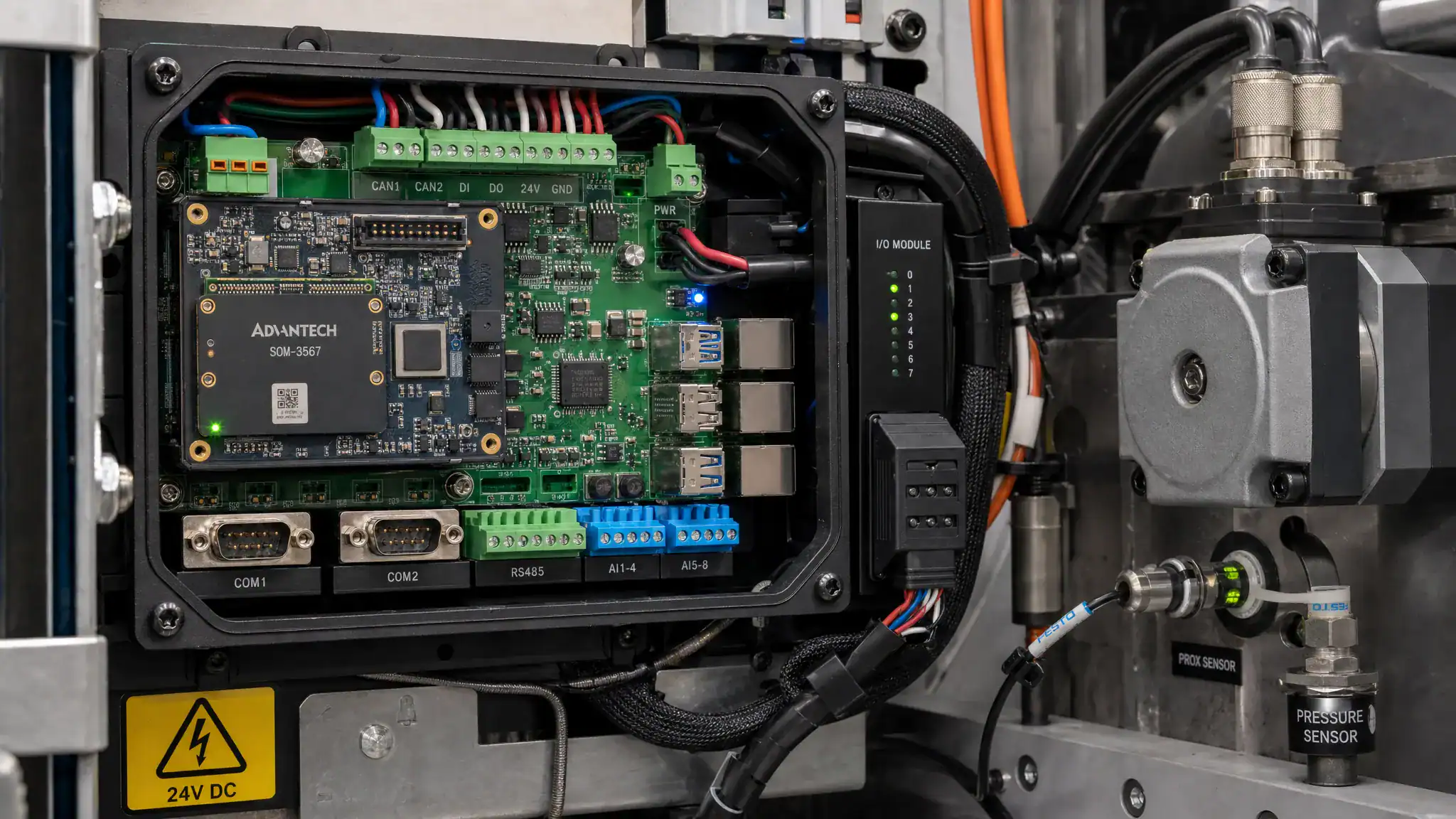
Common embedded system applications in professional products
Embedded systems are used wherever products need local intelligence, control or communication. The application may be small and power-constrained, or it may involve high currents, safety-related functions and complex integration with a larger machine.
Sensing and measurement
Many embedded products start with a physical signal: temperature, pressure, position, vibration, current, voltage, light, flow or chemical properties. The quality of the embedded design determines how accurately that signal is captured and interpreted.
In high-tech measurement equipment, for example, analogue front-end design, grounding, filtering and PCB layout can be just as important as the selected sensor. Poor analogue design can introduce noise that firmware cannot correct later. In maritime or machine environments, cabling and EMC can further influence signal integrity.
Control and actuation
Embedded controllers often drive motors, valves, heaters, pumps, relays or power stages. These applications require close interaction between embedded software, power electronics and the physical load.
A motor drive in a robot or industrial machine is not only a firmware task. It involves switching behaviour, current sensing, thermal management, protection circuits, EMC, safety behaviour and mechanical constraints. This is where hardware and software co-design becomes essential.
Connectivity and communication
Connected products use embedded systems to exchange data with other devices, machines, cloud platforms or operator interfaces. Depending on the product, this may involve wired communication, wireless communication, IoT connectivity or secure local networks.
Connectivity introduces additional design responsibilities. Wireless products may need to consider the Radio Equipment Directive in Europe. Products placed on the European market also need to be designed with relevant CE requirements in mind, as outlined in the European Commission’s CE marking guidance. The right approach is to consider these constraints early, not after the hardware is already fixed.
Protection, diagnostics and safety behaviour
In demanding applications, embedded systems often need to detect abnormal conditions and respond predictably. That can include overtemperature, overcurrent, undervoltage, communication loss, blocked motors, sensor faults or enclosure intrusion.
Diagnostics are not only useful for fault handling. They also support production testing, field service, warranty analysis and product improvement. A system that can log relevant events, expose useful status information and support controlled firmware updates is easier to maintain over its lifecycle.
Examples across demanding industries
Different sectors use embedded systems for different reasons. The technical challenge is to translate the application context into a reliable architecture.
| Industry or product type | Typical embedded functions | Key design priorities |
|---|---|---|
| Machine manufacturing | Motion control, sensor acquisition, HMI interfaces, safety-related monitoring | EMC, deterministic behaviour, maintainability and production testability |
| Robotics | Motor drives, position feedback, battery management, communication between modules | Low latency, power density, thermal control and robust connectors |
| Maritime | Monitoring, control, communication, navigation support and power management | Humidity, salt exposure, vibration, isolation and long service life |
| Defence and security | Secure communication, rugged control units, sensor integration and portable electronics | Reliability, robustness, controlled interfaces and environmental resilience |
| Automotive and mobility | Control units, power conversion, sensing, diagnostics and communication buses | Transients, vibration, thermal behaviour and lifecycle planning |
| High-tech equipment | Precision measurement, signal processing, motion control and embedded computing | Low-noise analogue design, timing, integration and scalability |
| Professional consumer electronics | Wireless connectivity, power management, user interfaces and compact electronics | RED and EMC awareness, battery life, enclosure integration and manufacturability |
The same embedded technology can behave very differently depending on where it is used. A wireless module that works on a desk may struggle inside a metal enclosure. A power stage that performs well in open air may overheat in a sealed product. A sensor interface that is stable in a short test cable may become unreliable in a machine with motors and switching loads nearby.
This is why application analysis is a core engineering activity, not a formality.
Architecture choices depend on the application
Selecting the processing platform is one of the visible decisions in embedded development, but it should not be made in isolation. The right choice depends on timing requirements, power budget, software complexity, security needs, interface count, lifecycle expectations and production volume.
| Architecture option | Often suitable for | Main considerations |
|---|---|---|
| Microcontroller-based design | Control loops, sensor interfaces, compact devices and low-power products | Real-time behaviour, limited resources, long lifecycle and efficient firmware |
| Embedded Linux or processor module | Data processing, connectivity, user interfaces and gateway functions | Boot time, cybersecurity, update strategy, thermal design and lifecycle support |
| FPGA or programmable logic | High-speed signal processing, deterministic timing and parallel interfaces | Development complexity, verification effort and specialist knowledge |
| Distributed embedded architecture | Machines, robots and modular equipment with multiple subsystems | Communication reliability, synchronisation, diagnostics and service strategy |
| Custom power and control electronics | Motor drives, converters, battery systems and high-current applications | Thermal behaviour, switching layout, protection and EMC performance |
A common mistake is to choose an architecture because it is familiar or fast for a prototype. That may be acceptable in early research, but professional product development needs a broader view. The architecture must support validation, compliance, manufacturing and maintenance.
For example, a single-board computer may accelerate early software development, but it may not be the best fit for a compact, power-sensitive or long-lifecycle product. A microcontroller may be efficient and robust, but insufficient if the application needs complex connectivity or local data processing. The design decision should be based on the product’s operating context and lifecycle, not only on development convenience.
Why prototypes fail outside the lab
Many embedded failures are not caused by one obvious design error. They are caused by assumptions that were never tested under realistic conditions.
A prototype might use a bench supply instead of the real power source. It might be tested with short cables instead of production cable lengths. It might run at room temperature without enclosure heating. It might be evaluated by engineers who know how to use it correctly, rather than by operators in the field.
These gaps can lead to failures during certification, pilot production or customer deployment. Typical symptoms include intermittent resets, noisy measurements, wireless range problems, unexpected firmware states, overheated components, EMC failures or unexplained field returns.
ProMicro has written more specifically about this pattern in the article on why embedded electronics fail outside the lab. The short version is that validation must reflect the real operating envelope, including power, temperature, EMC, mechanical stress, user behaviour and production constraints.
Designing embedded systems for compliance and reliability
Compliance should not be treated as a final hurdle. Standards and directives influence architecture, component selection, layout, enclosure design, cabling and firmware behaviour. For products with wireless communication, power electronics or safety-related functions, these choices can determine whether certification becomes predictable or painful.
EMC is a clear example. Filtering, grounding, switching edges, PCB stack-up, cable routing and enclosure design all affect emissions and immunity. If EMC is only addressed during final testing, redesigns can be expensive. If it is considered during architecture and PCB layout, risk is reduced earlier. ProMicro’s article on what EMC means in electronic product design explains this in more detail.
Functional safety may also be relevant depending on the application. Not every embedded product is safety-critical, but many products need defined behaviour when faults occur. The IEC functional safety overview gives a useful introduction to the broader concept. In practice, engineering teams should define what the system must do during abnormal conditions, how faults are detected and what state is considered safe for the product.
Reliability also depends on lifecycle decisions. Component availability, firmware update mechanisms, production test coverage, connector choices and enclosure materials all influence whether the product can be manufactured and supported over time.
Practical design principles for demanding embedded applications
A robust embedded system is rarely the result of one discipline working alone. It requires alignment between system engineering, electronics, embedded software, mechanical integration and manufacturing preparation.
The following principles help reduce technical risk before it becomes expensive:
- Define the application environment before finalising the architecture, including power source, temperature range, enclosure, cabling, vibration, moisture, user behaviour and expected lifetime.
- Treat hardware, firmware, power electronics and analogue electronics as one system, especially where sensors, motor drives, wireless communication or high-current switching are involved.
- Design with EMC, RED, CE and safety-related constraints in mind from the start, while recognising that exact requirements depend on product category and market.
- Validate prototypes under realistic conditions, not only on a bench, and use test results to improve the design before scaling.
- Prepare for manufacturing early by considering test points, programming, calibration, assembly tolerances, component lifecycle and service access.
This approach does not eliminate all development risk. It makes risk visible earlier, when architecture and design decisions are still easier to change.
From concept to volume-ready embedded electronics
For technical directors, CTOs and product development managers, the transition from concept to production is often where complexity increases. A demonstrator may prove that the idea is feasible, but volume-ready electronics require a stronger foundation.
A professional development path usually includes requirements clarification, system architecture, schematic and PCB design, firmware development, mechanical and enclosure alignment, prototype builds, verification, design iterations, manufacturing preparation and lifecycle planning. The exact process depends on the product, but skipping steps often moves risk downstream.
Production readiness also requires attention to details that may not be visible in the prototype: assembly repeatability, production test fixtures, firmware programming, calibration procedures, traceability, supplier documentation and component alternatives. These details directly affect yield, quality and long-term support.
This is where an end-to-end electronics partner can add value. ProMicro supports customers with embedded system development, power electronics, analogue electronics, PCB design, system engineering, enclosure design, rapid prototyping and support towards volume manufacturing. The goal is not just to create a working board, but to develop electronics that fit the product, the environment and the manufacturing path.
Questions to ask before starting an embedded system project
Before committing to a design direction, decision-makers should challenge the assumptions behind the product. Useful questions include:
- What environmental conditions will the product face during transport, installation, operation and service?
- Which functions must continue safely if sensors, communication, power or actuators behave unexpectedly?
- Which standards, directives or customer requirements may influence architecture, PCB layout, enclosure or firmware?
- How will the product be tested during development, production and field service?
- What production volume, product variants and lifecycle expectations should the architecture support?
- Which internal engineering skills are available, and where is specialist capacity needed?
The answers often reveal hidden requirements. Finding them early is far cheaper than discovering them during certification, pilot production or field deployment.
Frequently asked questions
What are embedded systems and applications? Embedded systems are dedicated electronic systems that combine hardware and firmware to perform specific functions inside products, machines or devices. Their applications include sensing, control, communication, diagnostics, power management and automation across sectors such as robotics, maritime, automotive, defence and high-tech equipment.
Why do embedded systems need to be designed around the application environment? The environment determines the real stresses on the electronics. Temperature, vibration, moisture, EMC, power disturbances, cable lengths, enclosure design and user behaviour can all affect reliability. A design that works in a lab may fail if these factors are not considered.
When should compliance be considered in embedded product development? Compliance should be considered during requirements and architecture definition. EMC, RED, CE and safety-related constraints can influence component selection, PCB layout, enclosure design, communication architecture and test planning. Early attention reduces the risk of costly redesigns later.
Can a prototype embedded system be used directly for volume production? Sometimes, but it should not be assumed. A prototype may need changes for manufacturability, testability, component availability, EMC performance, thermal behaviour and long-term reliability. A structured validation and industrialisation phase helps turn a working prototype into a production-ready product.
Developing embedded systems for demanding use?
If your product must operate reliably in a demanding environment, the embedded system should be designed around more than the immediate function. Power behaviour, analogue performance, EMC, firmware, enclosure integration, compliance risk and manufacturing readiness all need to work together.
ProMicro helps companies develop reliable embedded electronics from first idea to volume-ready solutions, combining embedded systems, power electronics, analogue design, PCB development, prototyping and manufacturing support. If you are developing a machine, connected device, control unit or high-tech product, a technical discussion early in the process can help identify risks before they become costly design constraints.