
In complex product development, risk rarely appears as one single technical problem. It builds up through unclear requirements, underestimated environments, late compliance questions, unstable interfaces, component choices, thermal constraints, firmware behaviour and manufacturing assumptions. For companies developing professional products in defence, maritime, high-tech, machine manufacturing, robotics, automotive or connected electronics, these risks can quickly become commercial risks.
This is where embedded systems play a critical role. A well-designed embedded system is not just a controller board or a piece of firmware. It is the part of the product that measures, decides, protects, communicates and adapts. When designed properly, it makes product behaviour more predictable, more testable and easier to scale from prototype to volume manufacturing.
Embedded systems do not remove every uncertainty from development. They do something more practical: they help teams identify, control and reduce uncertainty before it becomes expensive to correct.
Why complex product development creates technical risk
Modern electronic products are no longer isolated hardware devices. A machine controller may combine sensors, motor drives, wireless communication, power conversion, embedded software, analogue measurement circuits, safety logic, cloud connectivity and a mechanical enclosure. Each discipline influences the others.
A change in enclosure material can affect antenna performance or EMC behaviour. A different motor cable can increase conducted emissions. A sensor interface that works in a laboratory may be unstable in a humid, vibrating or electrically noisy environment. A firmware feature added late in development may increase processing load or expose limitations in the original architecture.
The most common risk sources in complex product development include:
- Requirements that describe desired functions, but not measurable operating limits
- Interfaces between electronics, software, mechanics and power systems that are not fully defined
- Real-world conditions such as vibration, temperature, moisture, electromagnetic noise and user misuse
- Late discovery of EMC, RED, CE or safety-related design issues
- Prototypes that work in controlled tests, but are difficult to manufacture or maintain
- Component availability, lifecycle and substitution risks
- Limited internal engineering capacity for specialist areas such as power electronics, analogue design or embedded firmware
The earlier these risks are translated into architecture decisions, design rules and testable requirements, the lower the probability of expensive redesigns later.
Embedded systems turn assumptions into controlled behaviour
One of the most valuable functions of embedded systems is that they convert assumptions into explicit logic. Instead of relying on the product always being used under ideal conditions, the embedded system can monitor real operating conditions and respond in a controlled way.
For example, a motor-driven product may need to handle stall conditions, voltage drops, overheating, unexpected load changes or communication loss. Without embedded control, these scenarios may result in unpredictable failure. With suitable sensing, firmware logic and power-stage protection, the product can detect the condition, limit current, shut down safely, log the event or notify a higher-level system.
This does not only improve the final product. It also improves the development process. When behaviour is defined through state machines, thresholds, diagnostics and test modes, engineers can verify what the product should do under normal, abnormal and boundary conditions.
| Development risk | How embedded systems reduce the risk | Practical example |
|---|---|---|
| Ambiguous functionality | Convert user needs into measurable states, limits and responses | Defining start-up, normal operation, fault and safe states |
| Environmental stress | Monitor and respond to temperature, voltage, current, vibration or communication quality | Thermal derating or controlled shutdown |
| Power or load variation | Use feedback and protection logic to prevent overstress | Current limiting in a motor drive or DC power stage |
| EMC sensitivity | Support stable architecture, filtering, grounding and interface decisions | Robust sensor interfaces and controlled switching behaviour |
| Field failures | Add diagnostics, event logging and watchdog mechanisms | Fault history for service and root-cause analysis |
| Production variation | Enable calibration, self-test and traceability | Factory test modes and stored calibration parameters |
| Lifecycle uncertainty | Design modular firmware and hardware interfaces | Easier component replacement or product variants |
Reducing requirements risk before design begins
Many technical problems start before schematic design or firmware development. They begin when the product goal is understood, but the technical requirements are incomplete.
A statement such as the device must measure accurately is not enough. The embedded system design needs to know the measurement range, sample rate, resolution, environmental conditions, allowed drift, calibration method, communication protocol, power budget and failure response. The same applies to motor control, wireless communication, sensor fusion, battery operation or user interface behaviour.
A strong embedded development process forces these questions to the surface early. It helps product owners and engineering teams define:
- What the product must do in each operating mode
- What conditions are considered normal, degraded or unsafe
- Which signals, voltages, currents and temperatures must be monitored
- How the product should respond to faults or unexpected user behaviour
- Which standards, interfaces and production constraints must influence the design
This reduces the risk of building a prototype that demonstrates the idea, but cannot become a robust product. It also helps decision-makers understand trade-offs before large investments are made in tooling, certification, software platforms or supply chain commitments.
Architecture decisions have a direct effect on risk
Embedded systems reduce risk most effectively when architecture is treated as a serious engineering phase, not as an administrative step. Architecture determines how hardware, software, power electronics, analogue circuits, communication interfaces and mechanical constraints work together.
Key architectural decisions include the choice of microcontroller or processor, sensor interfaces, isolation strategy, power supply topology, PCB stack-up, connector strategy, software partitioning, update method, wireless module selection and diagnostic concept. Each decision can reduce risk or move risk to a later stage.
For example, using a high-performance processor may offer flexibility, but it can increase power consumption, thermal load and EMC complexity. Using a compact PCB may support mechanical integration, but it can make routing, creepage, clearance, antenna placement and test access more difficult. Choosing a wireless module may shorten development time, but antenna integration and RED-related requirements still need careful attention.
This is why embedded system architecture should be developed with the full product context in mind. The product is not only a PCB. It is a combination of electronics, firmware, enclosure, cables, user context, power source, manufacturing process and lifecycle expectations.
Better control of real-world behaviour
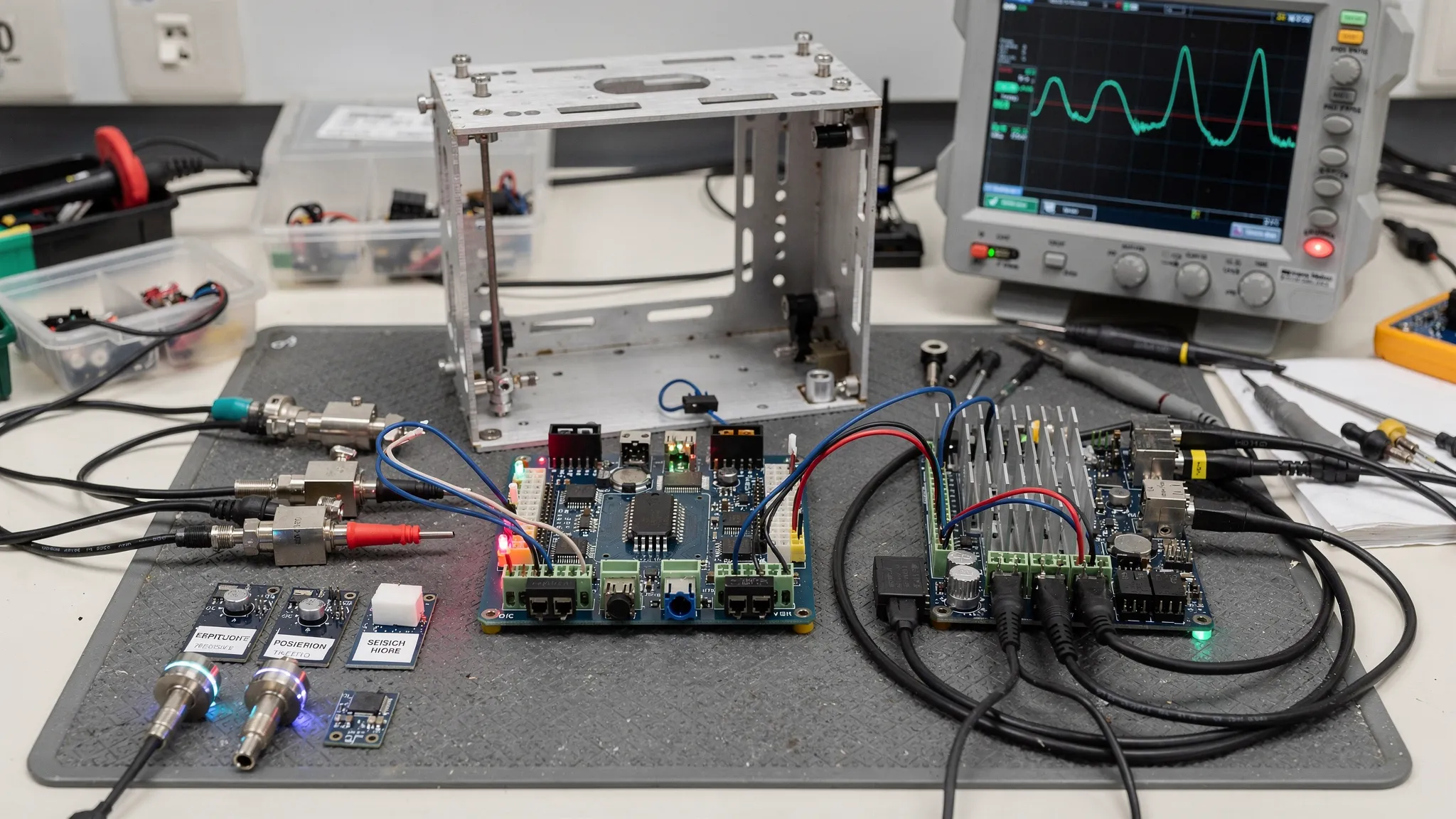
A prototype that works on a desk is not the same as a product that works reliably in the field. Real-world environments create edge cases. These include cold starts, brown-outs, voltage transients, EMI bursts, condensation, cable disconnection, load spikes, software timing issues and unexpected operator actions.
Embedded systems help reduce this risk by adding controlled behaviour around those edge cases. Firmware can validate sensor readings, reject impossible values, debounce inputs, monitor communication timeouts and place the product in a known safe state. Hardware can support this through suitable sensing, filtering, isolation, protection circuits and power supervision.
For products with motors, actuators or high-power loads, the relationship between embedded control and power electronics becomes especially important. A power stage may look acceptable in a simulation or evaluation setup, but behave differently once cable lengths, switching frequencies, parasitic effects, thermal conditions and enclosure constraints are included. Embedded monitoring and well-designed control loops can help manage these conditions, but only when the power electronics, PCB layout and firmware are developed together.
This integrated view is one reason why custom electronics can be necessary for demanding applications. Off-the-shelf modules can be useful, but they may not provide enough control over switching behaviour, thermal design, layout, diagnostics or compliance-related constraints. ProMicro has discussed this challenge in more detail in its article on custom power electronic solutions.
Lower compliance risk through design choices
Compliance is often treated as a testing phase, but many compliance outcomes are shaped much earlier. Embedded system choices influence electromagnetic compatibility, radio performance, electrical safety, thermal behaviour, documentation and production consistency.
For products sold in the European market, CE marking is based on meeting applicable EU requirements. The European Commission provides guidance on CE marking, while products with wireless communication may fall under the Radio Equipment Directive. Electronic products may also need to consider the EMC Directive, depending on the product and application.
An embedded system cannot guarantee certification. No serious engineering partner should promise that without proper testing and assessment. What it can do is reduce uncertainty by designing with compliance in mind from the beginning.
This includes identifying applicable standards early, selecting architectures that support EMC performance, controlling switching frequencies, designing stable grounding and shielding strategies, considering cables and connectors, selecting suitable radio modules and planning pre-compliance testing. It also means creating documentation and traceability that support later assessment.
For many products, EMC is one of the most underestimated risks. A device can function perfectly in normal operation and still fail EMC testing because of radiated emissions, conducted emissions, immunity issues or poor cable behaviour. ProMicro explains this topic further in its article what is EMC?.
Embedded diagnostics reduce field and service risk
Risk does not stop after launch. Once a product is installed in a machine, vessel, vehicle, defence platform or industrial environment, serviceability becomes part of product quality. If a failure occurs, the question is not only what went wrong, but whether the product provides enough information to diagnose it.
Embedded diagnostics can significantly reduce service and liability risk. Event logs, fault counters, voltage and temperature history, firmware version tracking, calibration data and communication status can help engineers distinguish between design issues, installation problems, misuse, component failures or environmental events.
This matters for OEMs and machine builders because field problems are expensive. Sending engineers to investigate intermittent faults, replacing parts without root-cause evidence or dealing with customer downtime can cost far more than building diagnostics into the product early.
Good diagnostics also support continuous improvement. Data from prototypes, pilot production and early field deployments can reveal patterns that were not visible in laboratory testing. That information can feed back into firmware updates, component selection, enclosure improvements or production test procedures.
From prototype risk to manufacturing readiness
A prototype often proves that the concept can work. It does not automatically prove that the product can be manufactured repeatedly, tested efficiently and supported over several years.
Embedded systems reduce manufacturing risk when production needs are included early in the design. This can include factory test modes, programming interfaces, calibration routines, serial number handling, test points, boundary conditions for automated testing and clear pass-fail criteria. These features may not be visible to the end user, but they can have a major effect on yield, service quality and production cost.
Manufacturing readiness also depends on hardware decisions. PCB layout, connector choice, component tolerances, thermal design, enclosure integration and assembly access all influence whether a design can move smoothly from engineering prototype to 0-series and volume production.
This is where embedded systems and electronics design must be connected to lifecycle thinking. Component availability, second-source options, firmware maintainability and documentation quality all reduce long-term risk. ProMicro covers related principles in its article on scalable embedded system development.
What decision-makers should ask before starting development
For CTOs, technical directors, founders and engineering managers, the value of embedded systems is not only technical. It is strategic. The right architecture can reduce delays, lower redesign costs and improve confidence before committing to certification, tooling or production.
Before starting development, it is useful to ask:
- What real-world conditions must the product survive, not just function in?
- Which failure modes are unacceptable, and what should the product do when they occur?
- Which EMC, RED, CE, safety or sector-specific requirements may apply?
- Which parts of the system require specialist expertise, such as power electronics, analogue design or wireless integration?
- How will prototypes be tested against realistic loads, cables, enclosures and environmental conditions?
- What production test, calibration and service information will be needed later?
- How long must the product remain manufacturable and maintainable?
These questions help prevent a narrow view of embedded development. The goal is not simply to make the electronics work. The goal is to create a reliable, scalable and maintainable product that performs in its intended environment.
When an external embedded systems partner reduces risk
Many companies have strong internal engineering teams, but complex electronic product development often requires temporary specialist capacity. This is especially true when embedded software, power electronics, analogue circuits, PCB design, EMC behaviour, enclosure integration and manufacturing preparation need to be aligned.
An external development partner can reduce risk when internal teams lack time, specialist knowledge or experience with production-ready electronics. The value is not only extra engineering hours. It is the ability to think beyond the requested task and identify hidden requirements before they become costly.
ProMicro supports customers from first idea to volume solutions, with expertise in embedded systems, power electronics, analogue electronics, PCB design, system engineering, enclosure design, rapid prototyping and manufacturing support. For companies developing complex machines, high-value technical equipment or connected products, this integrated approach helps reduce technical uncertainty across the full product lifecycle.
If you are considering working with an external electronics design partner, ProMicro has also published practical guidance on how to work with an external electronics design PCBA partner.
Frequently asked questions
How do embedded systems reduce risk in product development? Embedded systems reduce risk by making product behaviour measurable, controlled and testable. They can monitor real-world conditions, manage faults, support diagnostics, improve interface control and help prepare the product for compliance and manufacturing.
Are embedded systems mainly a software issue? No. Embedded systems combine hardware, firmware, sensors, power electronics, analogue circuits, communication interfaces, PCB layout and mechanical constraints. Treating them as software only can create integration, EMC, thermal and reliability risks.
Can embedded systems guarantee EMC, RED or CE compliance? No embedded design can guarantee compliance without proper testing and assessment. However, designing with compliance in mind from the start can reduce the risk of late redesigns, failed tests and certification delays.
When should embedded system architecture be defined? Architecture should be defined early, before detailed schematic, PCB and firmware work. Early architecture decisions influence component choice, power design, software structure, EMC behaviour, manufacturability and lifecycle support.
Why do prototypes sometimes fail when moving to production? Prototypes often focus on proving core functionality, while production requires repeatability, testability, component availability, thermal stability, documentation and manufacturability. Embedded test modes, calibration routines and lifecycle planning help close this gap.
Reduce risk before it becomes redesign work
The cost of technical risk increases as a product moves from concept to prototype, certification and production. Embedded systems help reduce that risk by bringing structure, control and verification into the development process early.
For complex electronic products, this requires more than a working PCB or isolated firmware task. It requires an integrated approach across embedded systems, power electronics, analogue design, PCB layout, enclosure integration, compliance awareness, prototyping and manufacturing preparation.
If your organisation is developing a complex electronic product and wants to reduce risk from concept to volume manufacturing, ProMicro can help you assess the technical challenges and define a practical development path.