
For many professional products, the first technical discussions focus on visible functions: the sensor must measure this, the motor must deliver that torque, the device must connect over wireless, the interface must fit into a compact enclosure. Those functions matter, but they are only part of the engineering challenge.
In embedded product development, the real question is not simply whether a feature can be made to work. The question is whether the complete system can work reliably, safely, repeatedly and economically in its intended environment, from first prototype to volume manufacturing.
That is why system design embedded thinking matters from day one. It prevents teams from treating firmware, PCB layout, power electronics, analogue electronics, mechanics, compliance and manufacturing as separate work packages that are only brought together near the end. By then, many of the most expensive design constraints are already locked in.
What system design embedded thinking means in practice
System design embedded thinking means looking at an embedded product as an integrated technical system rather than as a collection of components. It connects the product idea to all the engineering realities that will determine whether the product succeeds in the field.
For an OEM, machine builder, robotics company, automotive supplier, maritime technology company or defence-related developer, this includes questions such as:
- What physical environment will the electronics operate in?
- What power conditions, transients, heat, vibration, moisture or electromagnetic disturbances can occur?
- Which functions require real-time behaviour, fault detection or safe shutdown?
- How will firmware, power electronics, sensors, communication interfaces and mechanics influence each other?
- What must be designed in early to support EMC, RED, CE, safety and manufacturability?
- How will the product be tested, updated, serviced and supported over its lifecycle?
This mindset does not slow development down. In practice, it often prevents rework by making hidden constraints visible before architecture, component choices and PCB layout become difficult to change.
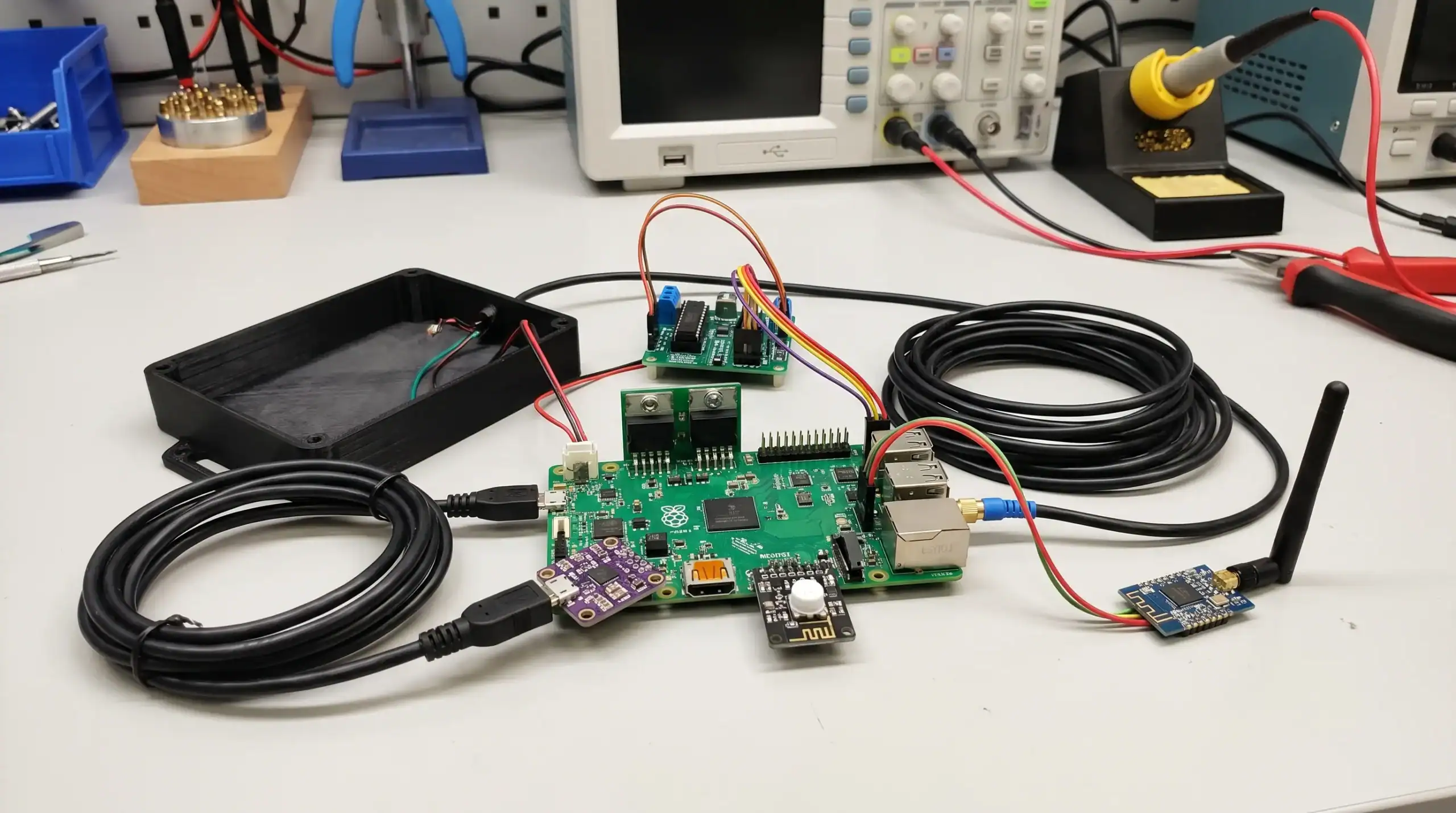
Why day-one decisions have a long technical shadow
Embedded electronics are shaped by early decisions. The selected processor influences firmware architecture, timing behaviour, cybersecurity options, supply continuity and thermal design. The power architecture affects EMC, efficiency, heat dissipation and fault tolerance. The enclosure affects antenna performance, cooling, cabling, ingress protection and serviceability.
When these decisions are made without a full system view, the prototype may still work in the lab. Problems often appear later, during EMC pre-compliance, certification preparation, production scaling or real-life use.
| Day-one design decision | Later impact | Risk if treated too late |
|---|---|---|
| Power architecture | Thermal behaviour, EMC, safety margins, power integrity | Brown-outs, overheating, interference or oversized filtering |
| Processor or controller choice | Firmware complexity, real-time behaviour, security, lifecycle | Performance limits, redesigns or difficult long-term support |
| Sensor and analogue front-end | Measurement accuracy, noise immunity, calibration | Unstable readings, field drift or poor repeatability |
| Wireless and connectivity concept | Antenna performance, RED considerations, enclosure layout | Weak range, compliance delays or late mechanical changes |
| PCB and enclosure integration | Cooling, cable routing, assembly, vibration resistance | Prototype success but production or field failures |
| Test and programming strategy | Manufacturing yield, diagnostics, serviceability | Slow production ramp-up and limited fault analysis |
The earlier these relationships are understood, the easier it is to design a robust architecture. This is especially important for products that combine motor drives, sensors, wireless communication, IoT connectivity, battery systems or high-current electronics.
Hidden requirements are often more important than the first specification
A written specification usually describes what the product should do. It may state voltage ranges, communication protocols, enclosure dimensions, user functions and cost targets. However, many of the most important requirements are hidden in the application context.
A machine installed in a factory may experience switching noise from nearby drives. A maritime device may face humidity, salt exposure and long cable runs. A defence-related system may need predictable behaviour under electrical disturbances. A robotic product may combine fast motor control, high peak currents, sensor accuracy and compact mechanical integration. A consumer electronics product may need a refined user experience while still meeting safety, wireless and production constraints.
These contextual factors influence the design before the first schematic is drawn. They determine whether the system needs galvanic isolation, surge protection, shielding, watchdogs, diagnostic logging, redundant sensing, thermal derating or specific firmware fault states.
A strong embedded system design process therefore starts by challenging the brief. Not to make the project more complicated, but to uncover the conditions that the product must survive.
Hardware and firmware should be co-designed
A common development risk is treating hardware and firmware as sequential phases. First the electronics are designed, then firmware is added. For simple devices this may work, but complex embedded products rarely behave so neatly.
Firmware decisions affect hardware requirements. Hardware limitations affect firmware architecture. Power modes, boot behaviour, sensor sampling, motor control loops, communication timing, error handling and update mechanisms all require interaction between electronics and software.
For example, a motor drive may need fast current measurements, robust gate control, thermal monitoring and safe fault handling. A wireless sensor may need low-power states, wake-up behaviour, secure communication and stable analogue measurement. An industrial device may need diagnostics that help service engineers understand faults without dismantling the product.
If these aspects are not considered together, teams can end up compensating in software for hardware limitations, or adding hardware fixes because firmware assumptions were incomplete. Co-design avoids this by defining interfaces, timing, fault behaviour and verification criteria early.
This is also where embedded systems differ from general software development. The code is not running in isolation. It is controlling physical electronics, reading imperfect signals, reacting to disturbances and operating inside a constrained thermal and power envelope.
Compliance must be designed in, not inspected in
Compliance is one of the clearest examples of why system thinking matters early. EMC, RED, CE and safety-related design considerations are not final paperwork exercises. They are influenced by architecture, PCB layout, grounding, shielding, cable routing, enclosure design, firmware behaviour and component selection.
Leaving EMC until the end can lead to late redesigns, added filters, enclosure changes or schedule pressure. Early design choices such as power converter topology, switching frequency, return path control, connector placement and separation between noisy and sensitive domains can make a significant difference.
This does not mean certification results can be guaranteed purely by good design. Formal testing remains necessary where applicable. But designing with compliance in mind from the beginning improves the chance that testing confirms a well-controlled design rather than revealing fundamental architectural weaknesses.
For a deeper explanation of electromagnetic compatibility and why it belongs early in the development process, see ProMicro’s guide on what EMC means for electronic product design.
Manufacturing readiness starts before the prototype
A prototype proves that a concept can work. It does not automatically prove that the product can be manufactured consistently, tested efficiently or supported over several years.
Manufacturing readiness depends on design choices made from the beginning. Test points, programming access, calibration methods, connector selection, component tolerances, assembly sequence, thermal interfaces and enclosure constraints all affect production. So does component availability, especially for products with long market lifecycles.
Prototype shortcuts can be useful when they are intentional and documented. They become dangerous when they hide risks that must later be solved under time pressure. A development board, hand-soldered modification or oversized laboratory power supply may help prove a principle, but the production design must still deal with real tolerances, disturbances, assembly variation and service needs.
This is why scalable embedded development is not only about adding more features later. It is about creating an architecture that can move from concept to prototype, from prototype to pilot series, and from pilot series to volume manufacturing without unnecessary redesign. ProMicro has written more about this in its article on scalable embedded system development.
A practical day-one framework for embedded system design
The first phase of an embedded product should create more than a list of functions. It should create a shared system understanding between product owners, electronics engineers, firmware developers, mechanical designers, production stakeholders and compliance specialists.
A practical framework includes six early activities:
- Define the mission profile: Clarify where the product will be used, by whom, for how long, under which environmental, electrical and mechanical conditions.
- Map system boundaries and interfaces: Identify power inputs, sensors, actuators, communication links, user interfaces, enclosures, cables and external systems.
- Identify the main risk drivers: Focus on EMC, heat, power peaks, analogue accuracy, wireless range, safety, lifecycle, firmware complexity and manufacturability.
- Choose architecture before detailed design: Decide on power domains, processing concept, communication structure, protection strategy, mechanical integration and test approach.
- Plan verification early: Define how requirements will be tested through simulation, bench testing, prototypes, pre-compliance checks and production tests.
- Consider lifecycle from the start: Review component availability, firmware update strategy, service access, diagnostics and future product variants.
This type of early structure is particularly valuable when internal teams have limited capacity or when the product crosses multiple specialist domains. It gives decision-makers a clearer view of technical risk before significant development budget is committed.
The business value of early system design
System design is not only an engineering preference. It is a business risk management tool.
Late technical surprises can affect launch dates, certification planning, supplier commitments, customer trials and production cost. In high-value professional markets, a field issue can also damage customer confidence. For machine manufacturers and OEMs, electronics reliability is often directly connected to the reliability of the complete product or machine.
Early system thinking helps management teams make better trade-offs. It clarifies where standard modules are sufficient and where custom electronics are justified. It shows which requirements drive cost and complexity. It also helps avoid overengineering, because architecture decisions are based on real product risks rather than assumptions.
The same principle applies beyond engineering. Companies expanding product development, manufacturing or commercial operations into new jurisdictions often benefit from specialist guidance on structure and compliance. For example, firms considering UAE entities may use expert support for company setup and ongoing corporate management so that legal and operational foundations are addressed early rather than corrected later.
In both cases, the lesson is similar: the earlier structural decisions are made with specialist input, the fewer avoidable constraints appear downstream.
When to involve an embedded systems partner
Some companies have strong internal engineering teams but lack specialist capacity in power electronics, analogue design, EMC-aware PCB layout or embedded architecture. Others have a clear product idea but need help translating it into a reliable, manufacturable electronic system. In both cases, the best time to involve an external partner is before key architecture choices are fixed.
An embedded systems partner can help challenge assumptions, identify hidden requirements, evaluate technical feasibility and define a development route. The value is not only in designing a PCB or writing firmware. It is in connecting system engineering, electronics design, embedded software, power electronics, analogue electronics, enclosure considerations, prototyping and manufacturing preparation.
This is the type of integrated approach ProMicro focuses on. By supporting customers from idea generation through development and towards volume solutions, ProMicro helps reduce technical risk early and create electronics that are designed for real-world performance, compliance awareness and long-term use.
For a related perspective, read ProMicro’s article on how embedded systems reduce risk in complex product development.
Frequently asked questions
What does system design embedded thinking mean? It means designing an embedded product as a complete system from the start, including hardware, firmware, power, analogue electronics, mechanics, compliance, manufacturing and lifecycle considerations.
Why is it risky to start directly with PCB design? PCB design locks in many architectural decisions. If power behaviour, EMC, thermal management, firmware interfaces or manufacturing needs are not understood first, the PCB may need expensive redesign later.
How early should EMC, RED or CE considerations be reviewed? They should be reviewed during the concept and architecture phase. Early consideration helps guide topology, layout, enclosure, cabling, wireless choices and test planning, although formal certification testing may still be required later.
Can an internal engineering team still lead the project when using an external partner? Yes. A good external partner supports the internal team by adding specialist expertise, capacity and system-level review. The product owner remains in control of the product vision and business priorities.
Is system-level design only relevant for high-volume products? No. It is also important for low-volume professional products, complex machines and high-value equipment, because reliability, serviceability, certification risk and field performance can be more important than unit volume.
Build embedded products with confidence from day one
The most reliable embedded products are rarely the result of isolated design tasks. They are the result of early system-level decisions that connect the product idea to real-world use, compliance, manufacturing and lifecycle requirements.
If your organisation is developing a product that combines embedded software, power electronics, analogue electronics, sensors, connectivity or mechanical integration, involving the right technical partner early can prevent costly redesigns later.
ProMicro supports companies from first idea to production-ready electronics with expertise in embedded systems, power electronics, analogue design, PCB development, system engineering, prototyping and volume manufacturing support. If you want to reduce technical risk before critical design choices are fixed, contact ProMicro to discuss your project.