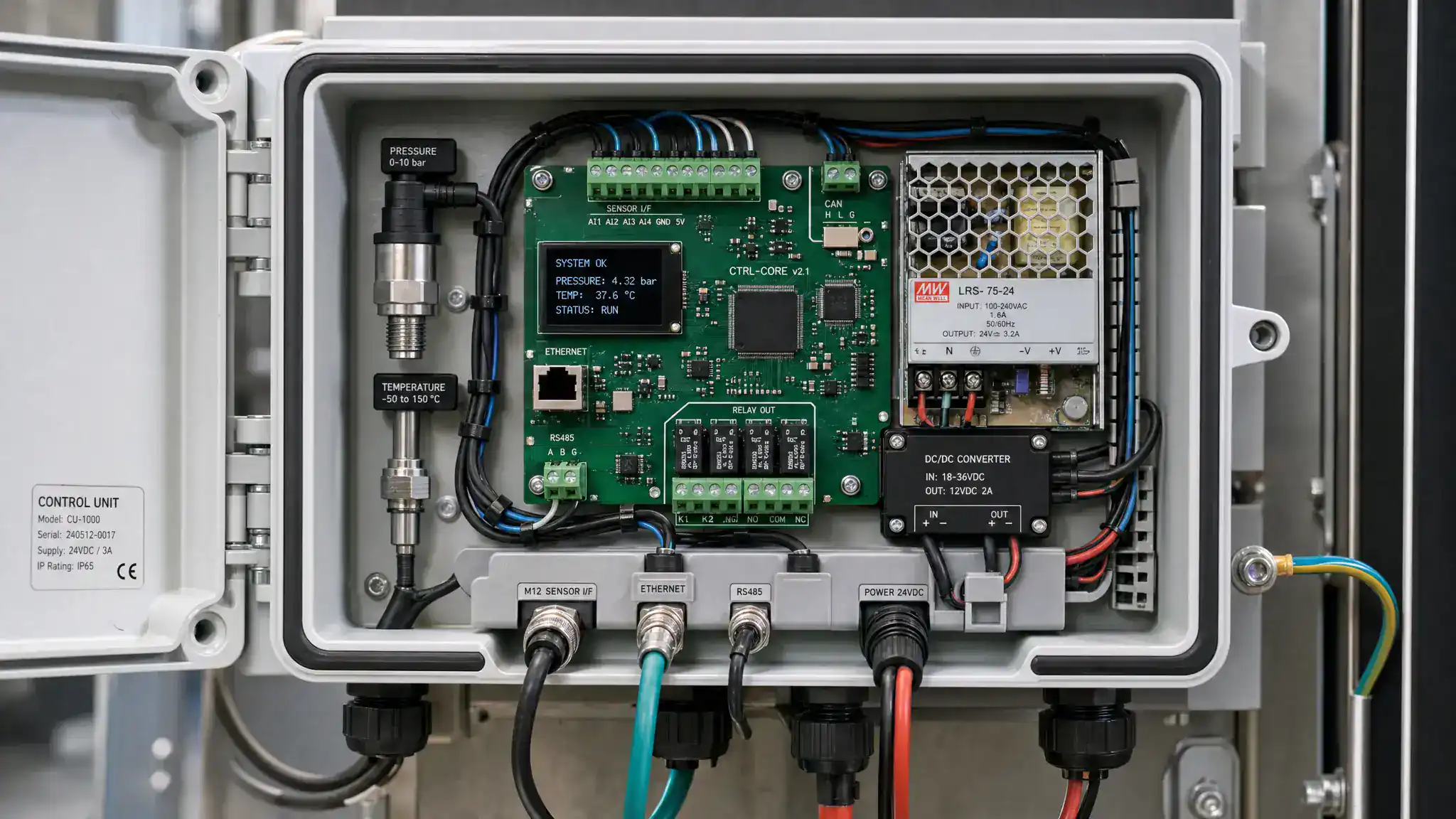
In a product development meeting, the phrase embedded system can sound deceptively simple. It may be described as a microcontroller, a PCB, a piece of firmware or the electronics inside a device. In real product design, however, the meaning of embedded system is broader and more consequential.
An embedded system is the part of a product that makes decisions, controls behaviour and connects software logic to the physical world. It reads sensors, drives actuators, manages power, communicates with other systems and handles fault conditions. It also has to do all of this reliably inside the product’s actual environment, not only on an engineer’s desk.
For CTOs, technical directors, product owners and engineering managers, this definition matters because embedded choices made early affect reliability, safety, EMC behaviour, certification risk, manufacturability and long-term support. A prototype that “works” is not the same as an embedded system that is ready for production.
A practical definition of an embedded system
A practical definition is this: an embedded system is a dedicated combination of electronics, firmware and interfaces built into a product to perform specific functions under real-world constraints.
Those constraints may include limited space, restricted power availability, temperature variation, vibration, electrical noise, wireless coexistence, enclosure limitations, component availability and regulatory requirements. This is what separates embedded product design from general software or IT systems.
Digital platforms, such as the healthcare marketing and patient automation services described by Louisville Web Lab, can often be updated centrally in a web environment. An embedded controller inside a machine, vehicle, maritime device or connected product must be designed for the physical, electrical and lifecycle context in which it is shipped. Updates may still be possible, but the product must remain safe, predictable and serviceable in the field.
The following table shows how the textbook meaning of embedded system expands when it becomes part of product design.
| Viewpoint | Simple definition | Real product design meaning |
|---|---|---|
| Processing | A microcontroller or processor | The computing element selected for timing, power, memory, cost, lifecycle and supply availability |
| Firmware | Software running on hardware | Product behaviour, control logic, diagnostics, update strategy and fault handling |
| Inputs and outputs | Sensors, buttons and interfaces | The way the product understands users, machines, loads, environmental conditions and external systems |
| Power | A supply voltage | Power architecture, protection, efficiency, thermal behaviour and safe operation under abnormal conditions |
| PCB | A board connecting components | A physical implementation that affects EMC, signal integrity, manufacturing quality and serviceability |
| Compliance | A final test step | A design consideration from the start, especially for EMC, RED, CE and safety-related requirements |
| Lifecycle | Maintenance after launch | Component availability, production variation, firmware updates, repairs and product revisions |
This is why the meaning of embedded system cannot be reduced to a component. It is a system-level discipline that connects product intent to reliable physical behaviour.
Why embedded systems matter before the PCB exists
Many product risks are created before schematic capture or PCB layout begins. If the embedded architecture is poorly defined, later engineering work often becomes reactive. Teams may need to add filters, change sensors, redesign power stages, modify firmware timing, rework enclosures or repeat compliance testing.
A more robust approach starts by asking what the product must do in its real application. What must it sense? What must it control? How quickly must it respond? What happens when power is unstable? How should it fail safely? What diagnostics are needed during production and field service? What wireless, EMC or safety constraints apply?
This is closely connected to the purpose of an embedded system in a product: converting product intent into controlled, repeatable behaviour. Once that purpose is clear, engineering decisions become easier to evaluate.
For example, a motor-driven machine may need current sensing, thermal monitoring, position feedback, communication with a main controller and protection against abnormal load conditions. A connected maritime product may need low-power operation, moisture resistance, robust communication and careful EMC design. A robotics application may require precise timing, sensor fusion, motor control and predictable behaviour during faults.
In each case, the embedded system is not just “electronics inside the product”. It is the product’s control layer.
The main building blocks in real embedded product design
A production-ready embedded system usually includes several engineering layers. These layers should be considered together because each one influences the others.
The processing platform defines how much computing power, memory, timing accuracy and peripheral support are available. The firmware defines how the product behaves, including control logic, state machines, communication protocols, diagnostics and error handling. The analogue and power electronics translate real-world signals and energy into usable information and controlled outputs.
Sensors and actuators connect the system to the outside world. Communication interfaces may include wired buses, wireless connectivity, service ports or integration with a wider machine network. The PCB layout determines signal quality, current paths, grounding, EMC behaviour and production repeatability. The enclosure and mechanical integration affect heat dissipation, connector placement, sealing, usability and exposure to vibration or moisture.
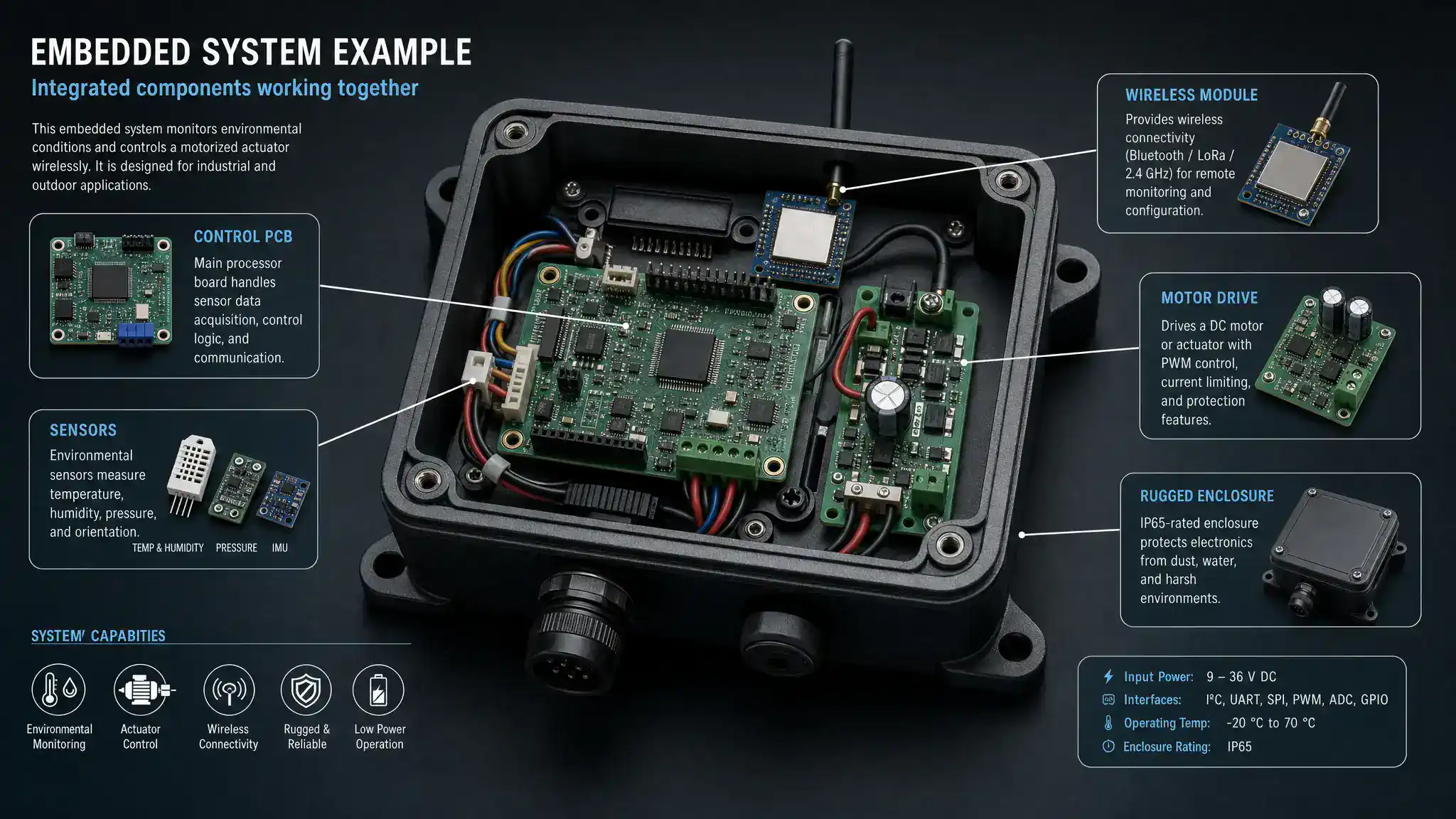
A strong embedded design brings these disciplines together early. If firmware is developed without understanding power behaviour, timing issues can appear late. If the enclosure is designed without considering antenna placement or thermal paths, wireless and reliability problems can follow. If PCB layout is treated as a simple routing task, EMC performance and signal integrity may suffer.
This is why system design and embedded thinking from day one are so important in professional product development.
Embedded system design decisions that affect reliability
Reliability is not achieved by adding a final inspection step. It is built through a chain of design choices. In embedded systems, those choices include component selection, electrical protection, firmware architecture, diagnostics, PCB layout, mechanical integration and manufacturing preparation.
One key decision is how the product handles abnormal conditions. Real products face voltage drops, short interruptions, user misuse, cable faults, sensor drift, condensation, temperature extremes and electromagnetic disturbances. A well-designed embedded system detects, limits or recovers from these conditions where appropriate.
Another important decision is how the system is tested. A lab prototype may prove the concept, but production readiness requires broader evidence. Engineers need to understand tolerance variation, thermal behaviour, startup and shutdown conditions, EMC-sensitive areas, firmware edge cases and how the product behaves over time.
| Product risk | Embedded design consideration | Why it matters |
|---|---|---|
| Unstable behaviour in the field | Power integrity, watchdogs, fault states and robust firmware architecture | Prevents avoidable lock-ups, unsafe outputs and unpredictable behaviour |
| EMC failures | PCB layout, grounding, filtering, shielding strategy and cable interfaces | Reduces the risk of redesign after pre-compliance or formal testing |
| Overheating | Power loss analysis, thermal paths, enclosure design and load profiles | Protects components and improves long-term reliability |
| Production variation | Test points, calibration strategy, component tolerances and manufacturing documentation | Helps products behave consistently across batches |
| Obsolescence | Component lifecycle review and alternative part planning | Reduces disruption during long-term production and maintenance |
Designing with compliance in mind also matters. Requirements such as CE, EMC and RED are not merely paperwork at the end of a project. They influence architecture, component selection, enclosure design, radio integration, cabling and test strategy. Good engineering cannot guarantee a certification outcome in advance, but it can reduce avoidable risks and surprises.
What the meaning of embedded system looks like by industry
The meaning of embedded system also depends on the product context. The core principle is the same, but the priorities differ by sector.
| Industry context | Typical embedded priorities |
|---|---|
| Machine manufacturing | Motor control, safety-related behaviour, sensor integration, industrial communication and maintainability |
| Robotics | Real-time control, motion accuracy, sensor fusion, power management and predictable fault handling |
| Maritime | Moisture resistance, robust connectors, EMC resilience, low-power operation and long service life |
| Defence and high-reliability systems | Robustness, traceability, environmental tolerance, controlled interfaces and long-term support |
| Automotive and mobility | Power efficiency, vibration tolerance, communication with other vehicle systems and lifecycle management |
| Consumer and professional electronics | Compact integration, usability, wireless connectivity, manufacturability and cost-aware reliability |
| High-tech equipment | Precision measurement, analogue performance, stable control loops, diagnostics and production repeatability |
These differences are one reason why embedded system development benefits from multidisciplinary thinking. A product may combine sensors, motor drives, wireless communication, analogue measurement, cloud connectivity, enclosure constraints and production test requirements. Treating each part as a separate supplier task can create integration gaps.
Embedded design is not just PCB layout
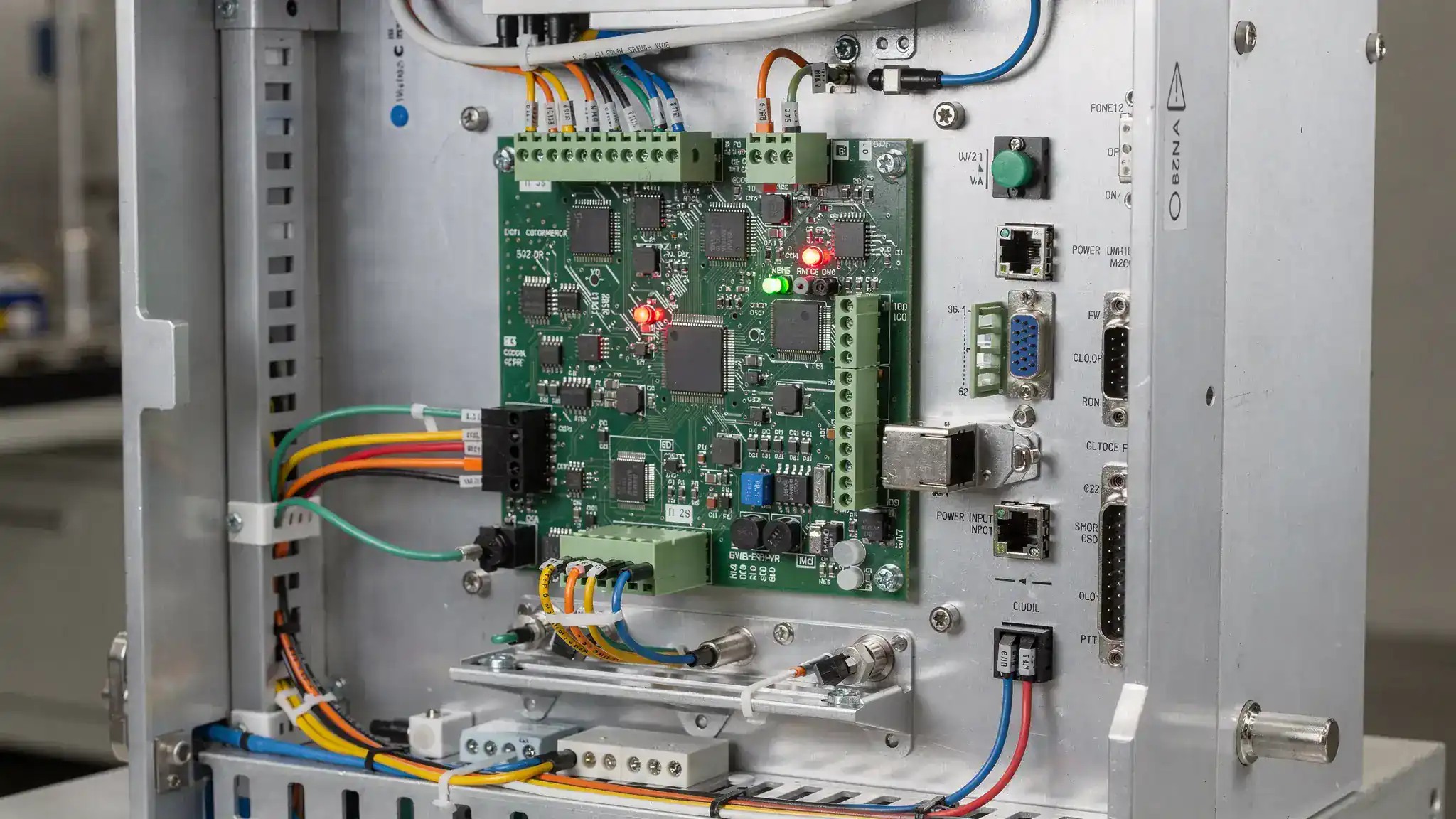
A common misconception is that embedded product development starts when someone needs a PCB. In reality, the PCB is the physical result of earlier system decisions. By the time layout begins, many important choices should already be clear.
Those choices include processor family, memory needs, power architecture, protection strategy, interfaces, sensor selection, firmware update approach, connector concept, diagnostic requirements and manufacturing test access. PCB design then translates these decisions into a layout that supports signal integrity, EMC performance, thermal behaviour and production quality.
This is why understanding what embedded hardware includes in a complete design is useful for product teams. Embedded hardware is more than a board. It is the physical foundation for product behaviour, reliability and compliance-oriented design.
Firmware deserves the same system-level attention. It should not be seen as code added after the electronics are finished. Firmware defines the user experience, state transitions, timing, communication, calibration, diagnostics and safe responses to faults. Hardware and firmware decisions should therefore be developed together.
A practical checklist before starting embedded system development
Before committing to detailed design, product teams should clarify several practical questions. These questions help expose hidden requirements and reduce avoidable redesign later.
- What exact product behaviour must the embedded system control, measure or communicate?
- Which environmental conditions will the product face during transport, installation, operation and maintenance?
- What power sources, loads, motors, batteries or external equipment will interact with the system?
- Which standards, market requirements or customer expectations influence EMC, radio, safety or CE-related design?
- What diagnostic information is needed during manufacturing, service and field troubleshooting?
- How will firmware be updated, configured, tested and maintained over the product lifecycle?
- Which components may create lifecycle or availability risks during volume manufacturing?
- What must happen when sensors fail, communication is lost, power is interrupted or the user does something unexpected?
These questions are not only technical details. They influence planning, cost, risk, supplier selection and time to market. The earlier they are discussed, the easier it is to create a product that is not just functional, but scalable and maintainable.
From prototype to volume manufacturing
A prototype often proves that an idea can work. A production-ready embedded system proves that it can work repeatedly, safely and economically under defined conditions. That transition is where many projects become more complex than expected.
During prototyping, flexibility is valuable. Engineers explore sensor options, control strategies, power concepts and communication methods. During production preparation, the focus shifts to repeatability, testability, component sourcing, documentation, enclosure integration and assembly quality.
The embedded system must therefore be designed for the full journey. A clever prototype architecture may not be suitable for volume manufacturing if it relies on hard-to-source components, manual calibration, fragile connectors or firmware that is difficult to configure. Similarly, a product may pass early functional tests but later reveal EMC, thermal or reliability issues when exposed to real installation conditions.
The practical meaning of embedded system in real product design is therefore this: it is the engineered bridge between concept and dependable product behaviour. It is where hardware, firmware, power, analogue electronics, mechanics, compliance and manufacturing readiness meet.
Frequently asked questions
What is the meaning of embedded system in product design? In product design, an embedded system is a dedicated combination of electronics, firmware, sensors, interfaces and power management built into a product to control specific behaviour. It must work reliably within the product’s physical, electrical and regulatory constraints.
Is an embedded system the same as a PCB? No. A PCB is one part of an embedded system. The full embedded system also includes firmware, processors, memory, sensors, actuators, power electronics, communication interfaces, diagnostics, mechanical integration and lifecycle considerations.
Why should embedded thinking start early in development? Early embedded thinking helps identify hidden requirements before they become expensive problems. It reduces the risk of late changes related to EMC, power behaviour, firmware timing, enclosure integration, component availability or manufacturing testability.
How does embedded design affect compliance? Embedded design affects compliance through component selection, PCB layout, grounding, filtering, enclosure design, radio integration, cabling and firmware behaviour. Designing with EMC, RED, CE and safety-related requirements in mind can reduce avoidable test and redesign risks.
When should a company involve an embedded systems partner? It is useful to involve an embedded systems partner when the product combines electronics, firmware, sensors, power systems, connectivity, compliance requirements or manufacturing preparation. Early involvement is especially valuable when internal teams lack specialist capacity or when the product must operate in demanding real-world conditions.
Building embedded products with fewer hidden risks
Understanding the meaning of embedded system is not an academic exercise. It helps product teams make better decisions about architecture, risk, compliance, prototyping and manufacturing readiness.
ProMicro supports companies developing professional electronic products from first idea to volume solutions. With expertise in embedded systems, power electronics, analogue electronics, PCB design, system engineering, enclosure design, prototyping and manufacturing support, ProMicro helps turn complex product ideas into robust, scalable electronics for real-world use.
If your product depends on reliable embedded behaviour, it pays to address the complete system early, not only the visible PCB or the first prototype.