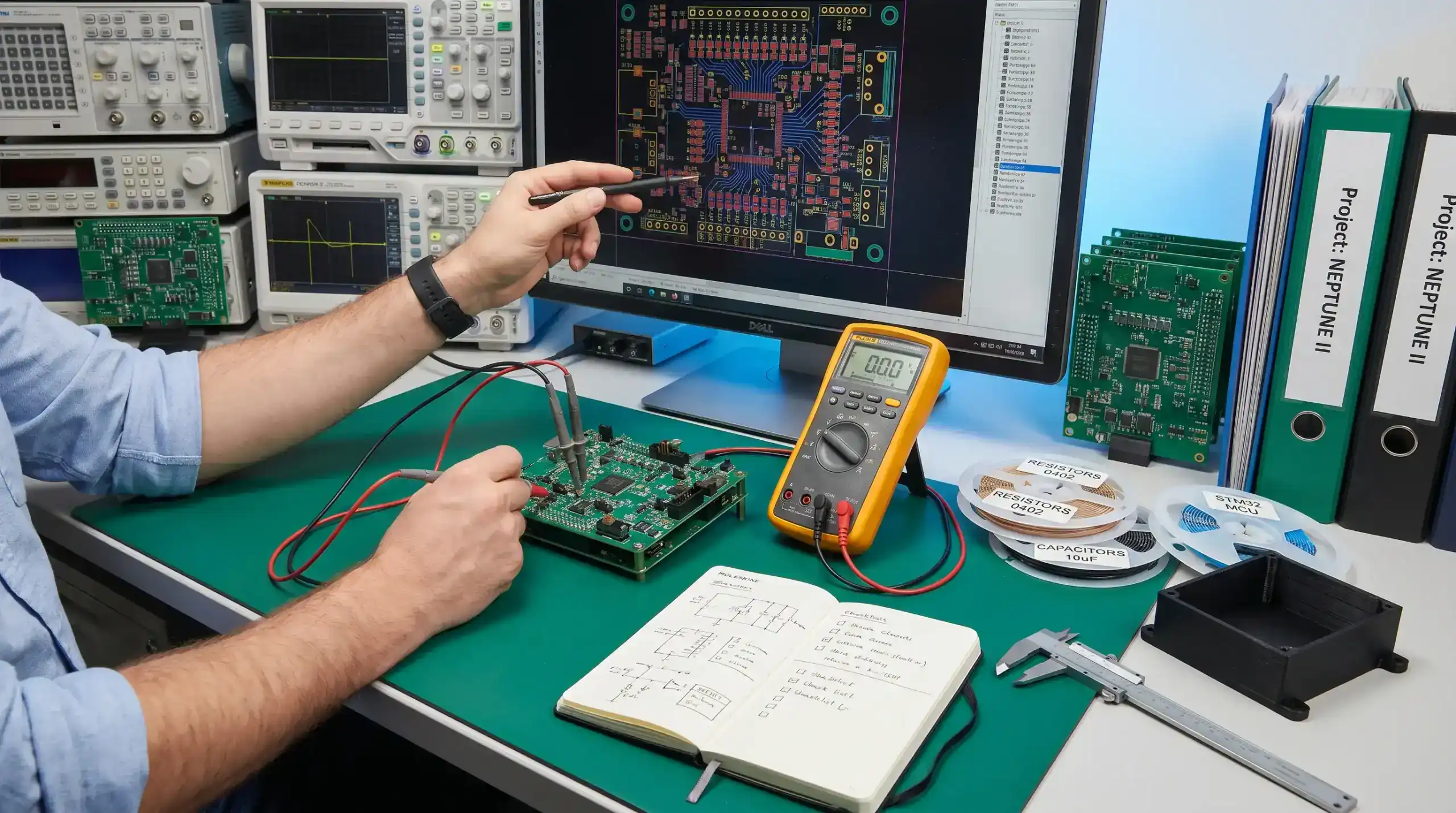
Selecting a PCB supplier is rarely just a purchasing decision. For OEM products, machines, vehicles, maritime systems, defence equipment or connected devices, the PCB becomes part of the product’s safety, reliability, EMC behaviour, thermal performance and long-term maintainability.
That is why assessing printed circuit board manufacturers should start before the first quotation request. A low unit price is useful only if the supplier can repeatedly build the board you actually need, at the quality level your product demands, with the right documentation, traceability and lifecycle support.
The right assessment helps you avoid a common problem: a prototype that works in the lab, but becomes unstable during certification, field testing or volume production. The goal is not to find the cheapest manufacturer. It is to identify a manufacturing partner whose capabilities match the technical risk of your product.
Start with the product risk, not the supplier brochure
Before comparing printed circuit board manufacturers, define what the PCB must survive and how failure would affect the product. A control board for a consumer accessory has a different risk profile from a motor drive in a machine, a marine sensor node, an automotive controller or a defence-related embedded system.
Important product context includes operating temperature, vibration, moisture, electrical load, expected service life, safety requirements, connectivity, enclosure constraints and exposure to interference. Even products that appear simple, such as LED indicators, illuminated interfaces or custom neon signage, can involve thermal, power, insulation and enclosure integration decisions that affect PCB reliability.
A strong manufacturer or manufacturing partner will ask questions about the application environment. If the supplier only asks for Gerber files and order quantity, you may not be dealing with a partner that is prepared to identify hidden risks.
Clarify what type of manufacturer you are assessing
The term “printed circuit board manufacturer” is used in different ways. Some suppliers manufacture bare boards. Others assemble components onto boards. Some provide full electronics manufacturing services, including sourcing, test, box-build and logistics.
Your assessment should match the scope you expect the supplier to take responsibility for.
| Supplier type | Typical responsibility | What to assess most carefully |
|---|---|---|
| Bare PCB fabricator | Produces the unpopulated PCB | Material capability, stack-up control, copper thickness, impedance control, surface finish, inspection and traceability |
| PCB assembly manufacturer | Sources components and assembles the PCBA | Process quality, soldering standards, component control, inspection, test strategy and rework control |
| EMS or box-build supplier | Assembles electronics into a larger product | PCBA quality, enclosure integration, cable harnesses, functional testing, logistics and documentation |
| Electronics design and manufacturing partner | Supports design, prototyping and transition to production | Requirements, DFM, DFT, EMC-aware design, lifecycle risks, documentation and manufacturing readiness |
If your immediate need is component placement and soldering, ProMicro has a separate guide on choosing a PCB assembly manufacturer for OEM products. For the broader assessment, keep fabrication, assembly, test and product context connected.
Match manufacturing capability to your PCB design
A capable manufacturer is not automatically suitable for every board. A supplier that performs well on simple two-layer boards may not be the right fit for dense embedded systems, high-current power electronics, impedance-controlled communication interfaces or compact sensor products.
Assess whether the manufacturer can reliably support your specific design features. This includes layer count, minimum track and gap, via technology, controlled impedance, copper weight, laminate type, high-voltage creepage and clearance, thermal vias, surface finish, solder mask requirements and panelisation constraints.
For power electronics, pay special attention to copper thickness, thermal paths, current density, solder joint reliability and heat dissipation into the enclosure or heat sink. For analogue electronics, layout sensitivity, grounding, leakage paths and material stability may matter more than headline manufacturing capability. For wireless or high-speed embedded products, impedance control and repeatable stack-up are essential.
Useful questions to ask include:
- Can the manufacturer provide a recommended stack-up before layout is frozen?
- Which tolerances are guaranteed, and which are only typical process capabilities?
- How are impedance-controlled tracks verified and reported?
- What inspection data is supplied with each production batch?
- Which design rules are preferred for stable yield rather than minimum possible geometry?
- How are material substitutions communicated and approved?
The best supplier is not always the one that says “yes” to everything. It is often the one that challenges borderline design decisions early.
Evaluate quality systems and production evidence
Quality claims should be supported by process evidence. Certifications and standards do not guarantee a good product, but they help show whether a manufacturer works in a controlled and repeatable way.
For professional electronics, ask about ISO 9001 certification and relevant IPC standards. Depending on the product, IPC-A-600, IPC-6012, IPC-A-610, J-STD-001 or IPC Class 2 and Class 3 expectations may be relevant. For safety-related, automotive, medical, aerospace or defence applications, additional sector-specific requirements may apply.
Do not stop at asking whether a certificate exists. Ask how quality is controlled in practice. Review examples of certificates of conformity, first article reports, solder inspection records, X-ray inspection reports, microsection analysis, test records, non-conformance handling and corrective action reports.
| Assessment area | Evidence to request | Warning signs |
|---|---|---|
| Process control | Quality manual, process flow, control plan | Vague answers about inspection and release criteria |
| Traceability | Batch records, material lots, component traceability | No clear link between production batch and supplied documentation |
| Inspection | AOI, X-ray, electrical test, visual inspection criteria | Inspection offered only as an optional extra for critical products |
| Rework control | Rework procedures and operator qualification | Uncontrolled manual rework or unclear acceptance criteria |
| Non-conformance handling | CAPA examples and defect trend tracking | Repeated defects without root cause analysis |
| Documentation | CoC, test reports, revision records | Incomplete or inconsistent production documentation |
A reliable manufacturer should be comfortable discussing defects. Every process has defects. What matters is whether they are detected, contained, analysed and prevented from recurring.
Look for DFM and DFT input before release
Design for manufacturability and design for test are not administrative steps at the end of development. They influence PCB layout, component placement, panelisation, test access, connector choices, programming access, mechanical integration and service strategy.
Good printed circuit board manufacturers should provide DFM feedback that goes beyond basic file checking. They should identify process risks, such as insufficient annular ring, difficult solder joints, poor component spacing, unfavourable panel break-outs, thermal imbalance, tombstoning risk or inspection blind spots.
For assembled boards, DFT is equally important. If your product requires firmware programming, calibration, functional testing, RF testing, high-current load testing or analogue measurement, test access must be considered early. Otherwise, production testing becomes slow, expensive or incomplete.
This is where design and manufacturing cannot be separated. The choices made in stack-up, layout, components and test strategy directly affect whether the product can be built repeatably. ProMicro explains this connection further in its article on how PCB fabrication and assembly choices influence product quality.
Assess compliance awareness, without expecting guarantees
A PCB manufacturer cannot promise that your complete product will pass EMC, RED, CE or safety testing. Compliance depends on the full system, including schematic design, layout, firmware behaviour, enclosure, cabling, grounding, power supply architecture and installation environment.
However, a manufacturer or electronics development partner should understand how manufacturing decisions can support or undermine compliance readiness. Examples include stack-up consistency for EMC performance, controlled impedance for communication interfaces, stable grounding structures, correct creepage and clearance, suitable solder mask and coating choices, and reliable connector or cable termination.
Be cautious with suppliers that treat compliance as someone else’s problem. They do not need to own the entire certification process, but they should understand that small production changes can affect emissions, immunity, safety margins and field reliability.
For connected products, ask how they handle RF-sensitive layouts, antenna keep-out areas, shielding, material consistency and changes in component sourcing. For power electronics, ask how high-current and high-voltage features are reviewed. For machinery and robotics, ask how vibration, connectors and thermal cycling are considered.
Check whether prototype capability can scale to volume
A prototype manufacturer may be excellent for fast iteration, but not always suitable for stable production. Volume manufacturing requires repeatable processes, controlled documentation, approved suppliers, test fixtures, operator instructions, yield monitoring and change control.
When assessing a supplier, ask how they support the transition from prototype to pilot build and then to serial production. The process should include design reviews, production data validation, first article inspection, test strategy confirmation, yield analysis and controlled release of manufacturing documentation.
A useful question is: “What changes between prototype and volume production in your process?” If the answer is “nothing”, that is not necessarily reassuring. Volume production normally requires more control, not simply more boards.
Before volume release, your data package should be complete and unambiguous. This includes PCB fabrication data, assembly drawings, bill of materials, approved alternatives, programming files, test specifications, mechanical constraints and revision history. If you are still preparing this step, ProMicro’s guide on how to prepare a PCB design for prototyping and volume build is a useful next read.
Review supply chain and lifecycle management
PCB manufacturing quality is not only about the production line. Long-term reliability also depends on material availability, component sourcing, approved alternatives and change control.
Ask how the manufacturer handles obsolete components, long lead times, laminate availability, minimum order quantities and supplier changes. For professional products with long service lives, this can be as important as the first production batch.
The supplier should not change laminate, copper thickness, surface finish, solder paste, components or approved alternates without a defined approval process. Even small changes can influence EMC behaviour, solderability, thermal performance, impedance or mechanical robustness.
For products in maritime, defence, machine building, robotics or automotive environments, lifecycle control is especially important. A product may need to remain serviceable for years, and the PCB documentation must support repairs, redesigns, second-source decisions and controlled updates.
Compare quotations on total technical risk
A PCB quotation often hides more than it reveals. Two suppliers may quote the same board very differently because they include different levels of inspection, test, tooling, engineering review, documentation, packaging or logistics.
When comparing quotations, make sure you understand what is included. A low price without adequate inspection, test coverage or engineering support can create expensive problems later. Late rework, failed compliance testing, field returns and production stops usually cost more than proper preparation.
Key commercial points to compare include tooling costs, test fixture costs, non-recurring engineering costs, lead times, minimum order quantities, yield assumptions, inspection level, documentation package, change fees and responsibility for component sourcing. Also clarify who owns test fixtures, manufacturing data and production-specific documentation.
The right commercial decision balances unit price, process maturity, engineering support and risk reduction.
Use a structured supplier assessment
A structured assessment prevents decisions being driven by the best sales presentation or the lowest prototype quote. It also gives engineering, procurement and management a shared basis for discussion.
| Assessment criterion | What good looks like |
|---|---|
| Application understanding | Supplier asks about operating environment, product lifetime, compliance and failure consequences |
| Technical fit | Capabilities match the PCB’s layer count, materials, tolerances, thermal requirements and assembly complexity |
| Engineering support | DFM, DFT and stack-up feedback are available before release |
| Quality control | Inspection, traceability, defect handling and documentation are clearly defined |
| Compliance awareness | Supplier understands EMC, safety, RF and high-current implications of manufacturing choices |
| Prototype-to-volume process | Pilot builds, first article checks, test strategy and production release are controlled |
| Supply chain control | Material and component changes require approval and are traceable |
| Communication | Technical questions are answered clearly, risks are escalated early and responsibilities are documented |
This assessment is especially valuable when internal teams lack specialist PCB, power electronics, analogue electronics or embedded systems capacity. It helps separate suppliers that can manufacture a board from partners that can support a reliable product.
When to involve an electronics design partner
If your product is technically complex, manufacturer selection should not happen after the PCB layout is complete. Early design choices determine manufacturability, testability, EMC behaviour, thermal stability and lifecycle options.
An electronics design partner can help define the requirements, review the architecture, translate product risks into manufacturing requirements, prepare the data package and challenge assumptions before they become expensive. This is particularly valuable when the product combines embedded software, sensors, wireless communication, motor drives, power electronics, analogue measurement or enclosure integration.
ProMicro supports customers from idea generation to volume solutions, with expertise in embedded systems, power electronics, analogue electronics, PCB design, system engineering, prototyping and manufacturing preparation. The value is not only in creating a PCB layout. It is in helping ensure that the electronics are reliable, manufacturable, maintainable and suitable for real-world use.
Frequently asked questions
What is the most important factor when assessing printed circuit board manufacturers? The most important factor is fit with your product risk. A supplier must be capable of building your specific PCB reliably, with the right materials, process controls, inspection, test strategy, documentation and change management.
Is ISO 9001 enough to qualify a PCB manufacturer? ISO 9001 is useful, but it is not enough on its own. You should also review IPC capability, process evidence, inspection data, traceability, DFM support, defect handling and experience with products similar to yours.
Should I choose a prototype PCB supplier for volume production? Not automatically. Prototype suppliers can be excellent for speed and iteration, but volume production requires stronger process control, test coverage, documentation, repeatability and lifecycle management.
How early should a manufacturer be involved in PCB development? For complex or compliance-sensitive products, involve manufacturing input before the layout is finalised. Early DFM, DFT, stack-up and material feedback can prevent rework, certification delays and production issues.
Can a PCB manufacturer guarantee EMC, CE or RED compliance? No PCB manufacturer can guarantee compliance for the complete product based only on the board. However, the manufacturer and design partner should understand how PCB materials, layout, stack-up, assembly and production changes can affect compliance readiness.
Build confidence before committing to production
Assessing printed circuit board manufacturers is about reducing uncertainty before it becomes cost, delay or field failure. The right supplier should understand your application, provide technical evidence, support manufacturability and testability, control changes and help the product move from prototype to reliable production.
If your team is developing a complex electronic product and wants to reduce risk before manufacturing decisions are locked in, ProMicro can support the process with electronics design, embedded systems expertise, power and analogue electronics knowledge, PCB design, prototyping and preparation for volume manufacturing.