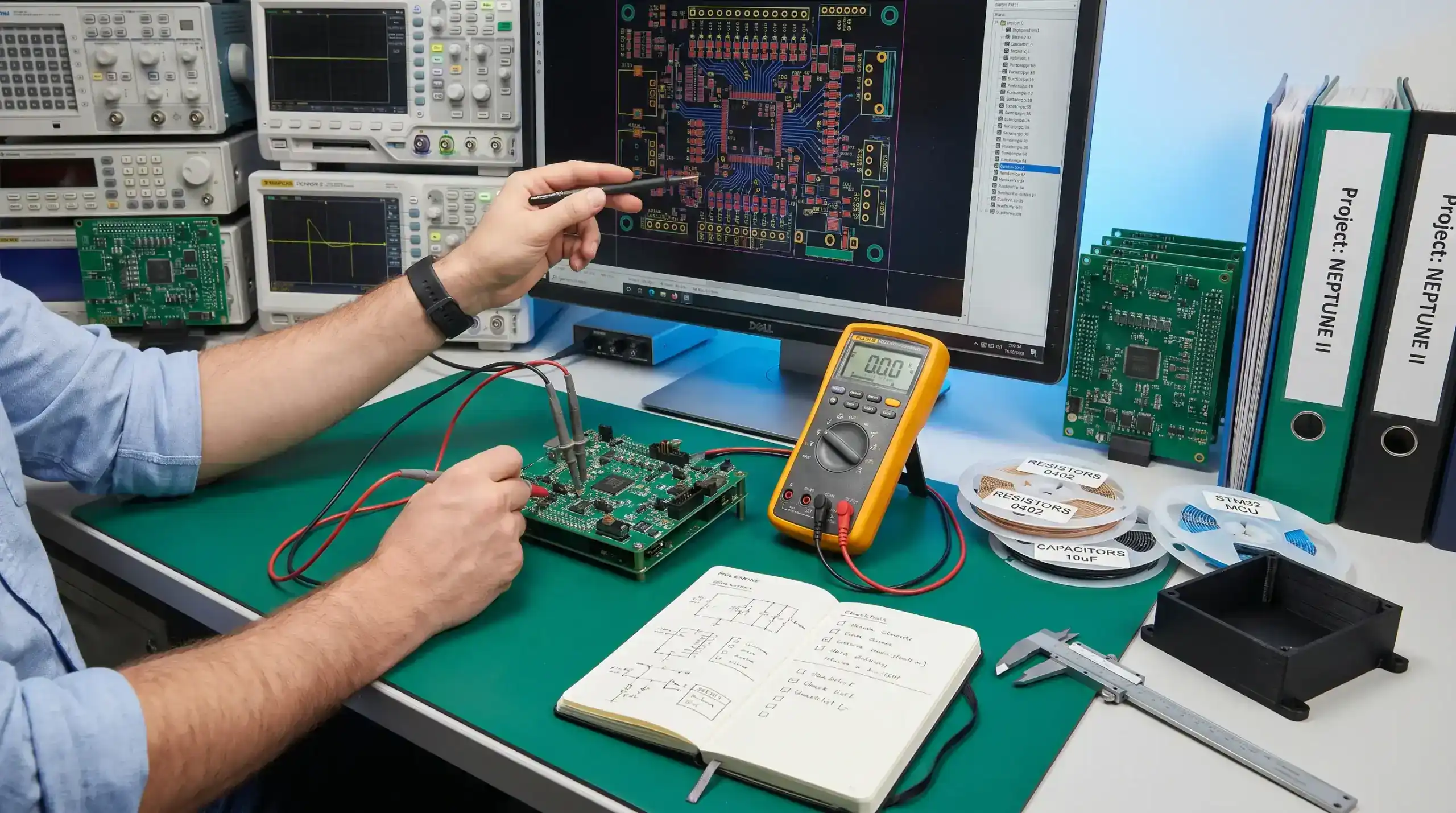
Selecting a PCB assembly manufacturer is not just a purchasing decision. For OEM products, it is a technical risk decision that affects reliability, certification readiness, field performance, service costs and the ability to scale production without repeated redesigns.
A prototype that works on the bench can still fail in volume manufacturing if the assembly process is not controlled, the bill of materials is fragile, the test strategy is incomplete or the design was never prepared for real production conditions. This is especially true for products that combine embedded software, power electronics, analogue electronics, sensors, motor drives, wireless communication or high-density PCB layouts.
The right PCB assembly manufacturer should therefore do more than place components on a board. They should understand manufacturability, process control, documentation, traceability and long-term supply risks. For OEMs in high-tech, machine manufacturing, robotics, automotive, maritime, defence and professional electronics, that distinction matters.
Start with the product risk profile
Before comparing suppliers, define what the product actually needs from manufacturing. Many OEMs begin with the question, “Who can assemble this PCB at the best price?” A better question is, “Which manufacturing partner can reliably build this product under the conditions it will face in the field?”
A low-complexity consumer accessory, a safety-related motor controller and a sensor module for maritime use do not require the same level of process control. The PCB assembly manufacturer you choose should match the technical and commercial risk profile of the product.
If the product definition is still incomplete, first clarify the operating environment, expected lifetime, interfaces, power requirements, firmware loading process, compliance expectations and production volumes. ProMicro covers this early preparation in more detail in its article on what OEMs should define before starting custom electronics design.
| Selection factor | Why it matters for OEM products | What to verify |
|---|---|---|
| Operating environment | Temperature, vibration, humidity, EMC exposure and contamination can affect assembly choices | Environmental assumptions, coating needs, connector selection and process limitations |
| Product lifetime | Long-life products need stable components and repeatable production | Lifecycle management, component monitoring and change control |
| Production volume | Prototype, pilot and volume builds require different processes | NPI process, capacity, yield tracking and ramp-up approach |
| Compliance expectations | EMC, CE, RED or sector-specific requirements influence layout, assembly and test | Understanding of design-for-compliance and documentation control |
| Technical complexity | Fine-pitch devices, BGAs, power stages or RF sections increase production risk | Assembly capability, inspection methods, rework limits and test coverage |
This upfront work also prevents poor supplier fit. A manufacturer that is excellent for simple SMT production may not be the right choice for a complex embedded controller with power electronics, calibration steps and traceability requirements.
Understand what type of manufacturing partner you need
Not every PCB assembly manufacturer offers the same level of support. Some focus on quick-turn prototype assembly. Others specialise in New Product Introduction (NPI), low-to-medium volume production or full electronics manufacturing services. The right choice depends on the maturity of your design and the level of engineering support your team needs.
| Manufacturer type | Best fit | Typical limitation |
|---|---|---|
| Prototype assembler | Early builds, proof-of-concept boards and quick iteration | May not optimise for volume repeatability or long-term lifecycle control |
| NPI-focused partner | Pilot builds, DFM feedback and process validation | May need a separate volume partner for larger production runs |
| Volume EMS or contract manufacturer | Stable designs with forecastable demand and controlled documentation | Less suitable if the design is still changing frequently |
| Specialist assembly partner | Products with coating, power electronics, RF, high-density or harsh-environment needs | May have higher setup effort and stricter documentation requirements |
For many OEMs, the strongest route is not to choose only on today’s build quantity. Choose for the transition you expect over the next two to five years. If you plan to move from prototypes to recurring production, ask whether the supplier can support design reviews, pilot builds, test fixture development, traceability and controlled engineering changes.
Evaluate technical assembly capability carefully
A credible PCB assembly manufacturer should be able to explain exactly what they can and cannot build reliably. Their capability should match your board technology, component package types, process requirements and inspection needs.
For example, boards with fine-pitch ICs, BGAs, thermal pads, heavy copper, mixed SMT and through-hole components, high-current paths, sensitive analogue sections or RF modules place different demands on assembly. If the product includes motor drives, wireless communication or precision sensing, process variation can directly affect performance.
Ask about capabilities such as SMT placement accuracy, solder paste control, reflow profiling, selective soldering, wave soldering, hand assembly, cleaning processes, conformal coating, potting, programming, calibration and final product assembly. Not every product needs all of these, but the supplier should be transparent about their strengths and limits.
The PCB fabrication choices also matter. Laminate, copper thickness, stack-up, surface finish, via structures and panelisation can influence assembly yield and long-term reliability. ProMicro explains these dependencies in its guide to PCB fab and assembly choices that affect product quality.
A good manufacturer will not simply accept the data package and proceed. They will review it for manufacturability, identify process risks and highlight unclear documentation before production starts.
Check quality systems, not only certifications
Certifications are useful, but they are not a substitute for a controlled manufacturing culture. ISO 9001 can indicate that a quality management system exists, while sector-specific standards may be relevant in automotive, medical, defence or other regulated environments. However, OEMs should also evaluate how quality is managed on the production floor.
Ask how the manufacturer controls incoming materials, ESD protection, solder paste storage, machine calibration, operator training, process deviations, rework, inspection records and non-conforming products. For complex electronics, traceability can be critical. You may need batch-level or serial-level traceability for components, PCB lots, firmware versions, test results and process history.
IPC standards are also relevant. IPC-A-610 is commonly used for acceptability of electronic assemblies, and IPC J-STD-001 addresses soldered electrical and electronic assemblies. The important point is not only whether the manufacturer mentions these standards, but whether the agreed workmanship class and acceptance criteria are clear in your manufacturing documentation.
For high-reliability OEM products, also ask how the supplier handles corrective actions. A strong supplier should be able to explain root cause analysis, containment actions and preventive measures in a structured way. If every issue is treated as an isolated incident, recurring failures are more likely.
Look closely at DFM, DFT and test strategy
Inspection alone does not create quality. It only detects some problems after they have already been built into the product. For OEM electronics, the test strategy should be designed into the product and manufacturing process from the beginning.
Design for Manufacturing (DFM) checks whether the PCB can be assembled consistently. Design for Test (DFT) checks whether faults can be detected efficiently during production. Both are essential when moving beyond one-off prototypes.
Typical test considerations include programming access, boundary scan, in-circuit test, functional test, calibration, connector access, test pads, measurement points, fixture design and pass/fail criteria. For connected products, firmware loading and version control must also be part of the production process.
A supplier may be able to build the board, but that does not mean they can verify the complete product. If your electronics include sensors, power stages, wireless interfaces or embedded control loops, the functional test needs to reflect real operating behaviour. This often requires collaboration between the OEM, the electronics design team and the assembly manufacturer.
Poor test planning is one of the main reasons prototypes become expensive during scale-up. Rework, manual inspection, unclear pass criteria and undocumented firmware steps all add risk. The earlier these elements are defined, the more predictable the production process becomes.
Assess supply chain and lifecycle management
A PCB assembly manufacturer is also part of your supply chain. Their sourcing strategy affects availability, cost stability, counterfeit risk and long-term maintainability.
For professional OEM products, ask whether the manufacturer sources through authorised distributors, how they handle customer-supplied components, how they verify alternatives and how they manage component obsolescence. During recent years, component availability has shown how fragile electronics supply chains can be when designs depend on single-source parts or unapproved substitutions.
The bill of materials should include manufacturer part numbers, approved alternatives where possible, lifecycle status, tolerances and critical component notes. Substitutions should never be made informally, especially for safety-related, EMC-sensitive, analogue or power components. A change that appears minor commercially can alter thermal behaviour, signal integrity, radio performance or compliance margins.
For long-life products, Product Change Notifications (PCNs), End-of-Life (EOL) notices and Last Time Buy decisions should be managed deliberately. A manufacturer that can assemble your product today is not necessarily the best partner if they cannot support repeat production over several years.
Plan the move from prototype to volume
Prototype assembly and volume assembly have different objectives. A prototype build is often about learning quickly. A volume build is about repeatability, yield, documentation, controlled change and predictable quality.
This transition is where many OEMs experience friction. A design that was hand-reworked during prototype development may need layout changes before it can be assembled reliably. Test procedures that worked for five units may be too slow or ambiguous for 500 units. Firmware programming that was done manually by an engineer may need controlled integration into the production flow.
A mature PCB assembly manufacturer should have a clear NPI process. This may include DFM review, first article inspection, pilot builds, process validation, yield analysis, test fixture preparation, work instructions and controlled sign-off before volume release.
For a deeper view of this transition, ProMicro’s article on printed circuit board assembly from prototype to volume explains how reliability, manufacturability and compliance expectations evolve as production scales.
Compare total manufacturing risk, not only unit price
Price matters, but the cheapest quote can become expensive if it excludes engineering support, test development, fixtures, rework, yield loss, component risk or documentation control. For OEM products, total cost of ownership is a better decision metric than unit assembly cost alone.
When comparing quotations, check whether each supplier has included the same assumptions. One manufacturer may include DFM review, test setup and programming. Another may quote only placement and soldering. Without a like-for-like comparison, the lowest quote may simply be incomplete.
Key commercial details include tooling costs, test fixture ownership, NRE charges, minimum order quantities, lead times, component procurement terms, warranty process, rework policy, packaging, logistics and payment terms. For regulated or high-value products, also clarify confidentiality, IP handling, data retention and access to production records.
A well-structured quote should make assumptions visible. If a manufacturer cannot explain the basis of the price, it may be difficult to manage changes later.
Evaluate communication and documentation discipline
In electronics manufacturing, unclear communication creates technical risk. The best PCB assembly manufacturer for an OEM product is usually not the one that simply says yes to every request. It is the one that asks precise questions, challenges unclear requirements and documents decisions properly.
Look for responsiveness, technical clarity and disciplined issue tracking. Can the supplier explain DFM findings in engineering terms? Do they document non-conformities? Do they provide clear build reports? Are they comfortable discussing process capability, yield, test coverage and corrective actions?
Clear digital communication is also valuable outside the factory. When an OEM needs to present product information, documentation or partner-facing material in a structured way, the same discipline applies to its web presence. For web projects rather than electronics, a specialist team such as BeBranded is a useful example of how clean structure, focused execution and maintainable systems reduce friction. In PCB assembly, the equivalent is a controlled data package, clear ownership and traceable decisions.
Documentation should include more than Gerber files. A production-ready package typically includes fabrication data, assembly data, bill of materials, approved vendor list, pick-and-place files, assembly drawings, test procedures, programming instructions, inspection criteria, packaging requirements and revision history.
Red flags when choosing a PCB assembly manufacturer
Some warning signs become visible early in supplier discussions. They do not always mean the supplier is unsuitable, but they should trigger deeper due diligence.
| Red flag | Why it matters | What to ask next |
|---|---|---|
| They quote without reviewing the design data | Hidden manufacturability issues may appear later | Ask for a formal DFM review before build approval |
| They are vague about inspection and test | Fault detection may depend too much on manual judgement | Ask for inspection methods, test coverage and acceptance criteria |
| They accept uncontrolled component substitutions | Product performance or compliance margins may change | Define an approved change process and alternative part rules |
| They cannot explain traceability | Field failures become harder to investigate | Ask what can be traced by batch, serial number or production lot |
| They focus only on price | Engineering support may be limited during NPI or scale-up | Compare total risk, not only assembly cost |
| They have no clear rework policy | Reworked products may become reliability risks | Define rework limits, approval rules and documentation needs |
For demanding OEM products, these issues are not administrative details. They influence product reliability, field serviceability and liability exposure.
Practical questions to ask during supplier selection
A structured supplier interview helps separate capable partners from suppliers that only appear suitable on paper. The goal is to understand how they think, not only what equipment they own.
Useful questions include:
- What type of products and volumes are you best suited for?
- Which IPC workmanship class do you normally build to, and how is that agreed?
- How do you perform DFM and DFT reviews before production?
- What inspection methods do you use for fine-pitch devices, BGAs or critical solder joints?
- How do you manage firmware programming, calibration and serialisation?
- How do you handle component substitutions, PCNs and obsolescence?
- What traceability can you provide for components, PCB lots, test results and firmware versions?
- How do you report yield, defects and corrective actions?
- What information do you need from the OEM before the first build?
The answers should be specific. A strong manufacturer will often ask questions back, because they understand that a reliable build depends on application context, not only assembly files.
Where an electronics design partner adds value
Choosing a PCB assembly manufacturer becomes much easier when the design package is complete, the risks are known and the product has been engineered for manufacturing from the start. This is where an electronics design partner can reduce uncertainty before the manufacturer is selected.
ProMicro supports OEMs with embedded system development, power electronics, analogue electronics, PCB design, system engineering, enclosure design, rapid prototyping and preparation for volume manufacturing. That broader view is important because assembly quality is not created only in the factory. It is influenced by architecture choices, component selection, layout decisions, thermal behaviour, EMC design, firmware access, test points, mechanical integration and lifecycle planning.
For OEMs with limited internal capacity or specialist expertise, working with a partner that understands both hardware and software can prevent avoidable redesigns. It also helps ensure that the PCB assembly manufacturer receives a package that is clear, manufacturable and suitable for controlled production.
The best outcomes usually come from collaboration between three parties: the OEM that understands the market and use case, the electronics design team that translates requirements into a robust system and the assembly manufacturer that brings process knowledge and production discipline.
Frequently asked questions
What is the difference between a PCB assembly manufacturer and an electronics design partner? A PCB assembly manufacturer builds PCBAs from production data, while an electronics design partner helps define, design, test and prepare the electronics for manufacturing. Some manufacturers offer engineering support, but OEMs should verify whether that support covers system architecture, embedded software, power electronics, compliance-oriented design and lifecycle planning.
Should an OEM choose the cheapest PCB assembly manufacturer? Not usually. Price is important, but OEM products should be evaluated on total manufacturing risk. A cheaper supplier may become more expensive if they lack DFM support, test capability, traceability, quality control or lifecycle management.
What documents should be ready before contacting a PCB assembly manufacturer? At minimum, prepare fabrication data, assembly data, bill of materials, pick-and-place files, assembly drawings, revision information and clear build requirements. For production-ready builds, include test procedures, programming instructions, inspection criteria, packaging requirements and approved component alternatives.
When should a PCB assembly manufacturer be involved? Ideally before the first serious prototype or pilot build. Early DFM and DFT feedback can prevent layout changes, test access problems, component sourcing issues and process risks from appearing late in development.
How can OEMs reduce risk before volume production? Use a controlled NPI process with DFM review, pilot builds, first article inspection, test fixture validation, yield analysis and documented engineering change control. Do not move to volume until the product, process and test strategy are stable enough for repeatable production.
Build the manufacturer selection around reliability
For OEM products, selecting a PCB assembly manufacturer should be treated as part of the product development strategy. The right partner will not only assemble boards, but also support manufacturability, quality control, testability, traceability and long-term production readiness.
If your product combines embedded software, sensors, power electronics, analogue circuitry, connectivity or demanding environmental requirements, the manufacturer selection should start before the design is frozen. Early engineering decisions strongly influence whether production is smooth, reliable and scalable.
If you want to prepare your electronics for prototyping, certification-oriented development and volume manufacturing, ProMicro can support your team with system-level electronics design, PCB development, embedded systems expertise and manufacturing preparation for professional OEM products.