
For OEMs, reliability is not something to add after the prototype works. It is shaped by early architecture decisions, component choices, firmware behaviour, power design, PCB layout, enclosure integration and manufacturing preparation. This is especially true for products used in defence, maritime, high-tech machinery, robotics, automotive systems and connected professional devices, where a small electronic weakness can become a field failure, warranty issue or delayed product launch.
Embedded solutions help OEMs move beyond a working circuit towards a complete, controlled and scalable product. A well-designed embedded system does not only read sensors, control actuators or communicate with other devices. It defines how the product behaves under stress, how it recovers from faults, how it handles power disturbances, how it supports compliance goals and how it can be manufactured and maintained over time.
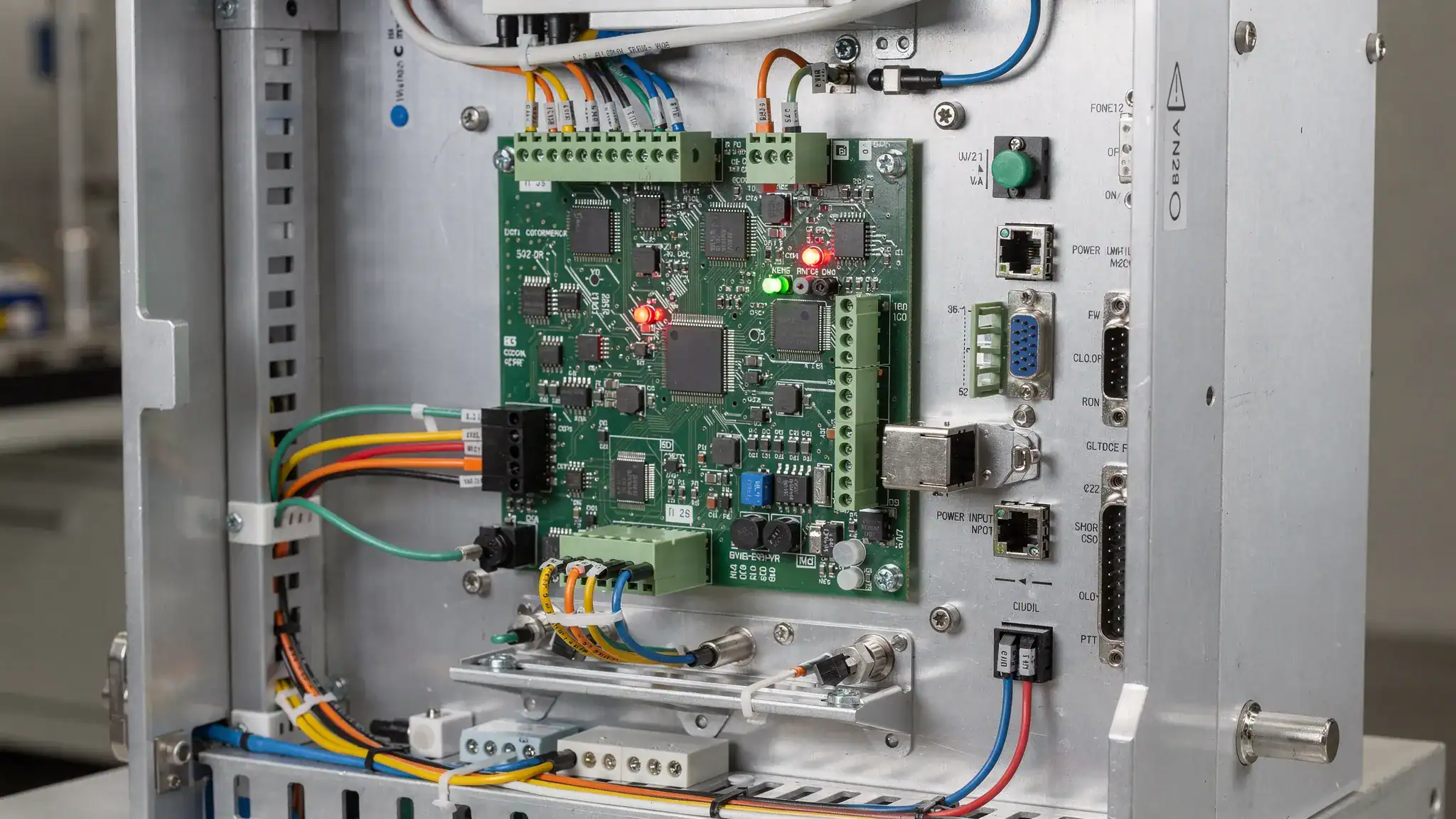
Reliability is a system property, not a final test result
Many OEMs first experience reliability problems when a prototype leaves the controlled lab environment. The prototype may function well on a bench supply, with short cables, a stable temperature and an engineer nearby. In the field, the same product may face voltage dips, electromagnetic interference, vibration, moisture, user mistakes, long cable runs, poor grounding or unexpected duty cycles.
This is why reliability should be treated as a design outcome. The embedded solution must be built around the real use case, not just the intended function. For an OEM, that means asking how the product will be installed, who will use it, what happens during abnormal conditions and which risks must be controlled before volume manufacturing starts.
| Reliability question | Hidden risk for OEMs | Embedded design implication |
|---|---|---|
| What happens when input power is unstable? | Resets, corrupted data, overheated components or unsafe states | Power protection, brown-out handling, filtering and defined restart behaviour |
| What happens when sensors produce noisy or invalid data? | Incorrect control decisions or false alarms | Analogue filtering, signal validation, diagnostics and firmware fault handling |
| What happens near other equipment? | EMC issues, communication errors or disturbed measurements | EMC-aware PCB layout, grounding strategy, shielding and cable design |
| What happens during production scaling? | Inconsistent quality, difficult testing or component substitutions | Design for manufacturing, design for test and lifecycle-aware component selection |
| What happens after launch? | Expensive service visits and unclear failure causes | Logging, diagnostics, update strategy and maintainable architecture |
When these questions are addressed early, OEMs reduce the chance that reliability problems appear during certification, first customer deliveries or field operation.
How embedded solutions reduce launch risk
An embedded solution gives structure to the product development process. Instead of treating hardware, firmware, power electronics, analogue electronics and mechanical integration as separate tasks, the complete product is designed as one system. That matters because many reliability problems occur at the interfaces between disciplines.
A motor drive, for example, is not only a power stage. It also depends on current sensing, thermal measurement, firmware control loops, switching behaviour, PCB parasitics, enclosure cooling, cable routing and EMC performance. A wireless sensor product is not only a radio module. It also depends on antenna placement, power consumption, battery behaviour, enclosure materials, firmware update strategy and compliance with radio-related requirements.
For OEMs, the benefit is not just technical neatness. Integrated embedded development makes trade-offs visible before they become expensive. It helps teams decide whether a function belongs in hardware or firmware, whether a standard module is sufficient, whether a custom PCB is needed, and how the product should be prepared for test, certification and production.
Turning requirements into controlled behaviour
Reliable products begin with clear and testable requirements. In practice, many early requirements are functional, such as measure temperature, control a pump, communicate wirelessly or drive a motor. These are necessary, but not sufficient.
A robust embedded solution adds behavioural requirements. It defines what the product must do when a sensor is disconnected, when communication is lost, when the enclosure becomes hot, when a user connects the wrong cable or when the supply voltage drops below the expected range. This level of definition is especially important for OEMs selling products under their own brand, because the product must behave predictably without an engineer present.
Good embedded design also makes assumptions explicit. If the electronics require a certain grounding concept, cable length, thermal path or enclosure material, that should be known before mechanical design, procurement and certification planning are locked in. Otherwise, the product team may discover too late that a seemingly small change has a large effect on performance or compliance.
Hardware and firmware must be designed together
In reliable embedded products, hardware and firmware are not sequential activities. The firmware needs hardware support for accurate measurement, safe actuation, fault detection and recovery. The hardware needs firmware that uses it correctly under both normal and abnormal conditions.
This co-design approach affects practical choices such as watchdog implementation, boot sequence, memory protection, communication timeouts, sensor plausibility checks and safe-state logic. It also affects testability. If the firmware can expose diagnostic values, production tests and service investigations become much more efficient.
For OEMs, this reduces dependency on guesswork. When a product fails during a field test, it is far better to have logged evidence of power events, sensor values and internal states than to rely on a customer description of what happened. Diagnostics do not remove the need for robust design, but they make reliability measurable and improvable.
Power and analogue electronics deserve early attention
Many embedded products fail because power and analogue behaviour were underestimated. Digital functions may look dominant, but the real-world interface is often analogue. Sensors generate small signals. Motors and solenoids create disturbances. Batteries sag. Long cables pick up noise. Switch-mode converters generate ripple and emissions. These effects can influence the processor, measurements, communication and safety-related functions.
An embedded solution that includes power electronics and analogue design from the start can prevent many late-stage problems. This includes selecting suitable converters, defining protection against reverse polarity and transients, designing stable measurement circuits, controlling thermal behaviour and keeping sensitive analogue signals away from noisy switching nodes.
For products with motors, heating elements, actuators or high peak currents, this becomes even more important. A power stage that works on an evaluation board may behave differently in the final enclosure with real cables, real loads and real thermal constraints. The earlier these conditions are modelled and tested, the lower the risk of redesign.
EMC and compliance become design inputs
EMC, CE and RED considerations should influence design decisions before the first PCB layout is finished. Leaving compliance until the end often leads to filters, shielding or layout changes that are more expensive than designing correctly from the start. For wireless products, the radio module is only one part of the compliance picture. Antenna integration, firmware behaviour, enclosure design, power supply noise and coexistence with other electronics can all matter.
An EMC-aware embedded solution considers grounding, return paths, decoupling, connector placement, cable interfaces, switching edges and enclosure integration. It also considers how the product will be tested and which operating modes must be represented during pre-compliance and formal testing. ProMicro has explained this topic in more detail in its article on what EMC means for electronic product design.
Designing with compliance in mind does not guarantee a specific test result, but it does reduce avoidable uncertainty. It gives OEMs a stronger basis for planning, budgeting and launching products without unexpected redesign loops late in the process.
Manufacturing readiness is part of reliability
A reliable prototype is not the same as a reliable product in series production. OEMs need electronics that can be assembled consistently, tested efficiently and maintained across the product lifecycle. This requires design for manufacturing and design for test from the beginning.
Manufacturing readiness includes practical details such as component availability, tolerance choices, test points, programming connectors, production fixtures, assembly constraints, thermal interfaces and documentation. It also includes decisions about how variants will be managed. If an OEM expects several product versions, the embedded architecture should avoid unnecessary redesign for every configuration.
The following table shows how embedded design choices influence the path from prototype to production.
| Development area | Prototype-focused approach | Production-ready embedded approach |
|---|---|---|
| Components | Chosen for immediate availability or lab convenience | Selected for performance, lifecycle, sourcing risk and manufacturability |
| PCB layout | Optimised mainly to make the prototype function | Designed for EMC, thermal behaviour, assembly, test and serviceability |
| Firmware | Focused on core features and demonstrations | Includes fault handling, diagnostics, update logic and production support |
| Enclosure integration | Treated as a later mechanical activity | Considered together with thermal, EMC, connector and user requirements |
| Testing | Manual validation by engineers | Structured verification, production test strategy and traceable results |
This is where many launch delays originate. The product is functionally correct, but not yet ready for repeatable production, certification support or long-term field use.
Real-life deployment conditions should shape the design
OEM products rarely operate in ideal conditions. A maritime device may face salt, vibration and condensation. A machine control unit may be installed near drives, relays and long cable harnesses. A defence or security product may be moved frequently, powered from different sources and used by operators who are not electronics specialists. A connected product may need to remain stable despite network outages, firmware updates or changing radio conditions.
In field trials for maritime, defence or remote industrial equipment, the deployment context can be as influential as the electronics, for example when instruments are installed in vehicles, vessels, cabinets or modified shipping containers used as mobile test environments. The embedded solution should therefore be specified around the full environment, including transport, installation, maintenance and abnormal use.
This does not mean every product needs extreme over-engineering. It means the design should match the real risk profile. A high-volume consumer device, a compact robotic actuator and a low-volume high-value measurement instrument all require different choices. Reliability comes from making those choices deliberately.
What OEMs should define before embedded development starts
A strong embedded development project begins with the right information. OEMs do not need to have every circuit detail defined before engaging a development partner, but they should be ready to discuss the product context, business goals and technical boundaries.
Useful inputs include:
- Target application, operating environment and expected lifetime.
- Supply voltage range, power sources, load behaviour and peak currents.
- Sensors, actuators, communication interfaces and connectivity needs.
- Safety-related behaviour, fault states and recovery expectations.
- Relevant standards, market regions and compliance considerations such as EMC, CE or RED.
- Production volume expectations, variant strategy and service model.
- Space constraints, enclosure concept, thermal limits and connector requirements.
- Existing prototypes, test data, known issues and internal engineering constraints.
These inputs allow the embedded architecture to be aligned with both engineering and commercial goals. They also help identify hidden requirements that may not appear in a functional specification, but can determine whether the product succeeds in the field.
When an external embedded partner adds value
Many OEMs have capable internal engineering teams. The challenge is that complex electronic product development often requires specialist knowledge across multiple domains at the same time. Internal teams may have strong product knowledge, but limited capacity for power electronics, analogue design, EMC-aware PCB layout, firmware architecture, enclosure integration or manufacturing preparation.
An external embedded development partner can add value when the product must move from idea to prototype and then towards a scalable volume solution. The partner should not simply execute isolated tasks. The real value comes from thinking at system level, challenging assumptions, identifying hidden risks and connecting design choices to manufacturing, compliance and lifecycle requirements.
ProMicro supports OEMs with embedded system development, power electronics, analogue electronics, PCB design, system engineering, enclosure design, rapid prototyping, volume manufacturing support and lifecycle management. That combination is important because reliability problems rarely respect discipline boundaries. A disturbance that appears as a firmware reset may originate in the power design. An EMC issue may be linked to PCB layout, cabling and enclosure choices. A production issue may be caused by a component decision made months earlier.
For OEMs that want to reduce technical risk, the best time to involve a specialist is before the architecture is fixed. Early collaboration gives more room to make sound trade-offs and avoid decisions that become expensive to change later. For a broader risk perspective, ProMicro also covers how embedded systems reduce risk in complex product development.
A practical checklist for more reliable embedded products
Before committing to a final design, OEM teams can use a simple reliability review to test whether the embedded solution is ready for the next phase. The goal is not to create paperwork for its own sake, but to make sure the design reflects the conditions it will face.
Ask whether the product has a defined behaviour for power loss, communication loss, sensor faults, overtemperature, user error and unexpected restart. Check whether the PCB layout, enclosure, cable interfaces and grounding concept have been reviewed together, not separately. Confirm that compliance considerations have influenced the architecture, especially for EMC and wireless products. Review whether the selected components are suitable for the expected product lifetime and production volumes.
Finally, examine test strategy. A reliable launch requires more than a successful demonstration. It requires structured verification, realistic prototypes, production test planning and feedback from field trials. When these activities are integrated into development, reliability becomes part of the product design rather than a late quality gate.
Frequently asked questions
What are embedded solutions for OEMs? Embedded solutions are integrated electronic systems that combine hardware, firmware, sensors, communication, power management and often mechanical integration to control a product or machine. For OEMs, they turn product functions into reliable, repeatable and manufacturable system behaviour.
How do embedded solutions improve product reliability? They improve reliability by addressing system risks early, including power disturbances, EMC, thermal behaviour, sensor errors, firmware faults, manufacturing variation and lifecycle constraints. This helps prevent issues that often appear after a prototype leaves the lab.
When should an OEM involve an embedded development partner? Ideally before the architecture and PCB layout are fixed. Early involvement allows the partner to review requirements, identify hidden risks, define the right architecture and design with manufacturability and compliance in mind.
Do embedded solutions help with EMC, CE and RED compliance? They can support compliance planning by making EMC, radio, safety and system behaviour considerations part of the design process from the start. They do not guarantee certification results, but they reduce avoidable uncertainty and late redesign risk.
Is a custom embedded solution always necessary? Not always. Some products can use standard modules or existing platforms. A custom or semi-custom solution becomes valuable when the product has demanding environmental conditions, strict size or power limits, specific performance needs, long lifecycle expectations or high reliability requirements.
Build reliability into the product before launch
For OEMs, reliable products are the result of disciplined engineering choices made early and validated throughout development. Embedded solutions help connect those choices across hardware, firmware, power electronics, analogue electronics, PCB design, enclosure integration, testing and manufacturing preparation.
If your next product needs to perform reliably in real-world conditions, ProMicro can help you move from concept to prototype and towards volume-ready electronics with a practical, system-level approach. Contact ProMicro to discuss your product idea, technical risks and development roadmap.