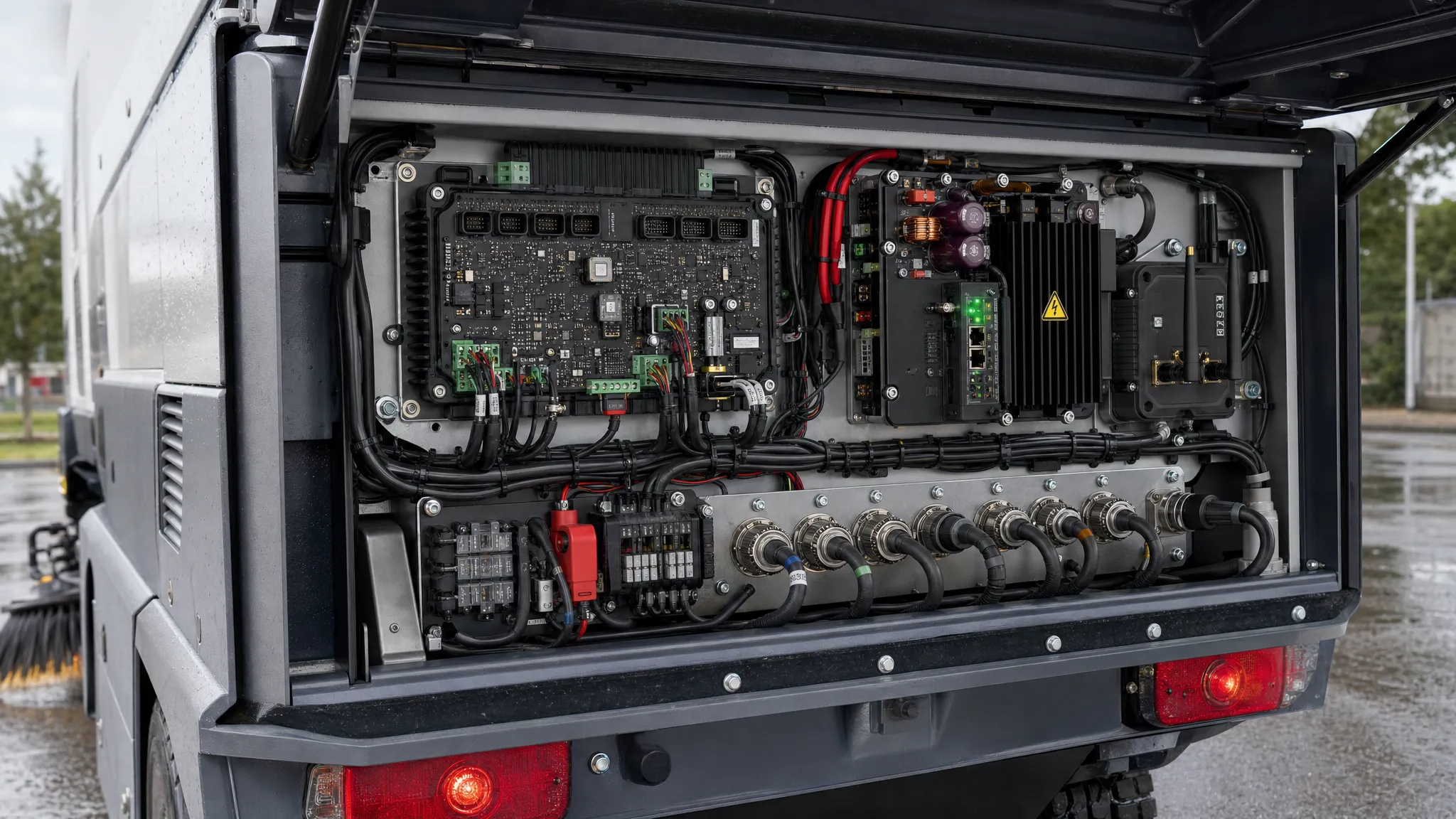
An embedded system is easy to define in one sentence, but harder to design well. In computer science, it is a computing system built into a larger product, designed to perform a specific function, often under strict constraints for timing, power, safety, size, cost and reliability.
That definition sounds simple. In practice, embedded systems sit at the point where software leaves the screen and starts controlling the physical world. They read sensors, control motors, manage energy, communicate with other devices, monitor faults and keep products operating safely in environments that are rarely as predictable as a development bench.
For engineering managers, CTOs and product teams, understanding embedded systems is not just an academic exercise. It affects architecture choices, certification risk, manufacturing readiness, serviceability and the long-term reliability of machines, vehicles and connected devices.
What is an embedded system in computer science?
In computer science terms, an embedded system is a dedicated computer system that is integrated into a device to monitor, control or automate a defined function. Unlike a desktop computer or cloud server, it is not designed to run many unrelated applications for a general user. It is designed around a specific product task.
A washing machine controller, a robotic actuator, a battery management unit, a maritime sensor module, an automotive control unit and an industrial drive controller can all contain embedded systems. The user may never see the computer inside, but the product depends on it.
A typical embedded system includes:
- A processor, such as a microcontroller, microprocessor or system-on-module.
- Firmware or embedded software that defines the system behaviour.
- Inputs such as sensors, buttons, encoders, voltage measurements or communication signals.
- Outputs such as displays, relays, motor drivers, valves, wireless modules or power stages.
- Supporting electronics for power, analogue signals, protection, communication and diagnostics.
The word “embedded” matters because the computing function is part of a larger physical product. The computer is not the destination. It is the control layer that makes the product behave correctly.
How embedded systems differ from general-purpose computers
General-purpose computers are designed for flexibility. They run many applications, accept frequent software changes and usually operate in environments where power, cooling, connectivity and user interaction are assumed.
Embedded systems are different. They are designed for a known function, a defined operating environment and a product lifecycle that may last many years. They often need to start quickly, respond predictably, tolerate electrical noise, survive temperature variation and keep working even when connectivity is unavailable.
| Aspect | General-purpose computer | Embedded system |
|---|---|---|
| Primary goal | Run many different applications | Perform a specific product function |
| User interaction | Usually direct, via screen, keyboard or touch | Often indirect, via sensors, controls or interfaces |
| Operating environment | Office, home, data centre or mobile use | Machine, vehicle, enclosure, field device or industrial setting |
| Timing requirements | Often flexible | Can be deterministic or real-time |
| Hardware constraints | Relatively flexible | Strong constraints on size, power, heat and cost |
| Lifecycle | Frequent upgrades are expected | Long-term availability and maintainability matter |
| Failure impact | Often inconvenience or data loss | Can affect safety, equipment, compliance or uptime |
This distinction also explains why embedded development should not be confused with conventional IT, website or app development. A browser-based platform can often assume flexible compute resources, fast deployment cycles and a human user in front of a screen. Specialists in web applications and digital interfaces work in that domain, while embedded engineers must also manage sensors, power electronics, EMC, heat, enclosure constraints and physical failure modes.
The basic architecture of an embedded system
Most embedded systems can be understood as a loop: measure, decide, act and verify. The system takes input from the real world, processes that input according to its software and hardware design, drives an output, then monitors whether the result is acceptable.
For example, a motor controller may measure current, speed, position and temperature. The embedded software calculates the required output, drives a power stage and continuously checks for overcurrent, overheating or unexpected behaviour. If something moves outside the safe operating range, the system must react in a defined way.

The main engineering layers are closely connected:
| Layer | Role in the embedded system | Design considerations |
|---|---|---|
| Hardware platform | Provides processing, memory, interfaces and physical connectivity | Processor choice, component lifecycle, PCB layout, thermal behaviour |
| Firmware | Implements control logic, communication, diagnostics and product behaviour | Timing, reliability, update strategy, fault handling |
| Power electronics | Converts and controls electrical energy for loads, batteries or actuators | Efficiency, heat, protection, switching behaviour, EMC |
| Analogue electronics | Measures and conditions real-world signals | Noise, accuracy, filtering, calibration, sensor interfaces |
| Communication | Connects the product to other systems or users | Wired interfaces, wireless modules, protocols, cybersecurity |
| Mechanical integration | Protects and positions the electronics | Enclosure, cabling, cooling, vibration, ingress protection |
| Validation and production support | Confirms the design works beyond the prototype | Testability, manufacturing data, compliance preparation, service diagnostics |
In real products, these layers cannot be designed in isolation. A firmware timing decision can influence power consumption. A PCB layout decision can affect EMC. A housing change can alter thermal performance or antenna behaviour. That is why embedded systems are best treated as complete engineered systems, not as a PCB plus code.
Where computer science fits into embedded systems
Embedded systems are strongly connected to computer science, but they use computer science in a constrained and physical context. Many familiar CS topics appear in embedded development, including algorithms, operating systems, concurrency, data structures, networking, security and software architecture.
The difference is that the consequences of implementation details are often more direct. An inefficient algorithm may not just make a user interface feel slow. It may cause a control loop to miss its timing window. A memory leak may not just require a server restart. It may cause a field device to fail after weeks of unattended operation.
Algorithms and control logic
Embedded software often implements decision-making logic for measurement, control and protection. That may include filtering sensor data, detecting thresholds, calculating motor control signals, managing charging behaviour or deciding when a device should enter a low-power mode.
The algorithm must be correct, but it must also be suitable for the target hardware. Processor speed, memory, numerical precision and timing constraints all influence the implementation.
Real-time behaviour
Many embedded systems must respond within a known time. This is known as real-time behaviour. A hard real-time system must meet deadlines to avoid unacceptable consequences. A soft real-time system should meet deadlines for good performance, but occasional delays may be tolerable.
Examples include motor control, safety monitoring, power conversion, sensor sampling and communication timing. Real-time design requires careful handling of interrupts, scheduling, task priorities and worst-case execution time.
Operating systems and firmware architecture
Some embedded systems run bare-metal firmware, where the code executes directly on the hardware without a conventional operating system. Others use a real-time operating system, often called an RTOS. More complex devices may use embedded Linux or another operating system when they need advanced networking, file systems, user interfaces or application frameworks.
The right choice depends on the product. A simple sensor interface may not need an operating system. A connected industrial gateway may need one. Choosing too much complexity can increase risk, but choosing too little can limit scalability.
Concurrency and state management
Embedded systems often manage several activities at once: reading sensors, controlling outputs, communicating with other devices, logging data and checking for faults. This requires disciplined state management.
Poor state design is a common source of unpredictable behaviour. A product may work during normal tests but fail when two events happen close together, such as a voltage dip during a wireless transmission or a communication timeout during a firmware update.
Security and updateability
As products become more connected, embedded systems increasingly need cybersecurity thinking. This includes secure communication, authentication, update mechanisms, access control and protection against unintended behaviour.
Security is not only a software concern. Hardware interfaces, debug ports, memory protection, boot processes and lifecycle support all influence the security posture of an embedded product.
Common examples of embedded systems in professional products
Embedded systems appear across almost every technical industry. In machine manufacturing, they control actuators, monitor sensors, interface with HMIs and communicate with higher-level automation systems. In robotics, they coordinate motion, sensing, power and safety functions. In automotive and mobility applications, they manage control units, battery systems, lighting, user interfaces and communication.
In maritime and defence environments, embedded systems must often operate under demanding environmental and reliability requirements. Moisture, vibration, temperature variation, electrical disturbances and long service life can all shape the design. In high-tech and semiconductor-related equipment, precision timing, signal integrity, diagnostics and maintainability are often critical.
Consumer and professional electronics also rely heavily on embedded systems, especially where products are becoming smarter, connected or energy efficient. The challenge is not simply adding a processor. The challenge is making the complete product robust, manufacturable and maintainable.
Why embedded systems are difficult to design reliably
A prototype can be impressive in the lab and still be far from production-ready. Embedded systems often fail later because the prototype did not represent the real operating environment, manufacturing variation or compliance constraints.
Several factors make embedded development technically demanding.
First, the system interacts with the physical world. Sensors drift, cables pick up noise, motors create disturbances, batteries behave differently with temperature and users operate products in ways that were not always anticipated.
Second, hardware and software decisions are interdependent. Firmware may compensate for analogue noise, but only within limits. A PCB layout may reduce EMC risk, but only if the enclosure, cabling and grounding strategy support it. A wireless module may be certified as a component, but the final product still needs careful integration.
Third, product lifecycles are long. Components may become unavailable, compliance requirements may evolve and field service needs may become clearer after deployment. Good embedded design considers diagnostics, test points, modular architecture and component lifecycle from the beginning.
Finally, compliance cannot be treated as a final checkbox. EMC, RED, CE and safety-related requirements need to influence architecture, layout, enclosure choices, cabling and firmware behaviour early in development. Designing with compliance in mind does not guarantee a certification outcome, but it reduces the risk of late-stage surprises.
From computer science concept to production-ready product
For a product team, the most important question is not only “what is an embedded system in computer science?” It is also “how do we turn this computing concept into reliable product behaviour?”
That transition requires more than choosing a microcontroller and writing firmware. It requires a structured development process that connects requirements, architecture, electronics, software, mechanics, validation and manufacturing preparation.
A practical development path usually includes clear answers to the following questions:
| Development question | Why it matters |
|---|---|
| What must the product control, measure or communicate? | Defines the functional scope and interfaces |
| What environment will the product operate in? | Influences temperature, EMC, vibration, sealing and protection choices |
| What timing requirements exist? | Determines processor, firmware architecture and RTOS decisions |
| What power constraints apply? | Shapes battery life, conversion stages, thermal design and safety margins |
| Which standards or market requirements are relevant? | Supports compliance-minded design from the start |
| How will the product be tested in production? | Improves manufacturability and reduces quality risk |
| How long must the product be supported? | Affects component selection, modularity and lifecycle planning |
The earlier these questions are answered, the easier it is to avoid expensive redesigns. Many embedded product problems are not caused by one bad component or one software bug. They are caused by hidden assumptions that were never made explicit.
Choosing the right level of embedded complexity
Not every product needs a powerful embedded computer. Some applications are best served by a small microcontroller with carefully written firmware. Others require a more capable processor, advanced communication, edge processing or an embedded operating system.
The right architecture depends on the product’s real requirements, not only on what is convenient during prototyping. A development board may be useful for early proof-of-concept work, but it may not be suitable for final size, cost, availability, EMC, thermal or manufacturing requirements.
A good embedded architecture balances current needs with future product direction. It leaves room for variants where necessary, avoids unnecessary complexity where possible and supports testing, maintenance and production scaling.
When to involve an embedded systems partner
Internal engineering teams often understand the product vision better than anyone else. However, complex embedded development may require specialist capacity across hardware, firmware, power electronics, analogue design, PCB layout, enclosure integration, compliance preparation and manufacturing support.
An external embedded systems partner can be valuable when the product includes several interacting technical domains, when internal capacity is limited, or when certification and production readiness are important. The goal is not to remove ownership from the product company. The goal is to make the technical path clearer, reduce hidden risks and support a more reliable route from concept to volume manufacturing.
ProMicro works in this space by combining embedded system development with power electronics, analogue electronics, PCB design, system engineering, enclosure design, rapid prototyping and support towards volume manufacturing. For products in high-tech, machine manufacturing, robotics, automotive, maritime, defence and professional electronics, that integrated view is often what determines whether an embedded system remains a lab prototype or becomes a robust product.
Frequently asked questions
What is an embedded system in computer science? An embedded system is a dedicated computing system built into a larger device to perform a specific function. It combines hardware and software to monitor, control or communicate with the physical world under defined constraints.
Is an embedded system the same as a microcontroller? No. A microcontroller may be part of an embedded system, but the embedded system also includes firmware, power electronics, sensors, interfaces, PCB design, mechanical integration and often communication or diagnostics.
Does every embedded system need an operating system? No. Simple embedded systems may run bare-metal firmware without an operating system. More complex systems may use an RTOS or embedded Linux when they need scheduling, networking, file systems or more advanced software architecture.
Why are embedded systems important in product development? They define how a product senses, decides, communicates and acts. Poor embedded design can lead to reliability issues, compliance delays, field failures or difficulty scaling from prototype to production.
Which programming languages are used in embedded systems? C and C++ are widely used because they offer control over memory and hardware. Depending on the application, teams may also use Python for testing, scripting or higher-level development, and other languages for specific platforms.
When should a company involve an embedded development specialist? It is wise to involve a specialist early when the product has demanding reliability, power, sensor, connectivity, EMC, safety, manufacturing or lifecycle requirements. Early architecture decisions are usually cheaper to improve than late-stage redesigns.
Need an embedded system that works beyond the prototype?
A clear computer science definition is useful, but successful embedded product development depends on how the concept is engineered into hardware, firmware, power, mechanics and production support.
If your team is developing a machine, connected device, control unit or high-value technical product, ProMicro can help assess the architecture, identify hidden technical risks and support development from first idea to volume-ready electronics. Visit ProMicro to discuss how embedded systems, power electronics and electronics design can be integrated into a reliable product development process.