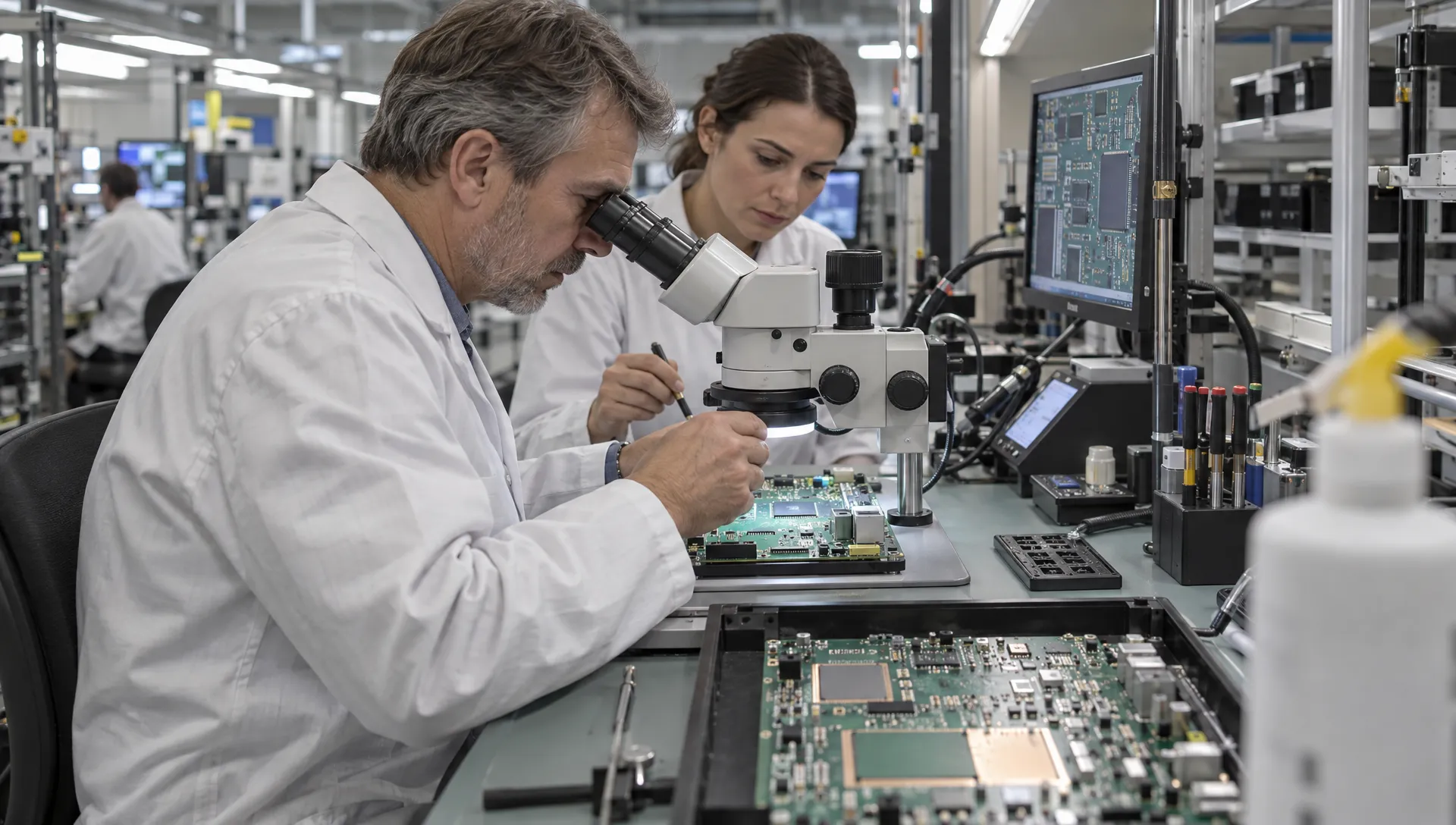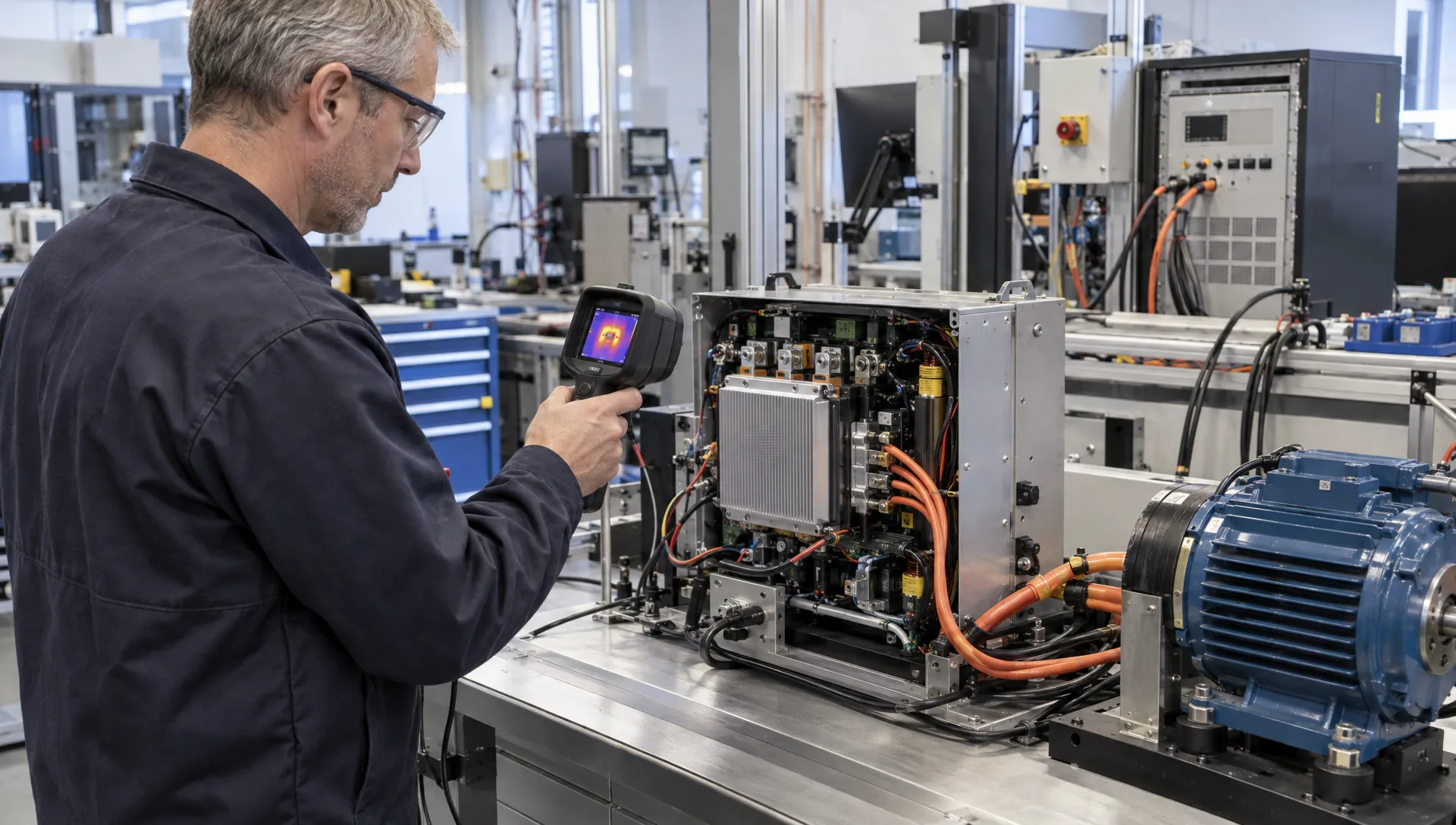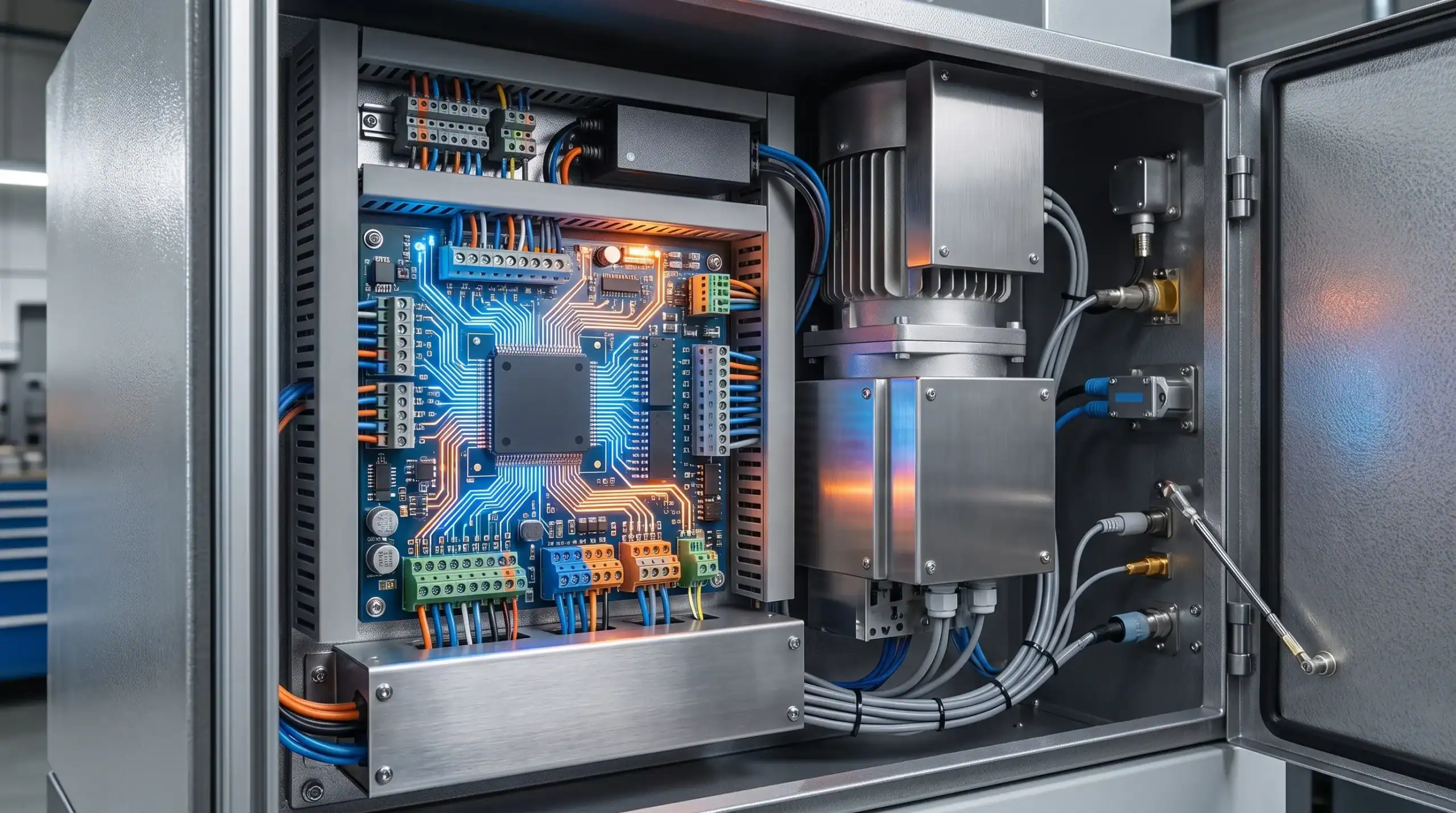
An embedded system is the part of a product that gives it controlled, repeatable behaviour. It is usually hidden from the user, but it determines whether a machine starts safely, a sensor reports accurately, a motor drive reacts in time or a connected device survives years of real use.
For OEMs and technical leaders, the question is not only what is meant by an embedded system in a textbook sense. The practical question is what it means for product architecture, risk, certification, manufacturing and long-term support. A microcontroller on a PCB may be part of the answer, but it is not the whole system.
In real products, an embedded system combines electronics, firmware, power, interfaces, mechanical constraints and the application environment into one engineered solution. That combination is where many product development risks appear, especially when a prototype has to become a reliable product.
A practical definition of an embedded system
An embedded system is a dedicated computing system built into a larger product to perform specific functions. It is not designed to behave like a general-purpose computer. It is designed to control, monitor or communicate within the physical product it belongs to.
A temperature controller in industrial equipment, a motor controller in a robot, a battery management unit in a vehicle, a sensor node in a maritime system or a wireless control module in a professional device are all examples. In each case, the embedded system exists because the product needs predictable electronic behaviour under defined conditions.
| Aspect | Embedded system in a real product | General-purpose computer |
|---|---|---|
| Main purpose | Performs defined control, sensing or communication tasks | Runs many types of user-selected software |
| Environment | Built into a machine, device, vehicle or instrument | Usually used as a separate computing device |
| Constraints | Limited power, space, heat, interfaces and timing margins | More flexible power, cooling and user interaction |
| Reliability focus | Must behave safely and consistently in the product context | Usually designed for broad usability and performance |
| Lifecycle | Tied to product support, components, manufacturing and service | Updated or replaced as a standalone platform |
This distinction matters because embedded systems are judged by product behaviour, not by processor specifications alone. A faster processor is not useful if the system creates EMC issues, overheats inside the enclosure or cannot be manufactured consistently.
Why the word embedded changes the engineering problem
The word embedded means the electronics and software are constrained by the product around them. The system has to work with the enclosure, power supply, wiring, sensors, actuators, communication interfaces, user behaviour and installation environment.
That is why embedded system development is not only firmware development. Firmware is critical, but it must be designed together with hardware architecture, analogue signal paths, power electronics, PCB layout, thermal design and test strategy. A control algorithm that performs well on a developer bench can behave differently when exposed to vibration, cable noise, supply dips, condensation or production variation.
For example, a motor control system in a machine may need to read position feedback, drive power electronics, detect fault conditions, communicate with a higher-level controller and shut down safely when limits are exceeded. Each part of that behaviour depends on the combined design of hardware and software.
The main elements inside an embedded system
Although every product is different, most embedded systems contain several common building blocks. The exact architecture depends on the application, expected lifetime, safety requirements, production volume and cost targets.
- Inputs and sensors: These may include temperature sensors, pressure sensors, encoders, current measurements, switches, cameras or analogue signals from the real world.
- Processing hardware: A microcontroller, microprocessor, FPGA, system-on-module or embedded computer runs the logic that controls the product.
- Firmware and control logic: The embedded software interprets inputs, makes decisions, handles timing, manages faults and controls outputs.
- Outputs and actuators: These can include relays, valves, displays, motor drives, power stages, LEDs, haptics or communication commands.
- Communication interfaces: Wired or wireless interfaces such as CAN, Ethernet, RS-485, Bluetooth, Wi-Fi, cellular or other protocols connect the product to users, machines or cloud services.
- Power and protection circuits: Embedded products often need robust power conversion, filtering, isolation, surge protection, thermal protection and safe behaviour during abnormal supply conditions.
These elements are not independent modules that can always be selected late in the project. The architecture determines the PCB layout, enclosure constraints, firmware structure, test access, certification path and production strategy.
From prototype logic to product behaviour
A prototype often proves that an idea can work. A product-ready embedded system must prove that it keeps working when conditions are less convenient.
That difference is where many projects become more complex than expected. A first prototype may use development boards, oversized power supplies, open wiring and manual resets. A real product may need a compact PCB, stable startup behaviour, watchdogs, fault logging, cable protection, EMC-aware layout, firmware update strategy and controlled production test procedures.
The product also needs to handle the cases that are not demonstrated during a successful lab test. What happens if a sensor is disconnected, a supply voltage drops, a motor stalls, radio communication is lost or the user powers the device repeatedly in quick succession? These questions belong to the definition of the embedded system because they define real product behaviour.

Examples in machines, vehicles and connected equipment
Embedded systems appear in almost every professional product category where electronics influence physical behaviour. The application context changes the design priorities, but the underlying principle remains the same: the embedded system turns product intent into controlled action.
| Product context | Typical embedded functions | Design priorities |
|---|---|---|
| Machine manufacturing | Motion control, safety monitoring, HMI interfaces, sensor processing | Reliability, serviceability, EMC, integration with machine controls |
| Robotics | Motor control, position feedback, sensor fusion, communication | Real-time response, power density, diagnostics, mechanical integration |
| Maritime systems | Monitoring, control, navigation-related electronics, connectivity | Moisture, corrosion, vibration, power disturbances, long service life |
| Automotive and mobility | Battery systems, control modules, sensors, actuators, connectivity | Safety, robustness, thermal behaviour, production repeatability |
| High-tech instruments | Measurement electronics, data acquisition, precision control | Signal integrity, analogue performance, calibration, stability |
| Consumer and professional devices | Wireless control, user interfaces, power management, IoT features | Cost control, usability, compliance, maintainability |
For a broader view of where these systems appear, ProMicro has also covered the application of embedded systems in machines, vehicles and devices. The common lesson is that the processor is only one part of the design problem. The environment around the processor often determines whether the product succeeds.
What is not an embedded system
Not every digital system is embedded. A cloud platform, office application or business automation tool can be highly sophisticated without being embedded in a physical product.
To draw a boundary, an AI-first recruitment platform can automate screening, outreach and scheduling workflows, but it is not an embedded system because its primary operating environment is cloud software rather than a dedicated electronic product. An embedded system may connect to cloud services, but its essential role is still inside the device, machine or equipment.
The same distinction applies to mobile apps and web dashboards. A connected product may include an app, cloud portal and analytics layer, but the embedded system is the part inside the product that measures, controls, communicates and protects the device. If the cloud connection fails, the embedded system may still need to maintain safe local behaviour.
A PLC-based control cabinet can also overlap with embedded thinking, but it is usually a configurable industrial control platform rather than a custom embedded product architecture. In many OEM products, a dedicated embedded system is chosen when size, cost, integration, power, ownership of the product design or long-term manufacturability make a standard controller unsuitable.
Why embedded design affects reliability, compliance and production
Embedded system choices made early in development have long consequences. The selected processor, communication method, power architecture, grounding approach, firmware structure and enclosure concept influence testing, compliance and service long after the first prototype is built.
This is especially relevant for products that must operate near motors, power electronics, radio modules, long cables or noisy electrical environments. Designing for EMC, RED, CE marking and safety-related constraints does not mean guaranteeing approval in advance, but it does mean making architecture decisions with those requirements in mind from the start.
| Early decision | Possible downstream effect |
|---|---|
| Processor and firmware architecture | Affects timing, update strategy, diagnostics and long-term maintainability |
| Power supply topology | Influences heat, efficiency, EMC behaviour and fault tolerance |
| PCB layout and grounding | Can determine signal integrity, emissions, immunity and analogue accuracy |
| Sensor and interface selection | Affects measurement quality, robustness, calibration and field reliability |
| Enclosure and connector choices | Influence moisture protection, strain relief, service access and user safety |
| Component selection | Impacts availability, lifecycle management, cost and production continuity |
Products used in harsh or safety-conscious environments need more than functional electronics. They need a system architecture that anticipates the physical world. ProMicro discusses this in more depth in its article on embedded systems in demanding real-world use, where conditions such as heat, vibration, EMC and production variation are central to the design challenge.
Questions to answer before developing an embedded system
A clear definition of the embedded system starts before schematic design or firmware coding. Technical leaders should clarify what the product must do, where it will operate, how it will be produced and how long it must be supported.
Useful early questions include:
- What physical behaviour must the product control or monitor?
- Which failure modes must be detected, prevented or made safe?
- What environmental conditions will the electronics face during installation, use, transport and service?
- Which standards, directives or customer requirements may influence architecture decisions?
- What production volumes, test procedures and lifecycle expectations apply?
- Which functions must keep working locally if wireless, cloud or higher-level communication is unavailable?
These questions help expose hidden requirements. Many embedded system risks are not visible in the initial feature list because they come from installation context, user behaviour, service needs, electromagnetic environment or manufacturing variation.
How an engineering partner supports the full system
For companies developing their own machines, instruments, connected devices or technical equipment, embedded system development often requires more than extra firmware capacity. The challenge is to align multiple disciplines into one product architecture.
That includes system engineering, embedded software, power electronics, analogue electronics, PCB design, enclosure considerations, prototyping, testing and preparation for production. When these disciplines are handled separately, design gaps can appear between the PCB, firmware, mechanics, certification strategy and manufacturing process.
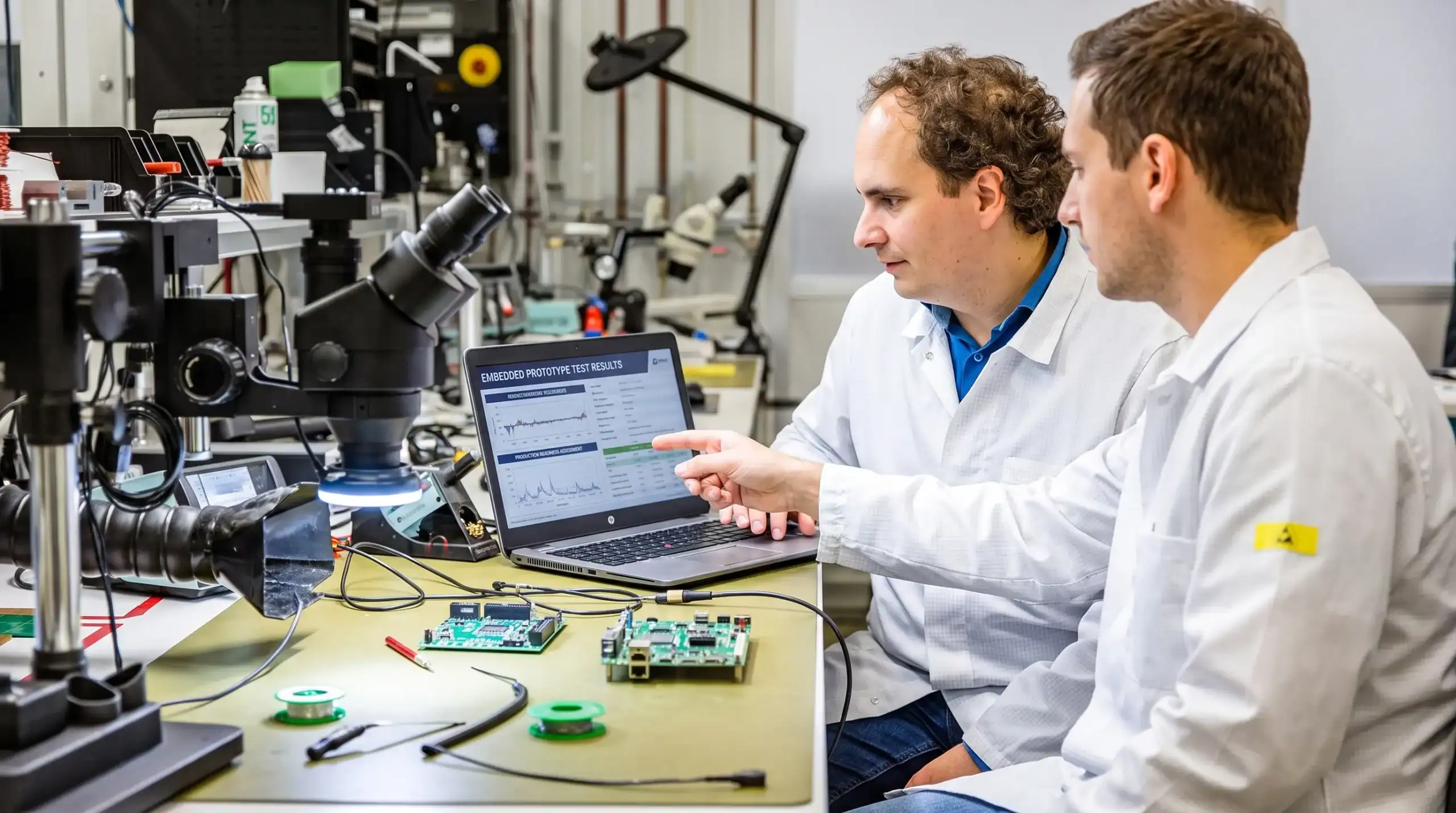
A structured engineering partner can reduce those risks by thinking beyond the requested task. For example, a customer may ask for a PCB layout, but the real issue may be current measurement accuracy, thermal behaviour, EMC susceptibility or lack of production test access. Identifying those issues early is usually less expensive than correcting them after certification testing or pilot production.
ProMicro supports electronic product development from early concept through prototyping and towards volume manufacturing, with a focus on embedded systems, power electronics, analogue electronics and practical system integration. For professional products, that integrated view is often the difference between a working prototype and a robust, maintainable product.
Frequently asked questions
What is meant by an embedded system? An embedded system is a dedicated combination of electronics and software built into a larger product to perform specific control, sensing, communication or monitoring functions. It is designed around the product it belongs to, rather than as a general-purpose computer.
Is an embedded system the same as firmware? No. Firmware is the software that runs on embedded hardware, but the embedded system also includes electronics, power design, interfaces, sensors, outputs, PCB layout, mechanical constraints and the operating environment.
Does every IoT product contain an embedded system? Most IoT products contain an embedded system because the device needs local electronics to sense, control and communicate. The cloud platform or mobile app is part of the broader solution, but the embedded system is the part inside the physical product.
Why do embedded systems fail after a prototype works? Prototypes can fail during scaling because real products face EMC, heat, vibration, supply variation, component tolerances, user errors, production variation and long-term lifecycle constraints. These factors must be considered during architecture and design.
When should an OEM involve an embedded systems partner? An OEM should involve a specialist partner when the product combines hardware, firmware, power electronics, sensors, communication, compliance concerns or manufacturing requirements that exceed internal capacity or specialist knowledge.
Turning an embedded idea into a reliable product
Understanding what is meant by an embedded system is useful only if it leads to better product decisions. In real products, the embedded system is where software meets electronics, power, mechanics, users, standards and the physical environment.
If you are developing a machine, connected device, control module or high-tech product and need support from concept to production-ready electronics, ProMicro can help you assess the architecture, identify hidden risks and develop a robust embedded solution for long-term use.