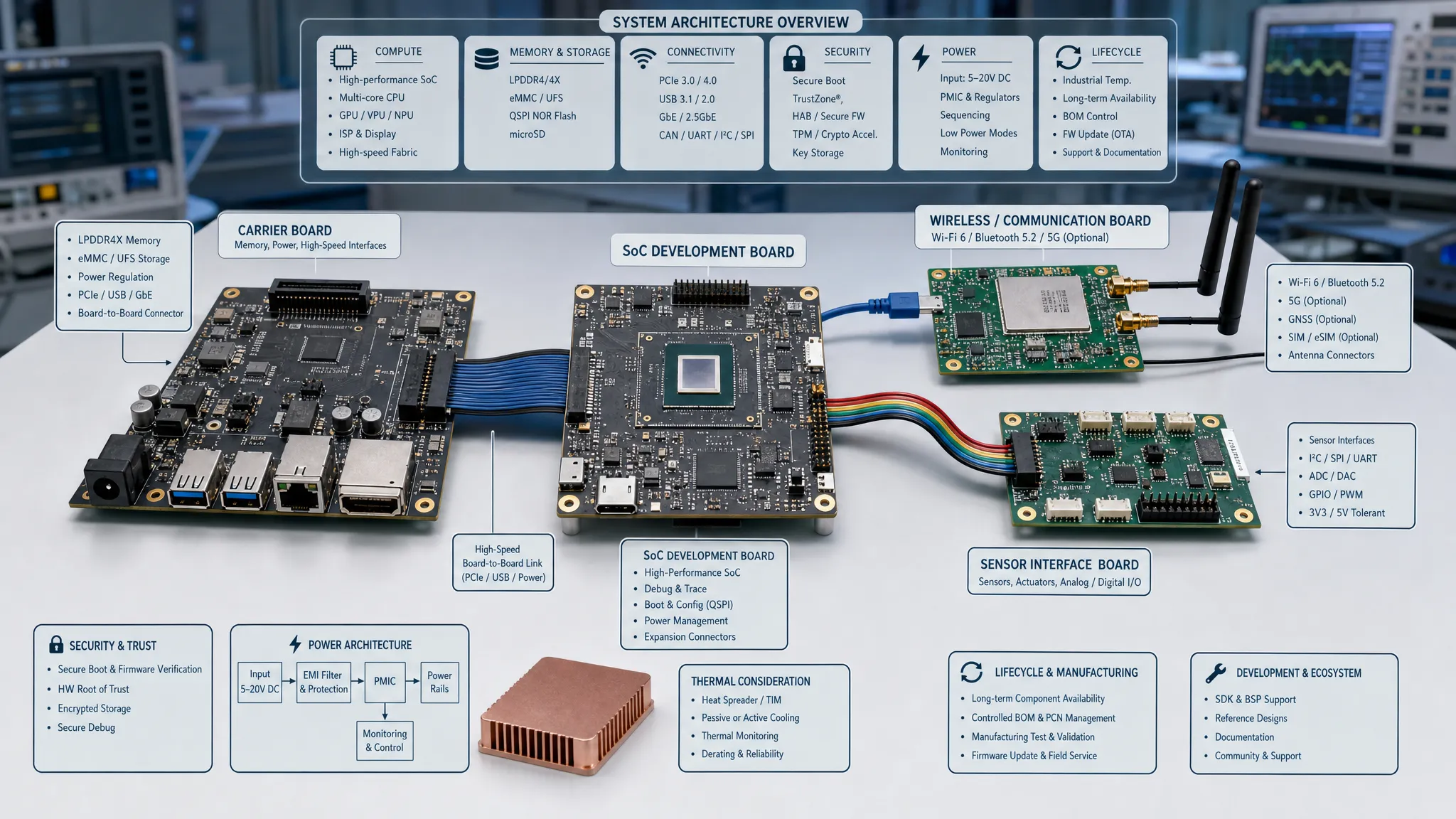
A system on chip can make an embedded product smaller, faster and more capable, but it also moves many design decisions into the earliest architecture phase. For OEMs building machines, robotics, maritime equipment, automotive electronics, connected devices or high-tech instruments, the choice of SoC influences far more than processing performance. It affects PCB layout, power integrity, firmware architecture, security, EMC behaviour, certification readiness, production testing and long-term serviceability.
That is why system on chip design in embedded systems should not be treated as a component selection task. It is a system engineering decision. The right SoC can reduce size and integration effort. The wrong one can create hidden risks that only appear during compliance testing, field operation or volume production.
What is a system on chip in embedded system design?
A system on chip, usually shortened to SoC, is an integrated circuit that combines multiple computing and interface functions on a single silicon die. Instead of using separate chips for the processor, graphics, memory control, communication interfaces and hardware accelerators, an SoC integrates many of these functions into one device.
In embedded systems, an SoC typically sits at the centre of the product architecture. It runs the main application software, processes sensor data, manages communication, controls user interfaces and coordinates with surrounding electronics such as power stages, analogue front ends, motor drives, wireless modules or safety circuits.
A typical embedded SoC may include:
- One or more CPU cores, such as Arm, RISC-V or proprietary cores
- Memory controllers for DDR, LPDDR, NAND flash or eMMC
- Interfaces such as Ethernet, USB, PCIe, CAN, SPI, I2C, UART, MIPI or LVDS
- Graphics, video or display engines
- AI, DSP or cryptographic accelerators
- Security functions such as secure boot and hardware key storage
- Power management and clock control blocks
- Some analogue or mixed-signal functions, depending on the SoC family
The term “system on chip design” can mean two different things. For semiconductor companies, it can mean designing the silicon itself. For most OEMs and product developers, it means designing an embedded product architecture around a selected SoC, including the hardware, firmware, power, PCB, enclosure, test strategy and manufacturing approach.
This second meaning is usually the practical challenge. The SoC is highly integrated, but the final product is still a complete embedded system that must operate reliably in a real environment.
SoC, microcontroller, microprocessor and module: what is the difference?
The terminology can be confusing because boundaries are not always strict. Some microcontrollers are marketed as SoCs, and some SoCs include microcontroller-like real-time cores. For engineering decisions, the distinction should be based on function, integration and system complexity rather than marketing language.
| Architecture option | Typical strengths | Typical limitations | Common use cases |
|---|---|---|---|
| Microcontroller (MCU) | Deterministic control, low power, simpler firmware, integrated peripherals | Limited processing power, limited memory, less suitable for high-level OS workloads | Motor control, sensors, safety monitoring, simple machine control |
| Microprocessor (MPU) | Higher compute performance, external memory, Linux-capable | Requires more supporting circuitry, more complex PCB and power design | Gateways, industrial HMIs, data processing, connectivity hubs |
| System on chip (SoC) | High integration, multiple interfaces, accelerators, strong compute density | More complex power, boot, firmware, layout, thermal and lifecycle considerations | Connected devices, edge computing, vision, robotics, high-data products |
| System in package or module | Faster integration, reduced high-speed layout burden, often pre-tested | Higher unit cost, dependency on module supplier, less design freedom | Lower volume products, accelerated prototypes, complex wireless or compute platforms |
An MCU may be the best choice for a robust, low-power embedded controller. An SoC becomes attractive when the product needs higher processing capability, advanced connectivity, multimedia, complex user interfaces, local data processing or edge intelligence.
The decision is rarely about maximum performance alone. It is about matching the architecture to the real application, including environmental conditions, compliance requirements, production volumes, software maintenance and expected product lifetime.
Why SoCs are used in modern embedded products
SoCs are increasingly common because embedded products are expected to do more locally. Machines need diagnostics and connectivity. Maritime systems need robust communication and monitoring. Robotics platforms need sensor fusion, motion control and sometimes vision processing. Professional consumer electronics need compact design and low power consumption. Defence and security applications often require secure boot, encrypted communication and controlled update mechanisms.
A well-chosen SoC can support these requirements by combining processing, interfaces and accelerators in a compact footprint. It can reduce board area, simplify some interconnects and enable more software-defined product functionality. This is especially useful when product variants must share a common electronics platform while offering different features through firmware, connected services or optional interfaces.
However, higher integration does not automatically mean lower engineering risk. The complexity moves from component count to architecture quality. Power sequencing, DDR routing, high-speed signal integrity, thermal management, secure boot, Linux board support packages and compliance behaviour must be handled carefully.
In other words, an SoC can simplify the bill of materials while making system design more demanding.
Key design areas when using an SoC
A system on chip in embedded system architecture touches almost every engineering discipline. The following areas usually determine whether the product becomes reliable and production-ready or difficult to certify and maintain.
Requirements and operating context
SoC selection should start with the product context, not the processor catalogue. The development team needs to understand what the product must sense, control, communicate, store and display. It also needs to understand where the product will operate: temperature range, vibration, humidity, electromagnetic environment, supply quality, enclosure constraints and expected service life.
A lab prototype may run well on an evaluation board, but that does not prove the architecture is ready for an industrial machine, maritime device or vehicle environment. Requirements should include electrical, mechanical, software, compliance and lifecycle assumptions from the start.
This is where hidden requirements often appear. A device may need remote diagnostics, production calibration, field firmware updates, protection against brown-outs or a safe state after communication loss. These requirements are easy to miss if SoC selection is based only on CPU speed and interface count.
Power architecture and sequencing
Most SoCs require several supply rails, often with strict voltage tolerances and start-up sequences. Core voltage, I/O voltage, memory voltage, analogue rails and peripheral rails may all need to behave correctly during start-up, shutdown, sleep modes and fault conditions.
Poor power architecture can lead to intermittent boot failures, excess heat, unstable communication or reduced lifetime. In power-sensitive products, sleep and wake behaviour must also be designed at system level. It is not enough to choose a low-power SoC if the surrounding regulators, sensors, transceivers and firmware do not support the intended power states.
For products that include power electronics or motor drives, the SoC power domain must also be protected from switching noise, transients and ground disturbances. This is a common source of failures that only appear when the full system is tested under realistic load.
PCB layout and signal integrity
SoC-based boards often involve high-speed interfaces such as DDR memory, Ethernet, USB, PCIe, MIPI camera links, display interfaces or fast ADC connections. These interfaces are sensitive to trace length, impedance control, return paths, via structure, stack-up and power integrity.
A functional schematic does not guarantee a functional PCB. Layout decisions can determine whether the board boots reliably, passes EMC testing and remains stable over temperature and production variation.
This is particularly important when moving from an evaluation board to a custom PCB. Evaluation boards are useful for software exploration, but they do not represent the final product environment, enclosure, cable routing, grounding concept or production constraints.
Firmware, boot chain and operating system
SoC design is closely linked to software architecture. Many SoCs run Linux, a real-time operating system or a combination of both. Some include heterogeneous cores, where a high-performance application processor runs the main software while a smaller real-time core handles deterministic control.
The boot chain must be designed deliberately. It may include boot ROM, first-stage bootloader, second-stage bootloader, kernel, device tree, root file system and application software. Secure boot, firmware update strategy and recovery mechanisms must be considered early, especially for connected or safety-sensitive products.
A common mistake is to treat the board support package as a late software task. In reality, firmware architecture depends on hardware design decisions such as clocking, memory map, peripheral assignment, power states, watchdog configuration and production test access.
Security and update strategy
Connected embedded products need a security concept that fits the product lifecycle. SoCs often include useful hardware security features, but those features only help if they are integrated into the full system.
Important design questions include how firmware is authenticated, how keys are stored, how updates are delivered, how rollback is prevented and how the product recovers from an interrupted update. For professional markets, the update strategy must also respect operational constraints. A machine controller, maritime device or defence-related product cannot be treated like a consumer gadget that can simply reboot at any time.
Security should also be balanced with serviceability. Products need controlled access for production programming, diagnostics and field support without creating unnecessary attack surfaces.
Compliance considerations for SoC-based embedded systems
SoC-based products can face EMC, RED, CE, safety and cybersecurity-related requirements depending on their function, market and connectivity. The exact standards depend on the product category and region, but the engineering principle is consistent: compliance should be considered during architecture and design, not only after the prototype is built.
High-speed processors, switching power supplies, wireless interfaces, long cables and compact enclosures can all influence emissions and immunity. A certified module or radio chipset can reduce some risks, but it does not automatically make the final product compliant. The integration, antennas, enclosure, power supply, grounding, cabling and firmware behaviour still matter.
For organisations managing broader regulatory workflows, documentation and remediation planning may be supported by AI-powered compliance workflow tools. At product level, however, compliance evidence still depends on sound engineering decisions, traceable requirements, representative prototypes and structured validation.
A practical design-for-compliance approach for SoC-based systems should include early identification of relevant standards, review of high-risk interfaces, pre-compliance testing where appropriate and documentation of design decisions that affect EMC, safety and radio behaviour. ProMicro has also written about embedded design decisions that affect EMC, safety and lifecycle for teams that want to reduce late-stage redesign risk.
When an SoC is the right choice
An SoC is usually a strong candidate when the product needs significant local processing, rich connectivity or compact integration. Examples include edge gateways, smart sensor platforms, machine vision devices, advanced human-machine interfaces, robotic subsystems, connected maritime equipment and high-tech measurement instruments.
The choice becomes especially relevant when the product needs to process data locally instead of sending everything to the cloud. Local processing can reduce latency, improve resilience when connectivity is limited and support privacy or security requirements.
An SoC may also be appropriate when the product roadmap includes multiple variants. A capable SoC platform can provide headroom for future software features, additional interfaces or upgraded connectivity, provided that the lifecycle and supply chain risks are acceptable.
Still, an SoC is not always the best answer. If the product needs simple deterministic control, very low power consumption, minimal boot time or a long stable lifecycle with limited software complexity, an MCU-based architecture may be more robust and cost-effective. The right architecture is the one that serves the product requirements with the least unnecessary risk.
Common mistakes in SoC-based embedded development
Many SoC projects run into difficulty because early decisions are made from a prototype perspective rather than a production perspective. The product may work on an evaluation kit, but fail when integrated into a compact enclosure, exposed to real load conditions or prepared for certification.
Common mistakes include:
- Selecting an SoC before defining the operating environment and lifecycle needs
- Underestimating DDR layout, high-speed routing and power integrity effort
- Assuming a vendor evaluation board proves manufacturability
- Treating Linux integration, boot time and updates as software-only concerns
- Relying on certified modules without analysing final product compliance
- Ignoring thermal behaviour until enclosure design is nearly finished
- Choosing components without considering long-term availability and second sources
- Leaving production programming, test points and diagnostics until late in the design
These mistakes are rarely caused by lack of engineering skill. They often happen because SoC projects span multiple domains: digital design, analogue behaviour, power electronics, firmware, mechanics, compliance and manufacturing. If these disciplines are handled separately, integration risk increases.
From concept to production-ready SoC architecture
A robust SoC-based product development process should move through controlled phases. First, define the product requirements and operating context. Then create a system architecture that identifies processing needs, interfaces, power domains, communication paths, firmware responsibilities and compliance risks.
The next step is selecting the SoC or module. This should include more than comparing clock speeds and peripheral lists. Engineering teams should evaluate vendor support, software ecosystem, reference designs, long-term availability, security features, thermal profile, package complexity, memory requirements and manufacturing implications.
After selection, schematic and PCB layout must be developed with signal integrity, power integrity and EMC in mind. Firmware bring-up should be planned alongside hardware design, including bootloader strategy, production programming and diagnostics. Prototypes should be representative enough to validate the real risks, not only the basic function.
Before scaling, teams should verify the design under realistic conditions. That includes temperature, power disturbances, representative cabling, communication loads, enclosure constraints and application-specific stress cases. Production preparation should cover test strategy, documentation, component lifecycle, manufacturing data and service support.
For a broader technology selection framework, see ProMicro’s article on choosing embedded systems technology for long-term product success.
How ProMicro supports SoC-based embedded development
ProMicro supports companies developing reliable electronic products from first idea to volume manufacturing. In SoC-based embedded projects, the value is not only in selecting a processor or designing a PCB. The value lies in connecting the complete system: embedded hardware, firmware needs, power electronics, analogue interfaces, PCB layout, enclosure integration, prototyping, compliance-minded design and manufacturing preparation.
This integrated approach helps reduce risks that are often missed when electronics, software, mechanics and production are treated as separate work packages. For example, SoC power sequencing affects firmware boot behaviour. PCB stack-up affects EMC. Enclosure decisions affect thermal performance and antenna behaviour. Component choices affect lifecycle support and production continuity.
For OEMs and technical teams with limited internal capacity, an external embedded electronics partner can provide specialised knowledge without taking ownership away from the product owner. The best results come from close collaboration, clear requirements and a shared focus on reliable, scalable and maintainable electronics.
Frequently asked questions
What is a system on chip in an embedded system? A system on chip in an embedded system is an integrated circuit that combines processing, interfaces, memory control and often specialised accelerators on one chip. It acts as the central computing element in products that need compact integration and higher processing capability.
Is an SoC the same as a microcontroller? Not exactly. A microcontroller usually focuses on deterministic control with integrated memory and peripherals. An SoC typically offers higher processing performance, more complex interfaces, external memory support and often runs Linux or another advanced operating system. Some devices overlap, so the best choice depends on product requirements.
Does using an SoC make embedded design easier? It can reduce component count and board area, but it can also increase system complexity. SoC projects require careful attention to power sequencing, PCB layout, firmware bring-up, thermal behaviour, security and compliance.
Can a certified wireless SoC guarantee CE or RED compliance? No. A certified wireless component can help reduce risk, but the final product still needs correct integration. Antenna design, enclosure, power supply, cabling, firmware behaviour and EMC performance all influence compliance.
When should an OEM involve an embedded design partner? It is useful to involve a partner when the product combines multiple technical domains, such as SoC computing, sensors, motor drives, wireless communication, power electronics, analogue signals, enclosure constraints or certification risk. Early involvement helps identify hidden requirements before they become expensive redesigns.
Need support with SoC-based embedded product development?
If your product requires more than a standard controller, SoC architecture can provide the processing power and integration needed for advanced embedded systems. It also requires disciplined engineering across hardware, firmware, power, analogue design, compliance, prototyping and manufacturing readiness.
ProMicro helps companies turn complex electronic product ideas into reliable, scalable and production-ready embedded solutions. If you are evaluating an SoC-based architecture or want to reduce risk before moving from prototype to volume manufacturing, contact ProMicro to discuss your development challenge.