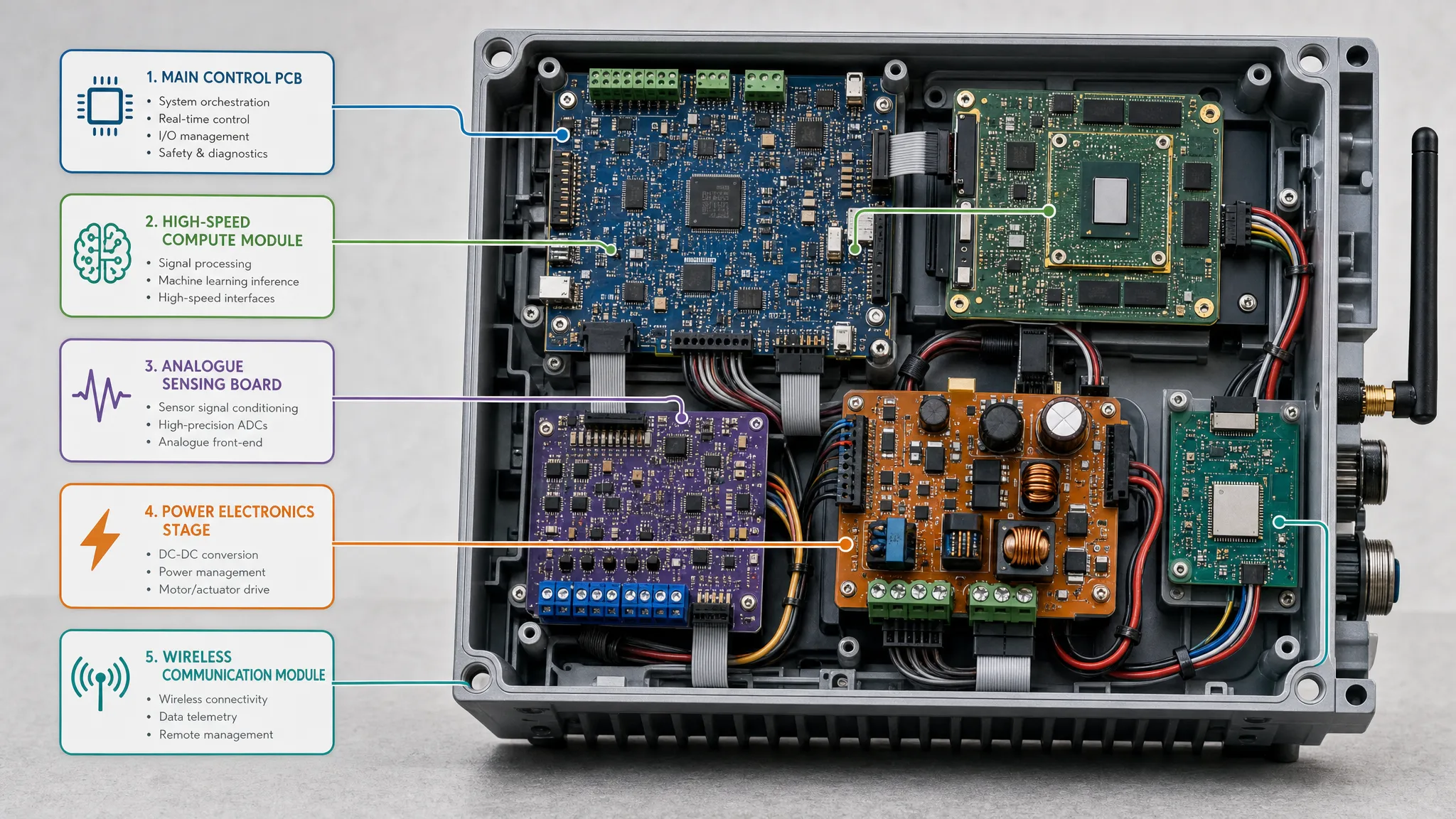
Performance in embedded products is no longer achieved by choosing the fastest processor and building the rest of the design around it. Modern machines, vehicles, instruments and connected devices often need to sense, control, communicate, protect, analyse and update in real time. One processing device rarely handles all of those tasks in the most efficient, reliable or scalable way.
That is where heterogeneous embedded systems become valuable. Instead of forcing every function onto one microcontroller or processor, a heterogeneous architecture combines different types of processing, analogue, power and communication building blocks. Each part of the system is selected for the work it does best.
For engineering managers, CTOs and product development teams, the key question is not simply “Can we add more processing power?” It is “Can we distribute the workload in a way that improves real-world performance, reduces risk and remains manufacturable over the product lifecycle?”
What makes an embedded system heterogeneous?
A heterogeneous embedded system uses multiple specialised hardware and software elements within one product architecture. These elements may include a low-power microcontroller for deterministic control, an application processor for user interfaces or connectivity, an FPGA for parallel signal processing, a DSP for filtering, a wireless module for communication, analogue front-end circuitry for precision sensing, and power electronics for motor or actuator control.
The important point is that heterogeneity is not just a collection of chips on a PCB. It is a system-level design choice. The architecture must define how tasks are divided, how data moves between subsystems, how timing is controlled, how faults are handled, and how the product will be tested and manufactured.
In practice, heterogeneous embedded systems often combine several of the following elements:
- A real-time microcontroller for control loops, safety monitoring and deterministic I/O
- An application processor or embedded computing module for Linux-based functions, dashboards, gateways or edge processing
- A DSP, FPGA, GPU or NPU for signal processing, image processing, AI inference or protocol acceleration
- Analogue electronics for sensor conditioning, measurement accuracy and noise control
- Power electronics for motors, batteries, converters, actuators or high-current loads
- Wired or wireless communication modules for fieldbus, Ethernet, cellular, Wi-Fi, Bluetooth, GNSS or other connectivity needs
The architecture becomes heterogeneous because the system has different types of work with different performance constraints. A motor control loop may need predictable microsecond-level timing. A vision pipeline may need high-throughput parallel processing. A cloud-connected interface may need memory, networking stacks and secure updates. A precision sensor may need low-noise analogue design more than raw CPU performance.
Why heterogeneous embedded systems improve performance
The performance benefit comes from matching the workload to the right technology. In many embedded products, a single processor architecture creates compromises. Either the processor is powerful but inefficient for simple real-time tasks, or it is efficient and deterministic but not suitable for heavier data processing, connectivity or user-interface requirements.
A heterogeneous system avoids this bottleneck by distributing functions intelligently.
| Workload type | Suitable subsystem | Performance benefit |
|---|---|---|
| Fast control loops | Real-time MCU or dedicated motor-control IC | Predictable timing, low latency and stable control behaviour |
| High-volume sensor data | DSP, FPGA or dedicated accelerator | Faster filtering, compression or pattern detection |
| User interface and connectivity | Application processor or embedded compute module | More memory, richer software environment and easier integration of network services |
| Precision measurement | Analogue front end with careful PCB layout | Better signal integrity and lower measurement noise |
| Power conversion or motor drive | Custom power electronics and control firmware | Higher efficiency, better thermal behaviour and improved load handling |
| Wireless communication | Certified or purpose-built communication module | Reduced RF design complexity and more robust connectivity integration |
This does not mean every product needs a complex multi-processor platform. In fact, unnecessary heterogeneity can increase cost, software complexity and validation effort. The advantage appears when the product has genuinely different performance domains that cannot be served well by one general-purpose device.
More deterministic real-time behaviour
One of the strongest reasons to use a heterogeneous architecture is real-time control. In robotics, machine manufacturing, maritime systems and automotive applications, timing matters. Motor control, actuator management, sensor sampling and protection functions must continue to operate predictably, even when higher-level software is busy.
If a single application processor runs the control loop, user interface, communication stack and diagnostics, timing can become harder to guarantee. Operating system scheduling, memory access, network traffic and background tasks may introduce jitter. By assigning time-critical control to a dedicated microcontroller or hardware accelerator, the system can maintain deterministic behaviour while a separate processor handles less time-critical functions.
This separation is especially useful in products where a delayed response is not just inconvenient, but can affect safety, reliability or process quality.
Higher throughput for data-heavy functions
Many modern products generate more data than traditional embedded systems were designed to handle. Vision sensors, vibration sensors, current measurements, radar, acoustic signals and multi-axis motion data can all create demanding data flows. Processing those streams on a general-purpose microcontroller may be possible at prototype stage, but the design can quickly reach limits when sampling rates, algorithms or product variants increase.
A heterogeneous architecture allows the system to use dedicated processing where it matters. For example, an FPGA can process sensor streams in parallel before passing reduced data to a microcontroller. A DSP can run filtering or spectral analysis more efficiently than a general-purpose core. An embedded AI accelerator can perform local inference without sending all raw data to the cloud.
The result is not only faster processing. It can also reduce bus traffic, memory pressure and communication latency across the complete system.
Better power efficiency and thermal performance
Performance is not only about speed. In embedded electronics, performance also means delivering the required function within the available power and thermal envelope. This is critical in battery-powered devices, sealed enclosures, maritime electronics, industrial systems near heat sources, and compact high-tech equipment.
A powerful processor that remains active for every task may waste energy and create unnecessary heat. A heterogeneous design can keep low-level monitoring on a low-power microcontroller, wake a higher-performance processor only when needed, and use hardware acceleration for specific tasks that would otherwise consume more energy in software.
For products with motor drives, power converters or high-current loads, thermal performance is strongly influenced by the interaction between power electronics, PCB layout, enclosure design and firmware behaviour. A system-level approach makes it possible to optimise switching behaviour, protection thresholds, cooling paths and control strategy together.
Improved signal quality and measurement performance
In many professional products, the limiting factor is not computing capacity but measurement quality. A system may need to detect small analogue signals while operating near switching converters, motors, wireless transmitters or long cable runs. If architecture and PCB layout are not handled carefully, noise can degrade accuracy and cause intermittent behaviour.
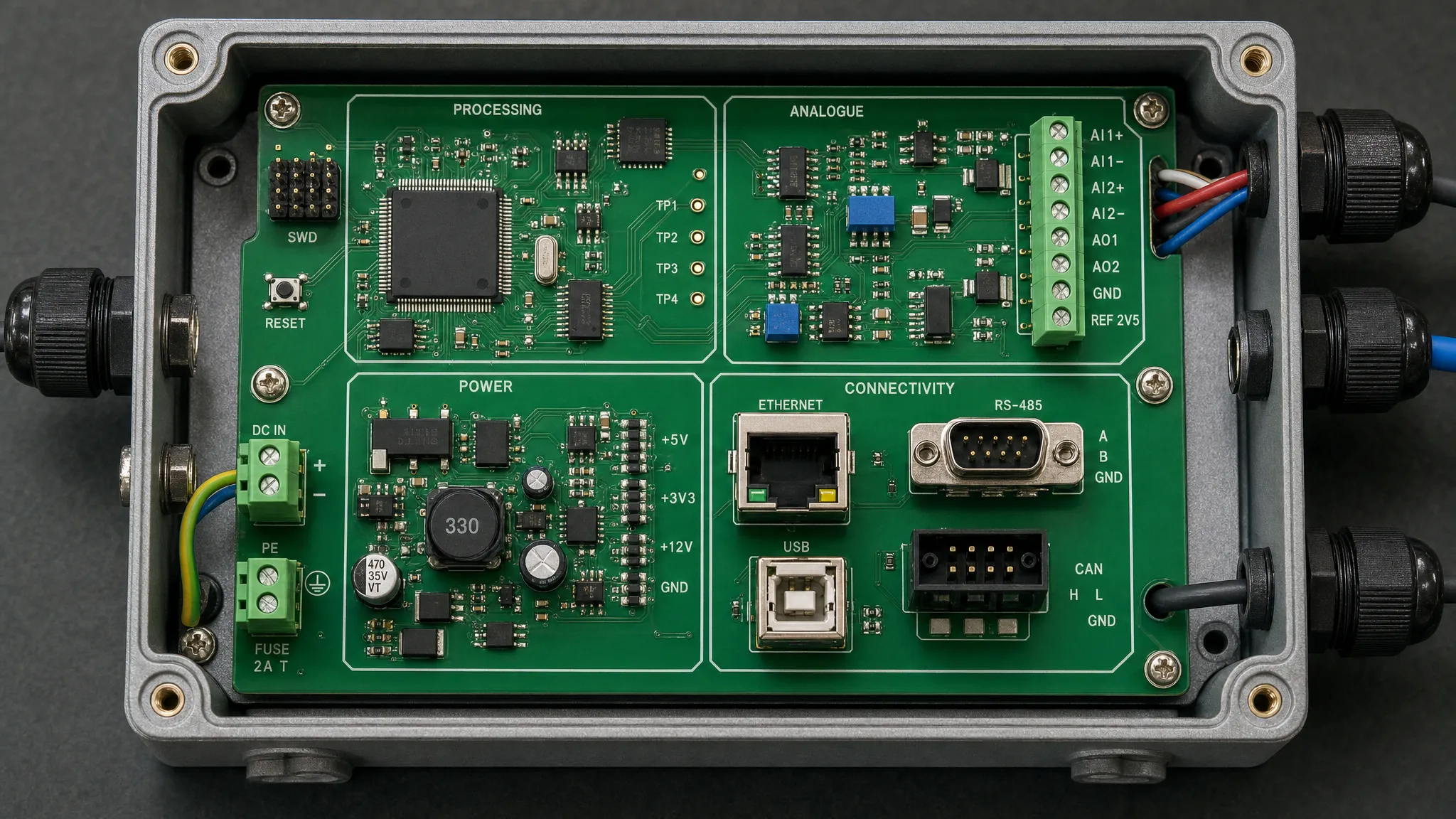
Heterogeneous embedded systems can improve performance by separating sensitive analogue functions from noisy digital and power domains. This may involve dedicated analogue front ends, isolation, appropriate grounding strategy, filtered power rails, careful routing and controlled sampling timing.
This is where embedded development moves beyond software and processor selection. The analogue, power, digital and mechanical aspects must be designed together. A reliable measurement chain depends on the sensor, analogue conditioning, ADC selection, PCB layout, firmware filtering, enclosure, cabling and EMC behaviour.
Real-world applications where heterogeneous design adds value
Heterogeneous design is most relevant when a product operates in a demanding environment, has mixed workloads or must scale from prototype to production without major redesign.
In machine manufacturing, an embedded product may need to control motors, monitor safety-related signals, communicate with higher-level machine controls, log performance data and support remote diagnostics. A dedicated control subsystem can maintain predictable machine behaviour while a separate compute or communication subsystem handles diagnostics and connectivity.
In robotics, performance depends on tight coordination between sensing, actuation, motor control, battery management, localisation and communication. A single processor may not be the best place for all of this. Dividing the architecture into real-time control, perception processing and system coordination can improve response time and robustness.
In automotive and maritime electronics, environmental conditions can be demanding. Voltage disturbances, temperature variation, vibration, moisture and EMC exposure must be considered from the start. Heterogeneous embedded systems can help by separating critical monitoring and control from higher-level connectivity or user-facing functions, but only if power, PCB, enclosure and firmware design are aligned.
In defence, secure communication, rugged operation, low power consumption and predictable behaviour are often key drivers. A heterogeneous architecture can support functional separation, fault containment and dedicated processing for encryption, radio interfaces or sensor processing, depending on the product requirements.
In high-tech and professional consumer electronics, the demand is often for compact, connected, intelligent products with reliable sensing and efficient power use. These products may combine embedded computing, wireless communication, battery management, custom PCB design and mechanical integration. Technical performance also has to be communicated clearly to customers, distributors and internal stakeholders, which is why some organisations involve external specialists in areas such as digital strategy and UX/UI design alongside their engineering partners.
Performance gains depend on architecture, not component count
Adding more processors, modules or accelerators does not automatically create a better product. Poorly integrated heterogeneous systems can perform worse than simpler designs because they introduce extra interfaces, synchronisation problems, firmware dependencies and test complexity.
To achieve real performance improvements, the architecture must be developed around the application context. That includes the operating environment, required response times, expected lifetime, production volume, compliance route, service strategy and future product variants.
Interface design affects latency and reliability
Every boundary between subsystems introduces communication requirements. The choice between SPI, I2C, UART, CAN, Ethernet, USB, PCIe, MIPI or another interface affects latency, throughput, firmware complexity, EMC performance and testability.
For example, an image sensor connected through a high-speed interface has very different layout and signal integrity requirements than a slow environmental sensor. A safety monitor communicating over a low-speed serial link has different timing and diagnostic needs than a high-bandwidth data path. The interface is not a minor implementation detail. It is part of the performance architecture.
Time synchronisation prevents hidden system errors
When multiple subsystems process data independently, timing relationships must be explicit. Sensor samples, actuator commands, communication events and diagnostic logs may all need to be aligned. Without a clear timing strategy, the system can produce behaviour that is difficult to reproduce or debug.
This is particularly relevant in robotics, motion control, measurement equipment and distributed sensing. A design may appear functional in the lab, but field behaviour can become inconsistent when timing, load, temperature or communication conditions change.
Power integrity and EMC must be designed in early
Heterogeneous systems often combine fast digital switching, sensitive analogue measurement, wireless communication and power electronics on one PCB or within one enclosure. This combination can create EMC and power integrity challenges.
If these issues are addressed only after the prototype is built, redesigns can become expensive. Grounding, filtering, shielding, cable routing, component placement, power sequencing and enclosure design should be considered early. ProMicro has written separately about what EMC means for modern electronic products and why it is important to treat compliance as a design consideration rather than a final test activity.
Firmware partitioning influences maintainability
Heterogeneous embedded systems require clear software boundaries. Teams need to define which subsystem owns each function, how errors are reported, how updates are managed, how boot sequencing works and how communication between processors is validated.
This has long-term consequences. If firmware responsibilities are unclear, later product updates can become risky. If a product has multiple variants, poor partitioning can lead to duplicated code and inconsistent behaviour. If field diagnostics are not designed in, service teams may struggle to understand failures once products are deployed.
Manufacturing and test strategy must follow the architecture
A heterogeneous architecture also changes production testing. A manufacturer may need to verify analogue performance, power-stage behaviour, wireless function, embedded firmware, communication between processors, calibration data, boot states and diagnostics. These tests should be planned during development, not added as an afterthought.
Design for testability may include test pads, debug interfaces, boundary scan, production firmware modes, calibration routines, logging and clear acceptance criteria. For volume manufacturing, this can be the difference between a product that is technically impressive and a product that can be built consistently.
| Architecture decision | Performance risk if ignored | Practical design focus |
|---|---|---|
| Task partitioning | One processor becomes overloaded or non-deterministic | Assign real-time, compute-heavy and communication tasks deliberately |
| Interface selection | Bottlenecks, latency or difficult debugging | Match bandwidth, timing, EMC and firmware requirements |
| Power architecture | Resets, noise, overheating or reduced efficiency | Plan rails, sequencing, filtering and thermal paths early |
| PCB layout | Signal integrity issues and EMC failures | Separate noisy and sensitive domains with controlled routing |
| Firmware boundaries | Unstable updates and unclear fault ownership | Define responsibilities, diagnostics and update strategy |
| Production testing | Inconsistent manufacturing quality | Build testability into hardware and firmware from the start |
When is a heterogeneous architecture justified?
A heterogeneous architecture is usually worth considering when the product has multiple performance domains that are difficult to reconcile in one processing device. The decision should be based on system requirements, not on the appeal of a specific chip, module or development board.
Questions that help clarify the need include:
- Does the product need both hard real-time control and high-level connectivity?
- Are there data-heavy functions such as vision, vibration analysis, AI inference or high-speed measurement?
- Is power consumption or heat dissipation a significant design constraint?
- Are sensitive analogue measurements combined with motors, converters or wireless transmitters?
- Does the product need functional separation for reliability, safety or fault containment?
- Will the architecture need to support future product variants or long-term availability?
- Does the product need to move from prototype to volume manufacturing without a major redesign?
If most answers are negative, a simpler embedded architecture may be more appropriate. Simplicity has value. Fewer devices can mean lower cost, easier validation and a shorter development path. But when mixed workloads and real-world constraints are central to the product, heterogeneous embedded systems can create a better balance between performance, reliability and scalability.
How ProMicro approaches heterogeneous embedded system development
For ProMicro, heterogeneous embedded system design is not limited to processor selection. The goal is to create electronics that perform reliably in their real application and can be taken from first idea through prototyping and towards volume manufacturing.
That requires collaboration across embedded software, power electronics, analogue electronics, PCB design, system engineering, enclosure considerations and manufacturing preparation. It also requires attention to hidden requirements: thermal exposure, EMC behaviour, cable lengths, user context, serviceability, component availability, production testing and lifecycle support.
A practical development process typically starts by clarifying what the product must achieve in the field. From there, the architecture can be divided into functional domains. Real-time control, sensing, power, connectivity, user interaction and diagnostics can then be assigned to suitable hardware and firmware building blocks.
This early architecture work helps reduce the risk of late changes. It also makes it easier to evaluate trade-offs between cost, performance, manufacturability, certification readiness and future scalability. For products that need to grow beyond a first prototype, this is often where the most valuable engineering decisions are made.
Frequently asked questions
What are heterogeneous embedded systems? Heterogeneous embedded systems combine different types of processing, analogue, power and communication subsystems within one product architecture. The aim is to assign each function to the technology that handles it most effectively.
Do heterogeneous embedded systems always improve performance? No. They improve performance when the product has different workload types, such as real-time control, high-speed data processing, connectivity and precision measurement. If the product is simple, a single microcontroller may be more efficient and easier to validate.
What is the main risk of a heterogeneous embedded architecture? The main risk is integration complexity. Interfaces, timing, power integrity, EMC, firmware partitioning and production testing must be designed carefully. Without system-level engineering, extra components can create more problems than they solve.
Are heterogeneous systems relevant for industrial and professional products? Yes. They are especially relevant in machines, robotics, automotive, maritime, defence, high-tech equipment and connected professional devices where performance, reliability, compliance and long-term support are important.
When should an OEM involve an external embedded systems partner? It is useful to involve a partner early when the product combines hardware, firmware, power electronics, analogue electronics, connectivity, enclosure constraints or compliance risks. Early input helps avoid architectural decisions that are difficult or expensive to correct later.
Discuss your embedded architecture with ProMicro
If your product needs more than a standard microcontroller design, the architecture should be evaluated before key choices are locked in. ProMicro supports companies with embedded system development, power and analogue electronics, PCB design, prototyping and preparation for volume manufacturing.
Whether you are developing a machine module, connected device, motor-driven system, measurement platform or high-tech product, a well-designed heterogeneous architecture can improve performance while reducing technical risk. Contact ProMicro to discuss how your concept can be translated into reliable, scalable and production-ready electronics.