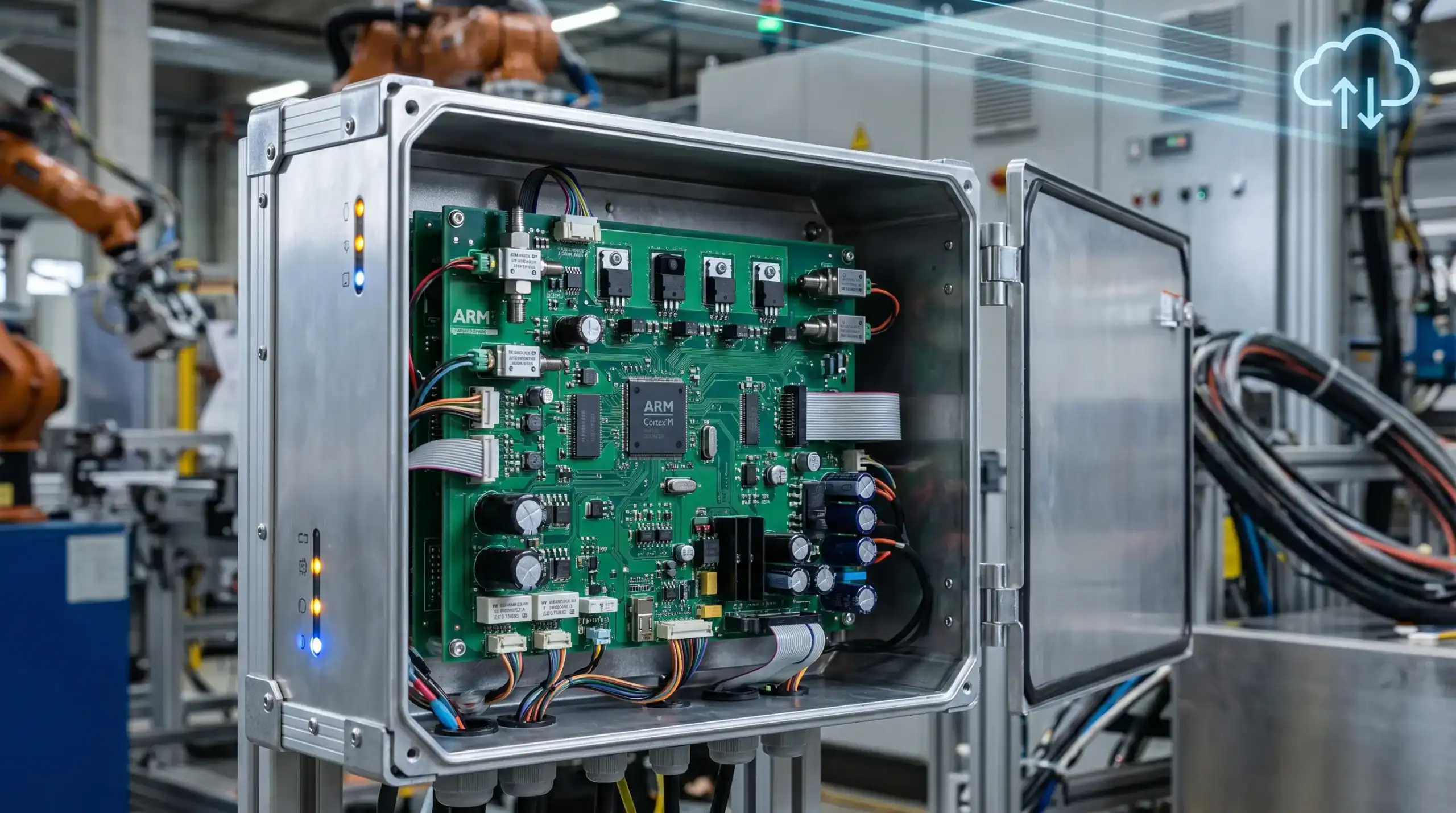
Smart connected products are often described in terms of apps, dashboards and cloud platforms. In practice, the intelligence starts much closer to the physical product. The embedded electronics inside the device decide what to measure, how to interpret signals, when to communicate, how to control power and motion, and how the product behaves when something unexpected happens.
For professional markets such as high-tech equipment, machine manufacturing, robotics, maritime systems, defence, automotive and industrial IoT, this distinction matters. A product is not smarter simply because it is connected. It becomes smarter when embedded technology turns real-world input into reliable, controlled and maintainable behaviour.
That requires more than selecting a microcontroller and adding a wireless module. It requires system-level engineering across hardware, firmware, power electronics, analogue electronics, PCB layout, enclosure constraints, compliance and production readiness.
What makes a connected product genuinely smart?
A connected product sends or receives data. A smart connected product uses that data to improve performance, safety, serviceability or user value.
In a professional product, smart behaviour may include detecting abnormal vibration in a machine before failure, controlling a motor based on load and temperature, adjusting power use to extend battery life, logging faults for service teams, updating firmware securely, or operating safely when the network connection drops.
These functions depend on several embedded capabilities working together:
- Sensing and measuring physical conditions with sufficient accuracy.
- Processing data locally within timing, power and memory limits.
- Controlling actuators, motors, valves, displays or power stages.
- Communicating with other devices, machines, gateways or cloud services.
- Detecting faults and responding in a predictable way.
- Supporting diagnostics, updates, calibration and lifecycle management.
The more demanding the application environment, the more important these capabilities become. A connected device used in a lab, office or consumer setting faces very different conditions from electronics installed near motors, long cables, metal housings, salt air, vibration, electrical noise or high temperature.
Embedded technology is the control layer between the physical and digital world
Embedded technology connects the physical product to digital functionality. It sits between sensors, power supplies, actuators, communication interfaces and software services. This position makes it critical to both product performance and product risk.
In a machine module, for example, the embedded system may read sensors, execute control loops, manage motor drives, monitor current and temperature, communicate with a higher-level controller and store diagnostic data. If the analogue front end is noisy, the firmware timing is inconsistent, the PCB layout creates EMC problems or the power supply reacts poorly to transients, the connected product may behave unpredictably even if the cloud software is well designed.
This is why smart product development benefits from hardware and software co-design. Firmware decisions affect PCB requirements. Connectivity choices affect antenna placement, enclosure design and compliance. Power electronics affect thermal behaviour, electromagnetic emissions and safety margins. Mechanical integration affects cabling, grounding and service access.
A connected product should therefore be treated as a complete electronic system, not as a PCB with connectivity added at the end.
How embedded technology supports smarter product behaviour
Reliable sensing turns field conditions into usable data
Smarter products depend on trustworthy data. Sensors must be selected, placed and conditioned for the real application environment. This often involves analogue electronics, filtering, calibration, shielding, grounding and careful PCB layout.
A sensor that performs well on an evaluation board may not provide stable readings inside a compact enclosure next to a switching converter, motor cable or radio module. Temperature drift, vibration, parasitic effects and electromagnetic interference can all reduce measurement quality.
Good embedded design considers these issues early. It defines what accuracy is needed, what noise sources exist, how signals are protected, how calibration will be performed and how the firmware will detect invalid or out-of-range data. This helps prevent a common problem: a prototype that appears functional in the lab but becomes unreliable in certification testing or field use.
For a deeper look at that risk, ProMicro has covered why embedded electronics can fail outside the lab and how early system choices can prevent it.
Local processing improves speed, resilience and data quality
Not every decision should be sent to the cloud. In many professional products, local processing is essential because control decisions must be made within milliseconds, network access is not guaranteed, or raw data is too large or sensitive to transmit continuously.
Local embedded processing can filter noise, detect events, compress data, run control algorithms, manage safety states and decide when communication is necessary. This reduces bandwidth, improves response time and allows the product to keep operating when connectivity is limited.
Edge processing can also improve privacy and intellectual property protection, because sensitive raw data does not always need to leave the device. For some products, only events, summaries, alarms or diagnostics need to be transmitted.
The engineering challenge is selecting the right processing architecture. A low-power microcontroller may be sufficient for sensor monitoring and basic control. A more powerful microprocessor or embedded computing platform may be needed for vision, complex communication stacks, user interfaces or local analytics. The correct choice depends on timing, power, thermal limits, lifecycle availability, software complexity and production volume.
Embedded control enables safe and efficient actuation
Connected products often do more than observe. They move, heat, switch, dose, illuminate, regulate or protect. This makes the relationship between embedded systems and power electronics especially important.
Motor drives, DC-DC converters, battery charging circuits, power distribution and protection functions must be designed around the actual load profile. Firmware then controls or monitors these circuits based on current, voltage, temperature, position, speed or fault conditions.
In robotics, machine building and automotive applications, for example, smarter behaviour may depend on accurate current sensing, controlled acceleration, safe shutdown states, thermal derating and predictable recovery after a fault. These behaviours cannot be added purely in software if the hardware architecture does not support them.
This is where embedded systems, power electronics and analogue design need to be developed together. The product must not only perform its intended function, but also handle overloads, noise, component tolerances and real-world usage patterns.
Connectivity becomes an engineering decision, not a feature checkbox
Adding connectivity is easy in concept, but selecting the right connectivity architecture is a system decision. Bluetooth, Wi-Fi, cellular, LoRaWAN, Ethernet, CAN, RS-485 and proprietary radio solutions all have different implications for power consumption, range, bandwidth, latency, cost, compliance and lifecycle support.
For a handheld service tool, low power wireless communication may be appropriate. For a machine controller, deterministic wired communication may be more suitable. For maritime or remote industrial monitoring, range and reliability may be more important than bandwidth. For safety-related control, the product may need to maintain local operation even when the connection fails.
Connectivity also affects regulatory planning. Products with radio functionality may fall under the Radio Equipment Directive in Europe, while all electronic products must be designed with EMC and safety considerations in mind. Early architecture decisions, antenna placement, PCB layout, cabling and enclosure design can all influence compliance risk.
Where embedded design choices affect smart connected products
The table below summarises how several engineering areas contribute to smarter connected products, and what can go wrong when they are treated too late in development.
| Engineering area | Contribution to smarter products | Risk if neglected |
|---|---|---|
| Sensor and analogue design | Converts physical conditions into reliable data | Noisy readings, false alarms, unstable control or poor diagnostics |
| Processing architecture | Enables local decisions, filtering and control | Slow response, high power use, limited upgrade path or excessive cost |
| Power electronics | Provides efficient and protected energy conversion | Thermal issues, unstable operation, EMC problems or reduced lifetime |
| Connectivity | Links the product to devices, machines or cloud systems | Poor range, excessive power use, certification delays or unreliable communication |
| PCB layout and grounding | Supports signal integrity, EMC and manufacturability | Redesigns, interference, failed tests or inconsistent production behaviour |
| Enclosure integration | Protects electronics and supports thermal and RF performance | Overheating, poor antenna performance, ingress issues or service difficulties |
| Firmware architecture | Controls behaviour, diagnostics, updates and fault handling | Hard-to-maintain code, unsafe states, poor testability or unreliable updates |
| Lifecycle planning | Supports production, servicing and component availability | Obsolescence, supply issues, difficult repairs or expensive redesigns |
Compliance and security must be considered from the start
For connected products, compliance is not a final box to tick. It should influence architecture from the beginning.
EMC is a clear example. Switching power supplies, long cables, motor drives, wireless modules and high-speed digital signals can all create emissions or susceptibility issues. If these risks are only discovered during final testing, the result may be PCB redesign, enclosure changes, extra filtering, delayed launch or higher product cost.
A Design for Compliance approach identifies relevant standards early, considers the operating environment and includes EMC-aware decisions in schematic design, PCB layout, cabling, grounding, housing and test planning. ProMicro explains this further in its article on what EMC is and why it matters.
Security is also becoming more important for connected products. Firmware update mechanisms, device identity, secure communication, debug access, data handling and vulnerability management should be part of the system architecture, not an afterthought. The EU Cyber Resilience Act is increasing expectations around secure-by-design connected products and vulnerability handling, especially for products placed on the European market.
Designing with compliance and security in mind does not guarantee certification outcomes, but it reduces uncertainty and helps teams avoid preventable mistakes late in the process.
Smart connected products need to be manufacturable and maintainable
A prototype can prove that a concept works. A production-ready connected product must prove that the concept can be built repeatedly, tested efficiently, serviced over time and supported throughout its lifecycle.
This is where embedded technology decisions influence manufacturing readiness. Firmware may need production test modes, serialisation, calibration support and secure provisioning. The PCB may need test points, programming access and stable component sourcing. The enclosure may need thermal paths, assembly tolerances and serviceability. The software architecture may need version control, diagnostics and update procedures.
For companies developing their own product range, this lifecycle view is crucial. A smart product that cannot be tested efficiently in production, updated safely or supported when components become unavailable may create long-term cost and reliability problems.
Scalability is therefore not only about processing power or future features. It is about designing an embedded platform that can support variants, production volumes, maintenance and supply chain changes. ProMicro has explored this in more detail in its article on scalable embedded system development.
The organisational side: expertise, capacity and ownership
Connected product development often stretches internal engineering teams. A single project may require embedded firmware, analogue design, power electronics, RF considerations, PCB layout, mechanical integration, EMC knowledge, test strategy and manufacturing preparation. Few teams have all of that capacity available at the right moment.
This does not mean product companies should lose ownership of their idea. The strongest projects usually combine internal product knowledge with specialist engineering support. The product owner defines market needs, user context, strategic priorities and business constraints. The embedded design partner translates those inputs into a robust technical architecture and helps identify hidden risks.
Technical execution also depends on having the right people around the programme. When a connected-product strategy requires senior commercial, operational or technology leadership, organisations may also work with specialist partners such as Optima Search Europe, which focuses on business-critical leadership and go-to-market recruitment across technology sectors.
For the electronics development itself, an experienced partner can provide extra capacity, challenge assumptions and integrate disciplines that are often handled separately. This is especially valuable when the product must move from concept to prototype, from prototype to certification testing, and from testing to volume manufacturing.
Practical questions before developing a connected product
Before committing to architecture, components or PCB layout, technical leaders should clarify the product context. These questions help expose hidden requirements early:
- What physical conditions must the product measure, control or withstand?
- Which decisions must happen locally, and which can depend on cloud or external systems?
- What happens when communication is interrupted, degraded or unavailable?
- Which EMC, RED, CE, safety or industry-specific requirements may apply?
- What are the expected power, thermal and mechanical constraints?
- How will firmware be updated, verified and protected during the product lifecycle?
- How will the product be tested, calibrated and programmed in production?
- Which components are critical for long-term availability and future variants?
- What diagnostics will service teams need when the product is installed in the field?
Answering these questions early does not slow development down. It reduces rework by making the design direction clearer before expensive engineering decisions are locked in.
Frequently asked questions
What is embedded technology in a connected product? Embedded technology is the combination of electronics, firmware, processing, sensing, control and communication inside a product. It enables the device to interact with the physical world, make local decisions and exchange useful data with other systems.
Why is embedded design important for smart connected products? Embedded design determines how reliably a product measures signals, controls outputs, manages power, communicates, handles faults and supports updates. These functions directly affect field reliability, compliance risk and production readiness.
Can a development board be used in a production connected product? Development boards are useful for early proof of concept work, but they are rarely optimised for final form factor, EMC, thermal behaviour, lifecycle availability, production testing or cost. A custom embedded design is often needed for professional products.
When should EMC, RED and CE requirements be considered? They should be considered during early architecture and requirements definition. Late compliance work can expose problems that require PCB, enclosure, cabling or power design changes.
Does every connected product need cloud connectivity? No. Some products benefit from cloud services, while others only need local communication, gateway integration or service access. The right choice depends on latency, data value, security, power use, operating environment and business model.
How can ProMicro support connected product development? ProMicro supports embedded system development, power electronics, analogue electronics, PCB design, system engineering, enclosure integration, rapid prototyping, manufacturing preparation and lifecycle thinking from early concept towards volume-ready electronics.
Building smarter connected products with ProMicro
Smarter connected products require more than connectivity. They require embedded electronics that are reliable, compliant by design, manufacturable and ready for real-world use.
ProMicro helps companies turn complex product ideas into robust embedded systems by combining hardware, firmware, power electronics, analogue electronics, PCB design, prototyping and support towards volume manufacturing. If your team is developing a connected product and wants to reduce technical risk early, contact ProMicro to discuss the architecture, requirements and next development steps.