For a technical product, contract manufacturing electronic assembly is not simply the point where a PCB leaves engineering and enters a factory. It is the point where design intent, process control, test strategy, supply chain decisions and field reliability have to align. For defence, maritime, robotics, machine building, automotive or medical-adjacent products, that alignment often decides whether scale-up is controlled or painful.
Many electronics products work well as prototypes because skilled engineers are close to every build. Scaling changes the conditions. Assemblies must be repeatable, testable, traceable and robust enough for real environments, not only for a bench demonstration. The best outcomes come when manufacturing thinking starts early, before layout choices, component decisions and enclosure constraints are locked in.
Contract manufacturing electronic assembly needs early engineering input
A common mistake is to treat assembly as a purchasing activity. The bill of materials is sent out, prices are compared and the lowest practical quote wins. That approach can work for simple, low-risk electronics, but it is fragile for products with power conversion, analogue sensing, motor drives, wireless communication or safety-related operating conditions.
For high-value equipment, the assembly partner needs enough engineering context to understand what can go wrong. Is the product exposed to vibration, condensation, salt mist, electrical noise or repeated thermal cycling? Are there high-current paths close to sensitive measurement circuits? Is the enclosure part of the EMC strategy? Used well, contract manufacturing electronic assembly becomes a controlled extension of product development rather than a disconnected production step.
This is also why supplier selection should not focus only on placement capacity and lead time. If your team is comparing options, ProMicro’s guide on choosing a contract electronics assembly partner gives a useful framework for assessing technical depth, DFM feedback, quality systems and test readiness.
The scale-up gap between prototype and production
The prototype phase rewards speed and flexibility. Engineers may hand-solder modifications, swap components quickly and diagnose failures using deep product knowledge. Production rewards consistency. Every undocumented workaround becomes a risk because operators, purchasers and test technicians cannot rely on implicit knowledge.
This scale-up gap is where many costly issues appear. A connector is difficult to insert after enclosure assembly. A component has an extended lead time. Test points are missing for reliable fault isolation. A layout performs in the lab, but radiated emissions rise when cable lengths change in the final machine. None of these issues are unusual, but they are expensive when discovered after tooling, certification testing or first customer deployment.
The practical answer is to connect engineering, purchasing, assembly and test before the design is considered finished. That does not mean slowing the project down. It means replacing late surprises with earlier decisions.
Build manufacturing readiness into the design package
A production file set is more than Gerbers and a BOM. For professional electronics, the manufacturing package should explain how the product is intended to be built, inspected, programmed, tested and handled. A design package for contract manufacturing electronic assembly should make critical decisions visible before the first production batch is scheduled.
Requirements and real-use conditions
Manufacturing readiness starts with requirements. Technical teams often define electrical functions clearly, but leave environmental and operational requirements underdeveloped. For example, a product may need to survive supply dips, load transients, electrostatic discharge, motor noise or operator misuse. Those conditions influence PCB layout, component derating, enclosure design, software diagnostics and final test procedures.
The best requirements are specific enough to guide engineering trade-offs. Instead of only stating that a product must be robust, define the voltage range, expected duty cycle, thermal environment, service lifetime, maintenance access and relevant regulatory context. For wireless products, include radio performance and RED considerations. For industrial or machine products, include EMC and safety-related constraints from the start.
DFM and DFT decisions that affect reliability
Design for manufacturing and design for test are not administrative checks. They shape whether the product can be built repeatedly without hidden variation. In power electronics, this may involve creepage and clearance, copper weight, thermal paths and mechanical retention. In embedded systems, it may involve programming access, boundary scan, functional test modes and firmware version traceability.
| Design area | Why it matters for scale | Typical evidence to include |
|---|---|---|
| PCB stack-up and materials | Influences impedance, EMC behaviour, heat transfer and manufacturability | Stack-up notes, material class, copper weight and controlled impedance data |
| Component selection | Affects availability, derating, sourcing risk and long-term support | Approved manufacturer list, alternates, lifecycle status and critical component notes |
| Test access | Determines how faults are detected before shipment | Test points, programming interface, fixtures, limits and pass or fail criteria |
| Mechanical integration | Impacts connector stress, cable routing, shielding and serviceability | Assembly drawings, enclosure constraints, torque settings and harness details |
| Firmware release control | Prevents incorrect software versions in production | Version rules, programming files, checksum or identification method and release notes |

Control data, revisions and supply chain risk
Once a product moves towards production, configuration control becomes a reliability tool. The wrong component revision, PCB file or firmware image can create intermittent failures that are difficult to reproduce. A mature contract manufacturing electronic assembly process turns this information into controlled production data, not scattered project files.
What a complete handover package should contain
The handover package should be clear enough for a competent assembly team to build and test the product without relying on informal engineering memory. It should also be detailed enough for engineering to investigate field issues later.
A practical package usually includes:
- Released schematic, PCB layout data, fabrication notes and assembly drawings
- Bill of materials with approved alternates, lifecycle notes and critical part flags
- Programming files, firmware version rules and configuration settings
- Inspection criteria, test procedures, test limits and required equipment
- Mechanical assembly instructions, cable routing notes and packaging requirements
- Change control procedure, non-conformance handling and repair rules
For PCB-focused scale-up, the related ProMicro article on how printed circuit board assembly services support scale explains how manufacturability, sourcing and testing connect between prototype and volume production.
Change control is part of product quality
Changes are inevitable. Components become obsolete, suppliers update processes and product requirements evolve. The issue is not whether changes occur, but whether their consequences are understood.
A resistor substitution may look harmless until tolerance, temperature coefficient or voltage rating affects a measurement circuit. A connector alternative may pass purchasing review but fail vibration expectations. A PCB finish change may affect solderability or shelf life. For complex products, change control should involve engineering judgement, risk assessment and, where needed, targeted regression testing.
This is especially important for products operating in regulated or high-liability environments. Designing with CE, EMC or RED expectations in mind does not guarantee certification, but it reduces the chance that production changes undermine compliance assumptions.
Design test strategy before production pressure builds
Testing should be designed alongside the electronics, not improvised after the first batch. IPC-A-610 is widely used as an acceptability standard for electronic assemblies, but visual inspection alone cannot prove that an embedded system, power stage or sensor interface is functionally correct. Functional behaviour needs its own strategy.
For many professional products, the test flow combines inspection, programming, electrical checks and application-level functional tests. Some products benefit from in-circuit test or flying probe test. Others need boundary scan, calibrated loads, motor simulation, RF checks, thermal soak or burn-in. The right balance depends on product risk, production volume and failure consequences.
The aim is not to test everything in the most expensive way. The aim is to detect the faults that matter before shipment. Good contract manufacturing electronic assembly planning defines what each test catches, what it cannot catch and how failures are recorded for engineering feedback.
Manage pilot builds as engineering evidence
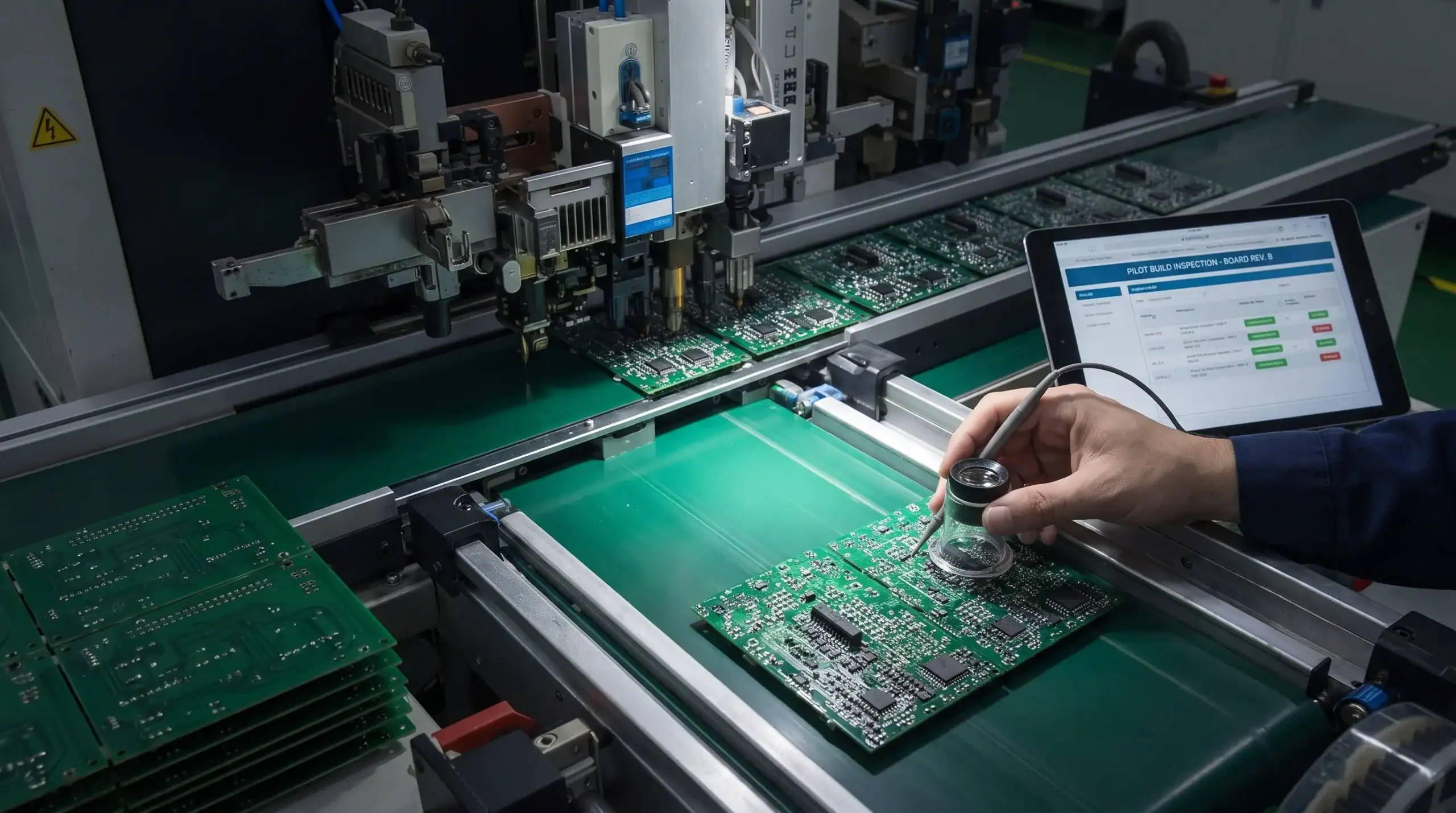
A pilot build is not only a small production run. It is a controlled learning step that proves whether the design package, assembly process, test strategy and supplier communication work together. The pilot should expose practical issues before volume commitments are made.
Typical pilot questions include whether operators can follow the assembly instructions without engineering interpretation, whether test limits are stable, whether yield is acceptable and whether rework causes secondary risks. For products with enclosure integration, it should also verify cable routing, connector access, thermal contact and labelling.
During scale-up, contract manufacturing electronic assembly should be managed with feedback loops. Defects from pilot builds should be classified, traced to likely root causes and fed back into design or process updates. If a failure points to layout sensitivity, firmware timing, thermal margin or sourcing variation, treating it as an isolated assembly defect may hide the real risk.
What to expect from the right assembly partner
The right partner will ask questions that may feel inconvenient early in the process. That is usually a positive sign. Questions about test access, component alternatives, moisture sensitivity, ESD handling, process capability, traceability and repair policy help reveal hidden risks.
A capable partner should also distinguish between prototype flexibility and production discipline. Early builds may tolerate engineering judgement at the bench. Volume production needs controlled work instructions, released data, purchasing discipline and measurable quality feedback. If a contract manufacturing electronic assembly partner challenges a design before production, that challenge can prevent a more expensive failure later.
For complex embedded products, it also helps when the partner understands the interaction between electronics, firmware and mechanics. A production issue may appear as a soldering problem, but the root cause could be a firmware state, a power sequencing condition, a grounding strategy or a mechanical tolerance. This is where multidisciplinary engineering matters.
Where ProMicro fits in the development-to-scale path
ProMicro is not only concerned with whether a board can be assembled. The broader question is whether the product can become a reliable, manufacturable and maintainable system. That requires attention to embedded electronics, power electronics, analogue design, PCB layout, enclosure constraints, EMC behaviour, test strategy and lifecycle choices.
For companies developing high-value equipment, ProMicro can support the path from idea and architecture through prototyping and manufacturing preparation. The value is strongest when manufacturing readiness is considered during development, not after release. This helps reduce technical risk, improve communication with assembly partners and make certification-aware design choices earlier.
When internal engineering teams need extra capacity or specialist knowledge, the relationship can also be structured without losing product ownership. ProMicro has written more about that balance in its article on outsourcing embedded electronics without losing control.
Frequently asked questions
What is contract manufacturing electronic assembly in a professional product context? It is the outsourced assembly, inspection, programming and testing of electronic products, supported by controlled production data and engineering feedback. For complex products, it should connect closely with design, sourcing, compliance thinking and lifecycle management.
When should assembly planning start? It should start during development, before the PCB layout and component choices are frozen. Early DFM and DFT input can prevent missing test access, sourcing problems, mechanical conflicts and EMC risks.
Is a working prototype enough to move into production? Usually not. A prototype proves technical feasibility, but production needs repeatable processes, released documentation, controlled components, reliable tests and clear change control.
How does this reduce scale-up risk? It exposes manufacturing, test and sourcing issues before they become volume problems. That gives engineering teams time to adjust the design, refine the process and protect product reliability.
Make assembly-ready design part of development
Reliable product scale depends on more than selecting an assembler at the end of the project. It depends on early engineering decisions, clear production data, testable design and disciplined feedback from pilot builds.
If your organisation is developing embedded electronics, power electronics or connected equipment for demanding environments, ProMicro can help connect development decisions with manufacturing readiness. Explore ProMicro’s electronics development expertise at ProMicro and involve the right technical input before scale-up pressure limits your options.