Why Off The Shelf Solutions in Power Electronics often fail
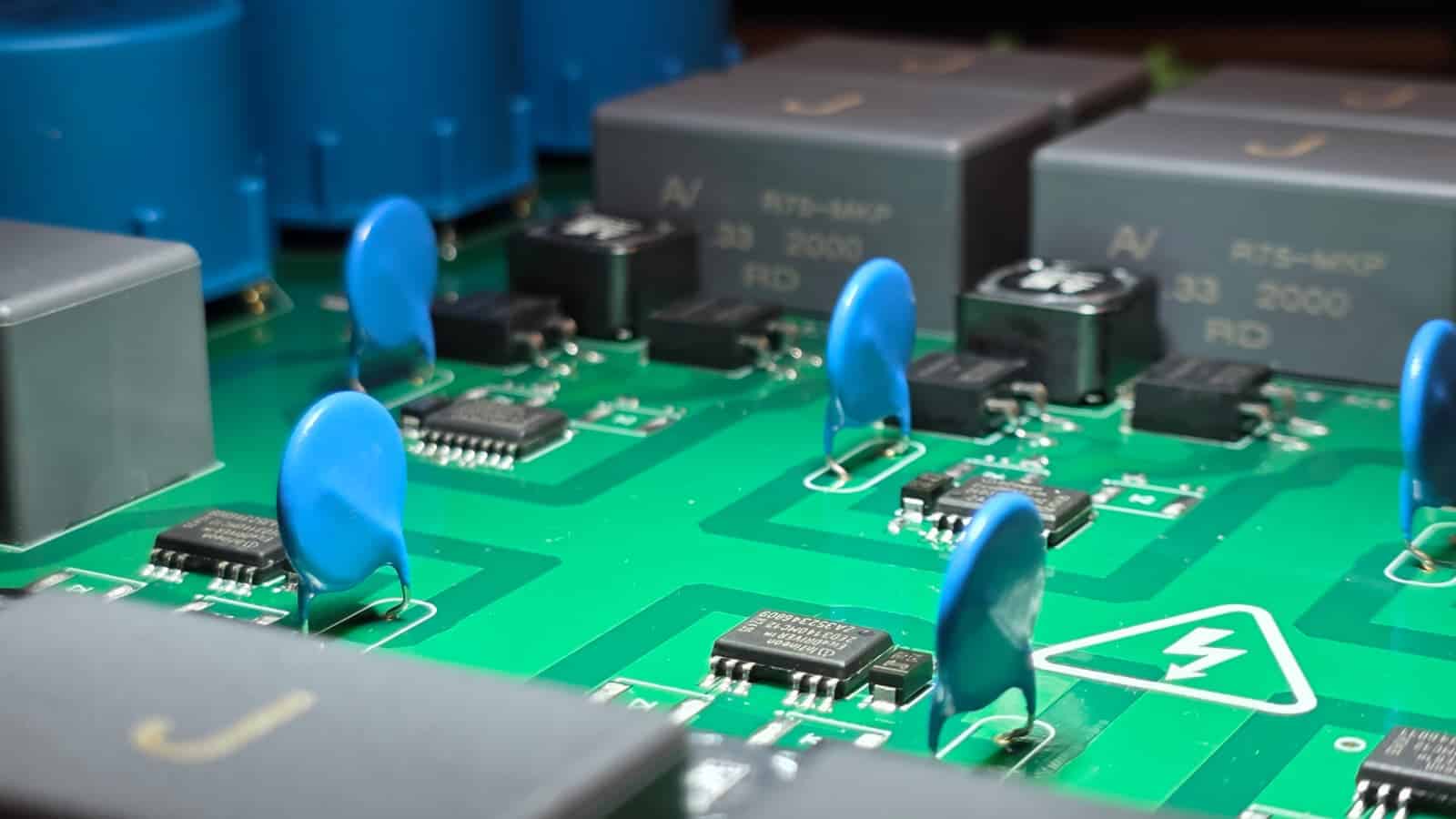
It seems safe to opt for an off the shelf solution when developing power electronics. They are readily available, relatively inexpensive and easy to integrate. Until the system is put under load for the first time. Components get hotter than expected, behaviour becomes unstable, or systems just fail to pass the required tests. By that point, the design is largely fixed, and any changes will impact the planning and the entire design. What started as an efficient choice turns into a costly process.
Standard solutions are designed to function ‘well enough’ in many situations, but in power electronics in particular, the mismatch becomes apparent sooner or later. This is because thermal behaviour, switching frequencies, EMC and load profiles vary greatly in this field.
A design based on specifications is no guarantee for success
The trap is subtle: every component in the bill of materials meets its datasheet and on paper the design is sound. Datasheets describe idealised, static conditions: typically 25 °C ambient, nominal input voltage, and a measurement taken on an optimised reference board with a limited bandwidth. Real applications rarely look like that.
A few concrete mismatches we see repeatedly in the field:
- Thermal derating. Power components are specified at 25 °C, but in an enclosed cabinet at 55 or 70 °C the allowable output power often drops below the rated value. A module selected on its headline number can run out of margin before it has left the prototype stage.
- Tolerance stack-up and ageing. Resistors are typically bought at ±1 %, with a further drift over lifetime. Aluminium electrolytic capacitors require Vdc + Vripple to stay below roughly 90 % of their rated voltage. When several components sit in the same thermal and electrical network, these small tolerances add up and the worst-case corner is significantly less comfortable than the nominal calculation suggests.
- Transient and dynamic behaviour. Load-step response curves in datasheets are measured on an optimised evaluation board. On a real PCB, loop inductance, decoupling strategy and control-loop bandwidth all shift the overshoot and recovery time. A supply that looks solid in the catalogue can ring or drop out on the first real load step.
- Parasitics that are simply not in the datasheet. Modern MOSFETs have on-resistances so low that PCB traces and connectors can contribute more ohmic loss than the transistor itself. Parasitic inductance in the switching loop creates voltage spikes and ringing that no component-level specification can predict.
None of these effects appear individually as a ‘design error’. They emerge from the gap between datasheet conditions and the system the product actually lives in. That is precisely why a design which meets every specification on paper can still miss its thermal budget, fail its EMC test, or behave unpredictably under load.
Power modules and EMC: treating the symptom instead of the cause
EMC is one of the clearest illustrations of that gap. Off-the-shelf DC/DC modules are optimised for size, cost and efficiency in a generic use case. Their switching edges generate broadband noise: the switching fundamental plus a long train of harmonics, together with common-mode currents that couple through parasitic capacitance between the switching node, the heatsink and ground. These emissions frequently fall outside the requirements of the applicable standards.
The standard response is to add an external filters: a common-mode choke, X and Y capacitors, sometimes additional ferrite beads. It works, but it works by treating the symptom. The filter has to be dimensioned after the fact, it occupies extra board area, it adds components to purchase and assemble, it introduces additional losses, and in densely packaged products there is simply no room for it. In the worst case, the filter has to be designed, laid out and qualified under schedule pressure, right at the end of the project.
With a custom design, EMC is addressed at the source, where it originates. Several levers become available as soon as the topology is under your own control:
- Controlled switching behaviour. Gate-drive slew rate, gate resistors and snubbers are used deliberately to shape dv/dt and di/dt, so that less high-frequency energy is generated in the first place.
- Switching frequency as a design choice. The switching frequency is selected with EMC limits, sensitive receive bands and the size of the passive components in mind, rather than inherited from a standard module.
- Layout at the source. Tight switching loops, continuous ground planes, shielding between high-dv/dt nodes and sensitive traces, and well-placed decoupling address both conducted and radiated emissions at their origin.
- Components matched to the application. Semiconductors, magnetics and capacitors are chosen for the actual ripple current, temperature range and regulatory class, not for a generic one-size-fits-all use case.
The result is a power stage that passes the applicable standards on its own merits, with a small and targeted filter at most, instead of a large corrective one bolted on at the end.
Practical challenges in power electronics projects
These are often not major design flaws, but subtle deviations: a datasheet figure measured at 25 °C that no longer applies at 55 °C, a load-transient plot taken on a reference board that looks nothing like the final layout, an EMC emission that only crosses the limit once the module sits in its real mechanical enclosure. In power electronics, the real challenges rarely emerge during the design phase. They only arise when systems start operating under real-world conditions. It is then that a ‘proven’ component turns out to behave slightly differently.
Avoiding delays in your power electronics development process
Consider power modules that systematically run hotter than expected inside a closed cabinet, power supplies that react erratically to a fast dynamic load, or a system that fails relevant tests by a few decibels during pre-compliance testing. These are all minor deviations that can accumulate to cause delays in the process, unexpected costs or even redesign. And so, the choice of a standard component ultimately becomes a major risk.
Custom design in power electronics
This is precisely why more and more companies ultimately opt for customisation. A custom design for power electronics often requires a higher investment in the development phase, but regularly prevents costly problems later in the project. By developing a solution that fits the application exactly, the risk of malfunctions, failures and unexpected modifications is significantly reduced.
Making informed choices in power electronics design
Rather than working straight towards a final design, a sound process begins by refining the application: the actual load, the environment and the critical failure mechanisms. From there, a development path emerges in which choices are explicitly made and justified, not only technically, but also in terms of risk, planning and costs.
Reliable power electronics without surprises
Incidentally, a project does not always have to start from scratch. By taking a critical look at a layout or existing design, it quickly becomes clear where the weaknesses lie and what steps are needed to mitigate them. The result is not a theoretically optimal solution, but a robust design that performs predictably. Under all relevant circumstances. And perhaps even more importantly: a development process with no surprises afterwards.
Taking the first step
Curious to find out what our power electronics process looks like? We’d be happy to walk you through the steps. Leave your details and we’ll get in touch to take the first step: a no-obligation chat.